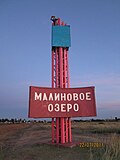
Raspberry Lake is an urban-type settlement in the Mikhailovsky District of the Altai Territory of Russia. Has the status of a single-industry town since 2010.
| Urban-type settlement | |||
| Raspberry Lake | |||
|---|---|---|---|
| |||
| A country |  Russia Russia | ||
| Subject of the federation | Altai region | ||
| Municipal District | Mikhailovsky | ||
| Urban settlement | Raspberry Lake Council | ||
| Internal division | New and Old Village | ||
| Head of urban settlement | Denichenko Alexander Ivanovich | ||
| History and Geography | |||
| Founded | 1942 | ||
| Former names | until 1966 - Mikhailovsky until 1942 - Soda factory | ||
| PGT with | 1942 | ||
| Timezone | UTC + 7 | ||
| Population | |||
| Population | ↘ 3030 [1] people ( 2018 ) | ||
| Nationalities | Russians and others | ||
| Denominations | Orthodox and others | ||
| Digital identifiers | |||
| Telephone code | +7 38570 | ||
| Postcode | |||
| OKTMO Code | |||
Content
- 1 Geography of the place
- 2 population
- 3 Economics
- 4 History of the plant MZHR
- 5 Car tracks
- 6 Tourist places and recreation centers
- 7 Climate
- 8 Rivers
- 9 Animals and vegetation
- 10 People associated with the village
- 11 Television
- 12 Broadcasting
- 13 Mobile Communications
- 14 Internet Service Providers
- 15 Attractions
- 16 Photos of the village Raspberry Lake
- 17 Notes
- 18 Links
Location geography
Located in the Kulundinskaya steppe on the shores of the lake of the same name , 5 km from the former railway station Raspberry Lake.
Tanatar lakes are a chain of soda and semi-soda (mustard) lakes, from which enterprises produce soda.
20 km from the village. Raspberry Lake is the state Russian-Kazakhstan border.
Distances to cities: Astana - 610 km, Semey - 160 km, Pavlodar - 350 km.
The nearest town, Rubtsovsk, is 160 km away.
It has the status of an urban-type settlement (since 1942).
Population
| Population size | |||||
|---|---|---|---|---|---|
| 1970 [2] | 1979 [3] | 1989 [4] | 2010 [5] | 2011 [6] | 2012 [6] |
| 5277 | ↘ 4728 | ↗ 5009 | ↘ 3586 | ↘ 3575 | ↘ 3529 |
| 2013 [7] | 2014 [8] | 2015 [9] | 2016 [10] | 2017 [11] | 2018 [1] |
| ↘ 3420 | ↘ 3353 | ↘ 3263 | ↘ 3180 | ↘ 3090 | ↘ 3030 |
Economics
The city-forming enterprise is the Mikhailovsky Chemical Reagents Plant (MHCR), which uses raw materials from Lake Tanatar.
LLC Mikhailovsky Chemical Reagents Plant is the only producer in Russia of pharmacopeia magnesium and copper acetic acid magnesium carbonate.
The plant is the oldest enterprise in the chemical industry and one of the largest enterprises in the Altai Territory, supplying its products to all regions of Russia, as well as to countries near and far abroad. The products are used in the widest areas: chemical, coal, medical, textile industry, agriculture, etc.
The village also has currently not working enterprises (for example, a brewery).
The company Altai-Soda OJSC previously extracted soda from Tanatar-type soda lakes. Now it processes small crustaceans from the lake.
The history of the plant MZHR
In 1928, an expedition of the West Siberian Geological Administration under the direction of Professor M.I. Kuchina at Mikhailovsky Lakes (Tanatar) identified significant stocks of soda. The water area was 20 km 2. Soda was produced from surface soda brines. Work on the extraction of soda, its transportation and processing was accompanied by the use of heavy physical labor. Soda processing consisted of drying it in flame-reflecting furnaces, firewood served as fuel, and later coal.
On January 20, 1943, a resolution of the State Defense Committee (G.K.O.) was adopted No. 2771 C, in which the NKVD was charged with the construction of the railway from Art. Kulunda Omsk railway to Mikhailovsky soda plant and construction work, providing an increase in the production of soda ash.
In 1943-1944, a complex for the production of soda ash with energy and other auxiliary workshops was built.
Along with the production of soda ash and, in some years, natural sulphate and crystalline soda, in order to improve the economic situation, additional cost-effective production facilities were introduced in 1959: briquetted soda and alkaline electrolytes.
In parallel, the issue of processing crystalline soda into calcined was resolved. In 1961, the workers of the plant designed and built a "fluidized bed" unit operating on raw soda. Since 1965, the installation worked on brines.
In 1962–66, the production of the following chemicals was organized: sodium percarbonate (persoli), urea resin, synthetic laundry detergents, and pharmacopeia magnesium carbonate.
In 1970, nine types of inorganic chemical reagents were commissioned: sodium chloride, sodium sulfate anhydrous, sodium sulfate 10-hydrous, sodium carbonate anhydrous, sodium carbonate 10-hydrous, magnesium oxide, magnesium sulfate, magnesium carbonate pharmacopeia.
Today, the company operates on modern technologies, has highly qualified personnel, vast experience in the market of chemical products. Today the plant produces more than 50 types of products of both chemical reagents and household chemical goods.
Highways
- Local value
Raspberry Lake - Uglovskoe - Rubtsovsk
Raspberry Lake - Mikhailovsky - Slavgorod
- How to get thereDeparture from Mikhailovsky in the village. Raspberry Lake
Previously, the village of Raspberry Lake had a railway station, but now it can be reached by road from Rubtsovsk (via the village of Volchikhu or the village of Uglovskoye).
You can get to Raspberry Lake by bus from Barnaul (a comfortable bus runs daily), the distance along the highway is 410 kilometers, the travel time is 7-8 hours.
Bus departure time:
From Barnaul to Raspberry Lake - at 16:40, arrival at 00:35.
From the village. Raspberry Lake to Barnaul - at 20:45, arrival at 5:40.
A more comfortable option: from Barnaul by train to Kulunda, then by bus to Mikhailovsky (110 km, travel time about one and a half hours).
There are minibuses from Mikhailovsky every 30 minutes, the journey time is about 20 minutes.
You can get to Barnaul by rail, and direct flights depart from many Russian cities.
Tourist spots and recreation centers
Since February 1, 2013 Raspberry Lake became part of the Big Tourist Golden Ring of Altai Territory.
On the shore of Lake Raspberry there is a new auto-camping (in the future, Raspberry Lake BO), for vacationers there are currently 2 tourist houses with two rooms for each, which are designed for 2 people, additionally they have a barbecue for a picnic, cleared Campground, a parking lot is organized (the campfire is free of charge). On the shore of the lake is a sauna.
At 400 meters there is a small freshwater reservoir, which is designed for swimming.
Favorable time for visiting the lake from June 3 to September 20.
- History of Raspberry Lake
Foreigners who were fortunate enough to share a meal with the great Empress Catherine II were surprised at the unusual pinkish-raspberry salt served to the table. Such a wonder they have not seen anywhere else. And the Russians knew that it was brought from the far, far Kulunda steppe, located at the foot of the Altai Mountains. But few could visit those distant places - it was so hard to get there. Only legends circulated that a huge pink lake was splashing there, having bathed in it, spontaneous women soon bring babies, and the pocked ones prettier.
The bitter-salty water in it is pink-crimson, this shade gives it a special phytoplankton. Another feature of this lake is the stock of healing mud. At the same time, a unique natural object is not protected in any way: it does not have the status of a specially protected natural area even at the local level. Meanwhile, Raspberry Lake, along with pine forest and solonchak vegetation, is a unique natural complex that needs protection.
Raspberry Lake was the property of Empress Catherine II. Annually, 100 pounds of this salt was delivered to her table, and only she was served at the table during foreign receptions, because the salt was an exquisite pink-raspberry color. This color is explained by the fact that raspberry lake is inhabited by the bacteria of serination of salinaria, which produce a pinkish pigment.
- Therapeutic mudRaspberry Lake. July 2017
Sulfide-silt dirt normalizes the functions of the skin: cleanses it, absorbs excess sebum, removes dead skin cells from the surface of the skin, and releases pores. All this prepares the skin for the intake of biologically active substances and hydration. Dirt improves metabolism in skin cells, stimulates blood circulation, reduces irritation and inflammation, smoothes wrinkles, and slows down the aging process of the skin. Mud has a healing effect in skin diseases - psoriasis, eczema, neurodermatitis. Mud applications on the skin of the scalp are effective for seborrhea, to strengthen the roots of the hair with early baldness and increased hair loss. Mud relieves rheumatic, muscle and joint pain, the substances contained in the mud penetrate the tissues and blood, and reduce inflammation in the joints. Mud therapy activates the metabolism, improves the supply of oxygen to tissues. The tissues warm deeply, the vessels expand, the blood and lymph circulation improves, toxins are washed out from the inflammatory focus, the body is cleansed and the pain decreases.
Climate
The continental climate of the village is determined by the peculiar geographical position in the south of Western Siberia . Openness to the effects of both the Altai Mountains , the Arctic Ocean and the semi-desert regions of Central Asia creates the possibility of the arrival of air masses of different properties, which contributes to a significant contrast in weather conditions. The village of Raspberry Lake is characterized by cool, moderately severe and light snowy winters and warm summers.
The coldest month of the year is January (average temperature −17.5 ° C), the warmest is July (+25.8 ° C). The absolute maximum (air temperature in the shade) was observed in July 1953 and August 2012 (+42.2 ° C). The absolute minimum is in January 1951 (−51.1 ° C). The average date of the last freeze in the air is May 19 , the date of the first freeze is September 17
Relative humidity in the cold season varies between 73–76%, and in the warm period is about 62%. The average annual rainfall is 539 mm, during the warm season (April - October) 65% of the total falls. The average number of days with precipitation is 180, of which 113 are in the autumn-winter period [12] .
The number of cloudy, clear and semi-clear days in a year is 130, 49 and 186, respectively. The total duration of sunshine per year is 2180 hours.
In the wind rose of Raspberry Lake, a predominance of south-west, west and south winds is observed.
Rivers
5 km from the village of Raspberry Lake, the Baklanikha River flows. It originates in the Volchikhinsky district, flowing out of the Ust-Volchikh river and the lake of the same name Baklanikha. The river is no more than 30 km long; it feeds several steppe lakes and flows into the Malinovoe lake. The riverbed is not wide - only 20-30 m, only up to 150 meters in some places, along the way forms lakes and draws in tributaries. The depth of the river is small, in some places it reaches 1.5-2 m, in summer the water warms up well. In the spring, in floods, the river from quiet and calm turns into a stormy one.
Animals and Vegetation
In the pine forests there lives a teleutka squirrel, there is a fox, a polecat. Small animals - rodents - are the same as in the steppe. With the transition to the forest-steppe, new habitats and new species of animals appear: gophers, red-cheeked and pockmarked, common hamster, from mice - housekeeper, red vole, from predators - wolf, lynx, fox, ermine, muskrat and brown hare.
Of large animals, elk is found.
Birds: peregrine falcon, steppe eagle, stilt, black vulture, crane, black grouse, capercaillie.
Snakes: steppe viper, already.
Vegetation: chamomile, meadow moss, blood-thistle, cinquefoil, onion, shepherd’s bag, creepy creeping.
People Associated with the Village
- Nina Nikolaevna Usatova (b. 1951, town Raspberry Lake) - actressActress Nina Usatova with her son at the entrance to the village
Nina Usatova says to herself like this: "I was born in the steppe, grew up all my life in the forest, but I love the sea." This love is from her childhood. She was born in the land of one hundred salt lakes, in the village of Malinovoe Lake, Altai Territory. Altai land - Klondike natural phenomena. There, in the house at the far station, the mother of Pelagia received childbirth father of the child forester Nikolai Usatov. They were waiting for their son, but the princess entered this world without knocking: the name Nina means "royal".
The salty Raspberry Lake of Nina Usatova is a real natural treasure. Legends circulate about his miraculous power. They say it heals wounds, turns back the clock. “It was good in childhood,” recalls Nina Usatova. “It seemed that we were the richest, we were the happiest. And it was, really? Childhood seems to us all happy.”
For more than half a century, she was drawn to her homeland, to that one tiny point on the map called Raspberry Lake, where she first touched the miracle of life.
Television
MV
- 4 First channel
- 6 NTV
- 10 Russia 1 / GTRK Altai
Dmv
- 22 Katun 24
- 27 match
- 49 NTV / MTV + Mikhailovsky
- Digital Television DVB-T2
- 1. Multiplex: 10 digital federal channels: FIRST CHANNEL, NTV, RUSSIA 1, RUSSIA 2, RUSSIA K, RUSSIA 24, TVC, KARUSEL in DVB-T2 format.
- 2. Multiplex: 10 digital terrestrial channels: TNT, STS, TV3, HOME, REN TV, MUZ-TV, MIR 24, SPORT PLUS, SPAS, STAR in DVB-T2 format.
Broadcasting
- 102.9 MHz - Radio of Russia / GTRK Altai
- 103.7 MHz - Police wave / Katun FM
Mobile Communications
- MTS
- Megaphone
- Beeline
All 3 mobile operators have 3G support
Internet Service Providers
- Rostelecom
- Trans TeleCom
Attractions
In 2014, on one of the streets of the settlement was built the temple of the Holy Martyr Tryphon, who is revered in these places and considered the patron saint here.
Two hundred years ago, Altai was one of the main frontiers of protecting the state border. The main population of the steppe zone was the Cossacks, who guarded the approaches to Russian territories. At the outposts and in the villages of the Cossacks it was customary to erect chapels and temples. There, representatives of the military class prayed, took the oath. Among the locals there are descendants of those Cossacks who were the first to set foot on this land. They decided to renew this tradition with the funds of the Cossack community and voluntary donations of believers to build a temple. It was erected as part of the Cossack Frontiers of Russia interregional project.
The new temple was built in accordance with all the rules and is a work of wooden architecture of the 21st century.
Photos of Raspberry Lake Village
Notes
- ↑ 1 2 Population of the Russian Federation by municipalities as of January 1, 2018 . Date of treatment July 25, 2018. Archived July 26, 2018.
- ↑ 1970 All-Union Population Census. The number of urban population of the RSFSR, its territorial units, urban settlements and urban areas by gender. . Demoscope Weekly. Date of treatment September 25, 2013. Archived on April 28, 2013.
- ↑ 1979 All-Union Population Census. The number of urban population of the RSFSR, its territorial units, urban settlements and urban areas by gender. . Demoscope Weekly. Date of treatment September 25, 2013. Archived on April 28, 2013.
- ↑ 1989 All-Union Population Census. The urban population . Archived on August 22, 2011.
- ↑ Results of the 2010 All-Russian Population Census in the Altai Territory. Volume 1. The size and distribution of the population . Date of treatment March 6, 2015. Archived March 6, 2015.
- ↑ 1 2 Population by municipalities as of January 1, 2011, 2012, 2013 (including settlements) according to current accounting
- ↑ The population of the Russian Federation by municipalities as of January 1, 2013. - M.: Federal State Statistics Service of Rosstat, 2013. - 528 p. (Table 33. The population of urban districts, municipalities, urban and rural settlements, urban settlements, rural settlements) . Date of treatment November 16, 2013. Archived November 16, 2013.
- ↑ Altai Territory. Estimated population as of January 1, 2014 and average for 2013 . Date of treatment July 3, 2017. Archived July 3, 2017.
- ↑ The population of the Russian Federation by municipalities as of January 1, 2015 . Date of treatment August 6, 2015. Archived on August 6, 2015.
- ↑ Population of the Russian Federation by municipalities as of January 1, 2016
- ↑ The population of the Russian Federation by municipalities as of January 1, 2017 (July 31, 2017). Date of treatment July 31, 2017. Archived July 31, 2017.
- ↑ Koshinsky, Kukharskaya V.L. Climate of Raspberry Lake. - Raspberry Lake: ZapSibNII, 1984. - S. 125.
Links
- Raspberry Lake - an article from the Great Soviet Encyclopedia .