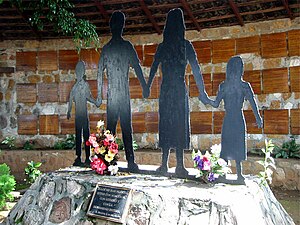
The Mozot Massacre ( Spanish: Masacre de El Mozote ) - a massacre that occurred during the Salvadoran civil war in the village of Mozote (El Mozote), department of Morazan , El Salvador , on December 11, 1981, when, at the hands of ultra-right government forces, about 800-1,200 civilians died (according to Soviet data, 962 people, including 300 children [1] ; according to the Americans, “at least 792 people” [2] , including 280 children [3] ). In December 2011, the Government of El Salvador apologized for this crime [4] , but the perpetrators were not punished for it. Being one of the numerous war crimes on the account of the Atlakatl battalion, it is considered one of the bloodiest crimes in the entire history of Central American countries.
Content
Context
In 1981, various left-wing guerrilla groups joined together in the Farabundo Martí National Liberation Front to fight against the right-wing dictatorship in El Salvador [5] . Before the massacre, unlike other villages in the district, Mosote had a reputation for neutrality. While many of the neighboring localities were mostly Roman Catholic and were considered sympathetic to the partisans influenced by the left-Catholic theology of liberation , Mosothe was inhabited mainly by "apolitical" Evangelical Protestants . The village for money supplied something for the guerilleros, but did not provide any more help and was reputed to be "a place where partisans should not look for recruits" [6] .
On the eve of the massacre, the richest man in the village of Mosotho, Marcos Díaz, gathered fellow villagers to warn them that the army would pass through their area with a punitive operation, but at the same time assured that no one from the local would suffer if they stay at home. Due to the specificity of Mosoteh, its residents did not expect a threat from the authorities, for the same reason hundreds of peasant refugees from nearby settlements flowed there (while usually no more than 20 families lived there, their number increased dramatically due to the influx of refugees).
Slaughterhouse
In his 1994 book The Massacre at El Mozote, American journalist Mark Danner resumed the course of events from December 10-12, 1981:
December 10th
On the afternoon of December 10, 1981, the Atlakatl unit of the Salvadoran army arrived in the remote village of Mosote after clashes with the FMLN partisans. The Atlakatl was an elite battalion of the “rapid reaction force” specially trained for counter-guerrilla warfare. He was the first detachment of this kind in the Salvadoran armed forces and was trained by US military advisers. He conducted his mission under the name Operation Rescue ( Operación Rescate ) to sweep the rebel presence in a small area in northern Morazans where the partisans had two camps and a training center.
When the battalion entered the village, the soldiers gathered all the inhabitants, laid them face down and told them not to leave their homes until the next day on pain of execution.
December 11 and 12
The next day, early in the morning, the soldiers gathered the whole village in the square. They separated the men from women and children and locked them in separate groups in the church, in the monastery and in various houses. [7]
From 8 in the morning until noon, the military interrogated, tortured and shot men and teenagers in small groups in different locations. For dinner, Atlakatl selected all young women and girls over 10 years of age who, after mass rape, were also shot with machine guns. After that, young children were locked in the church, and the remaining women were taken to the outskirts of the village to be shot. Towards the end, the soldiers began to shoot, cut their throats and hang children and babies. One of the witnesses described how a soldier threw a three-year-old child and pierced him with a bayonet [8] . Having destroyed all the local population, the military burned down the houses.
The battalion stayed in Mosot for another night, and the next day, together with other army units, continued the massacre in the villages of Rancheria and Los Terilos, located north of Mosot. Men, women and children were again kicked out of their homes, lined up, robbed and shot, and then set fire to their homes. [9] A day later, on December 13, the slaughter was repeated in the villages of Hokote Amarillo and Sero Pando south of Mosot.
First messages and controversies
The first information about the massacre in El Mosot spread the guerrilla radio "Venceremos". In the world media, news of the massacre first appeared on January 27, 1982 in reports published in The New York Times [10] and The Washington Post , whose correspondents, having arrived at the scene, spoke with the surviving eyewitness to the events Rufina Amaya, who had lost her husband and four children. The peasants provided the “ New York Times ” journalist Raymond Bonner with a list of 733 names killed by government troops [11] .
A Mexican journalist, Alma Guilmoprietyo, who came to the village a few days later, wrote in The Washington Post about dozens of dead bodies that she had seen lying in nearby fields, although a month and a half had passed since the massacre.
The Salvadoran military junta has denied these reports, and officials from the US presidential administration, Reagan , which supports it , called them "gross exaggerations." The Associated Press reported that "the US embassy disputed the reports, stating that its own investigation determined ... that no more than 300 people lived in Mosotte."
The conservative organization Accuracy in Media announced both leading publications telling the world about the tragedy that had befallen Mosota that they deliberately released their articles on the eve of the congressional debate, and its leader, Reed Irwin, said that “Mr. Thomas Enders, Assistant Secretary of State for Inter-American Affairs, declared before the Senate Committee that there was a regular battle and there is no reason “to confirm that government forces systematically exterminated civilians” [12]
On February 8, Elliot Abrams , Assistant Secretary of State for Human Rights and Humanitarian Affairs, oversaw the support of Washington for anti-communist forces in Central American countries (El Salvador, Honduras, Guatemala, Nicaragua) and subsequently convicted for involvement in the Iran-Contra scandal, told the Committee that death reports Hundreds of people in Mozot are “unreliable”, and the theme of the “incident is abused” by partisans [13] (Abrams later referred to the then US policy in El Salvador as “a brilliant achievement” [14] ).
The pro-government media, including The Wall Street Journal , picked up criticism of officials against journalists who have visited El Salvador as "overly gullible" and "playing along with communist propaganda." It got to the point that Time Magazine stated that Bonner, they say, had lost sight of the fact that women and children can also be active participants in the guerrilla war, and not just civilians. As a result of the harassment, Bonner was recalled to New York in August and later left the newspaper.
The wide disclosure of the fact of the Mosotne massacre called into question the entire policy of the Reagan administration in the region, where, under the banner of anti-communism, it supported the rightist repressive regimes and the ultra-right death squads . She was harshly criticized by the opposition, including in Congress, not least because of the many outrages in El Salvador. The sadistic slaughter of civilians not involved in the partisans could be negatively perceived by American public opinion (especially against the background of good treatment of FMLN guerrillas with government prisoners of war), and the attempts of the authorities of El Salvador and the United States to silence the crime only aggravated this attitude.
Later investigations
On October 26, 1990, Pedro Chicas Romero of La Hoya, who survived the carnage, hiding in a nearby cave, was sued for a massacre against the Atlakatl battalion [15] .
In 1992, as part of a peace settlement on the Chapultepec peace agreements signed in Mexico City on January 16 and marking the end of the civil war, the United Nations authorized the creation of a Truth Commission for El Salvador investigating human rights violations committed during the war. On November 17, with the participation of the Argentine forensic team, the exhumation of victims began. She confirmed Bonner and Guillermieprieto’s previous reports of hundreds of civilians killed on the spot. [16] So, in a mass grave located in an annex near the church, on a 3x5 meter section of the 146 remains, 140 belonged to children, from newborns to 12 years old.
The Minister of Defense of El Salvador and the Chief of the Joint Staff of the Armed Forces told the Commission of the truth that they allegedly did not have information that would allow the units and officers involved in Operation Salvation to be identified. They claimed that during this period there were no records.
In 1993, El Salvador passed a law that effectively exempted the army from criminal liability. In the same year, Danner published in the December 6 issue of The New Yorker an article that sparked controversy because it raised the topic of US intervention in Central America in the 1970s and 1980s and their support for authoritarian regimes and rights violations. person Subsequently, the author expanded his article “The Truth About El Mozote” into the book “The Massacre at El Mozote” ( The Massacre at El Mozote , 1994).
In 1993, a special State Department commission that studied the actions of American diplomats regarding human rights in El Salvador concluded that "the mistakes were certainly made ... especially that they could not get the truth about the December 1981 massacre." In his study of the media and the Reagan administration "On Bended Knee", American author Mark Hertsgaard wrote about the meaning of the first reports of the massacre:
... they disproved the fundamental moral claims underlying US policy. They pointed out that the United States did not support democracy in Central America, but repression. Therefore, they threatened to translate political debates from discussing means to discussing goals: from discussions, how best to deal with the perceived communist threat is to send US troops or just US assistance? - why the United States preferred to support state terror [17] .
A later court decision abolished the amnesty for defendants in cases suspected of "egregious human rights violations", but the repeated attempts by Salvadoran human rights defenders to initiate a trial did not produce results.
Heritage
On March 7, 2005, the Organization of American States and its Inter-American Commission on Human Rights resumed an investigation into the Mozot massacre on the basis of evidence found by Argentine forensic anthropologists [18] . Activists continued to lobby for consideration of the case by the Inter-American Court of Human Rights .
In a news item published in The Washington Post in January 2007, former Salvadoran soldier José Wilfredo Salgado told about returning to El Mosot a few months after the massacre and gathering skulls for young victims for “candlesticks” and talismans for good luck [19 ] .
While the right-wing conservative Nationalist Republican Alliance was in power, associated with the death squads during the civil war, the government of El Salvador refused to apologize for such massacres by pro-government forces; the Salvadoran state officially condemned the tragedy in Mozot only in December 2011, after winning the election of the former rebel Farabundo Marti National Liberation Front , which was transformed into a parliamentary left-wing party. Foreign Minister Hugo Martinez, speaking on behalf of the government, called the massacre a manifestation of "blindness of state violence" and asked for forgiveness. Then, President Mauricio Funes on behalf of the state apologized to the Salvadorans.
In October 2012, the Inter-American Court of Human Rights ordered El Salvador to investigate the Mozot massacre and bring those responsible to justice. The court ruled that the amnesty law does not apply to murder [20] . As compensation, the state will have to pay about $ 17.7 million [21] .
Bibliography
- Danner, Mark. The Massacre at El Mozote: A Parable of the Cold War. - Granta, 2005. - ISBN 1862077851 .
- Binford, Leigh. The El Mozote Massacre: Anthropology and Human Rights. - Tucson , Arizona : University of Arizona Press, 1996. - ISBN 0-8165-1662-6 .
Notes
- ↑ K.S. Tarasov, V.V. Zubenko. The US Secret War against Latin America. M., "International Relations", 1987. p.172
- ↑ Tim Golden. Salvador Skeletons Confirm Reports of Massacre in 1981 // The New York Times, October 22, 1992
- ↑ The New York Times, February 16, 1982
- ↑ El Salvador sorry for El Mozote massacre in 1981 . BBC News (December 10, 2011). The date of circulation is November 4, 2012. Archived November 4, 2012.
- ↑ Enemies of War: El Salvador Civil War . Public Broadcasting Service. The date of circulation is November 4, 2012. Archived November 4, 2012.
- ↑ Mark Danner The Truth of El Mozote Neopr . The New Yorker (December 6, 1993). The date of circulation is November 4, 2012. Archived November 4, 2012.
- ↑ Danner, 2005 , p. 67.
- ↑ John Schwartz . Elliot Abrams, appointed by Trump to give Venezuela a "democracy", has ruined democracy all his life // Skepsis
- ↑ Danner, 2005 , p. 81.
- ↑ Raymond Bonner . Massacre of the Hundreds Reported In Salvador Village , The New York Times (January 27, 1982). Released on November 4, 2012. (subscription required) (subscription required)
- ↑ Richard Boudreaux. "Many Die But No Agreement", (unavailable link) Associated Press, February 12, 1982. Retrieved 2008-05-04. (inaccessible link)
- ↑ Stanley Meisler El Mozote Case Study . Columbia School of Journalism. The date of circulation is November 4, 2012. Archived November 4, 2012.
- ↑ Robin Andersen. A Century of Media, a Century of War . - Peter Lang, 2006. - P. 89. - ISBN 9780820478937 .
- ↑ Corn, David Elliott Abrams: It's Back! The Nation (June 1, 2001). The date of circulation is November 16, 2009. Archived September 15, 2012.
- ↑ Douglas Martin Rufina Amaya, 64, Dies; Salvador Survivor . The New York Times (March 9, 2007). The date of circulation is November 4, 2012. Archived November 4, 2012.
- ↑ Tim Golden Salvador Skeletons Confirm Reports of Massacre in 1981 . The New York Times (October 22, 1992). The date of circulation is November 4, 2012. Archived November 4, 2012.
- ↑ Mark Hertsgaard. On the bended knee: the press and the reagan presidency. - Schocken Books, 1989. - P. 190. - ISBN 9780805209600 .
- ↑ Ian Urbina OAS to Reopen Inquiry Into Massacre in El Salvador in 1981 . The New York Times (March 8, 2005). The date of circulation is November 4, 2012. Archived November 4, 2012.
- ↑ Manuel Roig-Franzia . Former Salvadoran Foes Share Doubts on War , The Washington Post (January 29, 2007). Archived November 4, 2012. The appeal date is May 1, 2010.
- Sal El Salvador told to investigate 1981 El Mozote massacre , BBC News (December 11, 2012). The appeal date is December 11, 2012
- ↑ El Salvador confessed to killing children
Links
- Report of the UN Truth Mozote ( Excerpt )
- Evidence of Rufina Amaya - the only survivor of the massacre (in Spanish)
- The Dead: Victims at El Mozote and Nearby Villages . SOA Watch. Date of treatment January 22, 2012. - The list of victims of the massacre
- El Salvador judge reopens case of 1981 massacre at El Mozote . The Guardian , October 1, 2016.
- 35 Years After US-Backed El Mozote Massacre, Still No Justice . TeleSUR , December 9, 2016.
- A Massacre in El Salvador's Morazan Province: December 7-17, 1981 , 1982 pamphlet.