The 60-pound guns of the design of N.A. Baumgart of the 1855 model are cast-iron muzzle-loading guns of the caliber 196 mm, adopted by the Russian Imperial Navy in 1855. Also had the designation "300-pound gun . " They armed ships intended for long voyages and cruising warfare. They were mounted on wheeled wooden machines or on “rotary platforms” [1] . A number of guns were installed on the coastal fortifications. Vingrad cannons are detachable, the bottom of the channel is hemispheric [2] .
| 60 pound guns designed by N.A. Baumgart of 1855 | |
|---|---|
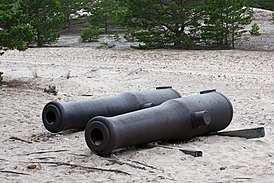 60-pound guns on the shore of the island of Gotska-Sandyon left there after the clipper " Horseman " jumped on the stones | |
| Production history | |
| Country of Origin |  Russian empire Russian empire |
| Years of production | 1855- |
| Made, units | no exact data |
| Service History | |
| It was in service |  Russian imperial fleet Russian imperial fleet |
| Gun characteristics | |
| Caliber mm | 196 mm (7.7 inches) |
| Barrel length, mm / calibres | 3452 / 17.6 |
| Barrel length, mm | 2928 |
| Barrel weight with a bolt, kg | 4914 |
| Loading principle | muzzle-loading |
| Gun mount specifications | |
| Calculation of installation, people | 19 |
Content
- 1 History
- 2 Tests
- 3 Production
- 4 machines
- 4.1 Wooden machine for 60-fn guns No. 1
- 4.2 Wooden machine for 60-fn guns No. 2
- 4.3 Wooden platform for round fire
- 4.4 Iron forged machines of the Andreev system
- 4.5 Iron ship machines of the von Schantz system
- 5 Tactical and technical data
- 6 Use
- 7 notes
- 8 Literature
History
At the very end of the 1840s, artillery colonel N. A. Baumgart , taking an English gun as a model, began developing a 60-pound sea gun based on the law “On the pressure of powder gases on the walls of a gun and the application of experimental results to determine the wall thickness of guns” Captain N.V. Maievsky . In 1851, the first samples were made. The guns were designed for a charge of 8.6 kg, but they poorly withstood a charge of 6.14 kg, as it turned out due to an incorrect calculation of the barrel walls. Later new prototypes were made according to the modified drawings, designed already for a charge of gunpowder reduced to 6.56 kg. These guns could fire cores, bombs and buckshot. The firing range of the core was 3.5 km, and the bomb 3.1 km. These guns could penetrate from board to board almost any wooden ship [1] [3] .
After the Crimean War, the Naval Department of the Russian Empire returned to the tests of 60-pound guns designed by N. A. Baumgart, following which they were put into service in 1855. Long, with a channel length of 17.6 caliber, received the designation No. 1 or "bomb" , and short, with a channel length of 15.4 caliber, respectively, No. 2 or "ordinary drawing" . In the same year, their mass production began. And at the shipyard of the Russian Empire, the Grand Duchy of Finland and England, copies of the drawings were sent to equip the ships under construction with new artillery.
It should be noted that at the same time, the 60-pound guns designed by the American D. Dahlgren were also adopted, and after a while the 60-pound guns designed by N. V. Maievsky , which caused some confusion. Thus, 60-pound guns designed by N.A. Baumgart and D. Dahlgren became the first Russian cannons specially designed for armament of ships, and guns designed by N.V. Maievsky came for coastal batteries.
In 1856-1859, cast-iron single-caliber 60-pound smoothbore muzzle-loading guns No. 1 and No. 2 designed by N. A. Baumgart and D. Dahlgren began to enter the fleet actively, becoming the main armament of some ships [4] . On March 10, 1857, Von Schantz began work on the manufacture of an iron machine for the 60-pound gun No. 2 at the Kronstadt Repair Facility. And on April 4 of the same year, the work was completed. On April 27, by order of the commander of the Kronstadt port, a commission was appointed to test the new machine [5] . By 1861, the Baltic Fleet already had 2070 guns, of which 1608 were 60-, 36- and 30-pound guns designed by N. A. Baumgart and D. Dahlgren [4] .
From the end of 1860 - the beginning of 1870, these guns began to be replaced with new weapons.
Tests
60-pound guns No. 1 designed by N.A. Baumgart entered trials in 1851. Having shown excess power, the hull of the sailing battleship was broken out for launch, the sample was not taken into service [2] .
After the Crimean War, they returned to testing these guns. For this, in 1855, two 60-pound gun barrels No. 1 designed by N. A. Baumgart were cast at the Aleksandrovsky Olonets Plant and two cast-iron barrels of 68-pound English-made guns were cast for comparison. They were brought to a comparatively long-term shooting at a charge of 18 pounds of gunpowder. The control shelling revealed a large "survivability" of the gun designed by N. A. Baumgart - the gun made according to English drawings was disabled after 546 shots, and the Baumgart gun after 789 shots. After that, the guns of the design of N. A. Baumgart were adopted [3] .
Also, in 1855, a fragment of the side of a British battleship with wood paneling and armor plates 4.5 inches (114 mm thick) was recreated on Volkov Field near St. Petersburg for new tests. In 1855-1856, this model was fired at an angle of 19 ° from a 60-pound gun No. 1 designed by N. A. Baumgart. The result was that the cores fired from a distance of 213 meters (100 fathoms) could not penetrate more than 60 mm, and the cast-iron cores cracked and the iron ones flattened. This circumstance forced officials from the Maritime Department to look for ways out, since the use of these guns against the battleships of the British Navy became meaningless.
As a first measure, less costly in terms of upgrading the fleet, steel cores were made. When shooting from a distance of 213 meters from a 60-pound gun No. 1, with an increased charge of gunpowder up to 9.4 kg, the cores pierced the armor, but got stuck in a wooden paneling. The guns of D. Dahlgren's design in such tests showed a comparative result. After the tests, it became clear that the 60-pound guns were not suitable for fighting armadillos, but they were a formidable weapon against merchant ships that did not have armor protection. They continued to be installed on ships for the so-called "cruising war" , and to combat the battleships began to develop heavier guns.
On April 27, 1857, by order of the commander of the port of Kronstadt, a commission was appointed to test the von Schantz iron machine. April 29, tests of the new machine began on a training battery, a former battleship, Prokhor . A 60-pound gun No. 2 was installed on the machine. The first firing occurred with charges of 4.5 kg of gunpowder at angles of vertical guidance of 0; + 9 °. The average rollback is fixed from 1727 to 1829 mm. In continuation, 25 shots were fired with the wedge removed, while the breech was laid on the bench, which made it possible to obtain a BH angle of + 14.75 °. When cleaning the bench and laying the breech on an iron pillow, an angle of BH + 21.5 ° was obtained. During the control firing at this angle of the barrel, the average recoil was 1715 mm. Laying a small wedge on a large one made it possible to increase the declination angle to −3 °, while the front end of the trunk was laid on the jamb of the port. May 25, 1857 the wooden wheels of the rear axle of the machine were replaced by four half-wheels (runners) [5] .
In 1858, experiments began with cutting the inner channel. To do this, a canal 64.5 cm long (30-pound gun No. 1) was drilled in a 60-pound cannon of the Baumgart design, which was cut in two lines. For tests used elongated shells weighing 24.57 kg, with a charge of 3.48 kg. She exploded in a 108 shot from jamming a projectile. The next year, the tests were resumed with the same gun, but in which four cuts were made in the barrel, it exploded on a 345 shot [2] . A 164-mm cast-iron rifled gun of the Italian designer Cavalli’s system was also tested, which showed extremely unsatisfactory results [4] . On this test were interrupted.
In 1861, tests were resumed - the serial 60-pound smoothbore guns of Baumgart No. 1 could not penetrate the new 114-mm English armor with steel cores from a distance of less than 185 meters. Which required increased quality control of the production of guns. In 1863, to continue the artillery tests, several more samples of British and German armor were installed on the Wolf Field, as well as mock-ups of ship compartments were constructed. After some tests were carried out, the program was curtailed, and tests of other samples were started at the training ground.
Production
The casting of gun barrels designed by N. A. Baumgart did not create any technological difficulties for Russian plants, therefore, in 1851, in the shortest possible time, prototypes of 60-pound guns No. 1 were made.
In 1855, two barrels of 60-pound guns No. 1 designed by N. A. Baumgart at the Aleksandrovsky Olonets Plant in Petrozavodsk were cast for testing.
The serial casting of the barrels of 60-pound guns designed by N.A. Baumgart was started at foundries in 1855. According to other sources, production was deployed by the end of the Crimean War.
The transition to serial production of new products was easy enough, as this did not require a significant re-equipment of production. Whereas the technology of casting 60-pound guns designed by D. Dahlgren meant investing in modernizing production and training workers. And the casting of the shafts of the 60-pound guns of Maievsky’s design required a significant re-equipment of production, so they started mass production only at the Fingspong factory in Sweden, some time later they began to cast them at only one Russian plant, but practically piece by piece.
60 pound guns designed by N. A. Baumgart and D. Dahlgren were cast in 1855-1856 at the Kamensky Zavod . During this period 34 guns were cast. But the tests showed that many guns are unsuitable for service and the selection committee rejected. And in April 1856, the order was issued by the Chief of the mining plants of the Ural ridge M. Glinka: “The artillery pieces cast at the Kamensky factory over the past two years do not withstand the established powder test and, as a result, are rejected ... the instability of Kamensky cast iron stems from the fact that the ores of which cast iron is smelted, they do not have the qualities that they had before ... ” As a result of this, the question arose of transferring the casting of tools to the Verkhneturinsky plant [6] .
Machine Tools
Wooden machine for 60-fn guns No. 1
Trunks of 60-pound guns No. 1 were placed on biaxial wooden machines. They had no side and persistent pillows. The lifting mechanism was a wooden wedge. To facilitate the rotation of the machine, a rotary beam was passed under it between the blocks of wooden axes. An iron arrow was attached to the front end of the swing bar. The arrow rotated on a pin that went vertically into the lower jamb of the port.
- HV angle, degrees: + 12.5 ° / + 20.35 ° −6.5 °
- Machine height, mm: 974
- Bed thickness, mm: 165
- Machine length, mm: no data
- Machine weight, kg: 1081
Wooden machine for 60-fn guns No. 2
The trunks of 60-pound guns No. 2 ( "ordinary drawing" ) were put on two-wheeled wooden machines with skids of the American system. The lifting mechanism was a wooden wedge. The beds were connected by cohesive and stubborn pillows. The bars and all the structural elements were fastened with a lock and cokes.
- HV angle, degrees: −7 °; + 15 °
- Machine height with wheels, mm: 940
- Bed thickness, mm: 165
- Machine length, mm: 1943
- Machine weight, kg: 700
- Width between beds, mm: front 578 / rear 635
- Front Axle Length, mm: 1524
- Distance from the deck to the lower jamb of the port, mm: 610
- Clear port height, mm: 1067
- Diameter of wheels, mm 467
Wooden platform for round fire
To conduct circular fire at the ends of the ships installed special platforms. They used wooden machines for 60-pound guns No. 1. The platform consisted of two wooden beams connected by three transverse pillows. The fastening was bolted and reinforced by a shackle. The beds were connected in front with two pillows, and behind - with two iron brackets, on which a bench, a gasket and two wedges of the lifting mechanism were superimposed. To pull the machine to the board, it was lifted onto eccentric rollers. When rolling back, the machine was held by a trouser and compressor. The trouser passed through wingrad and was attached to the frames. The compressor was located between the bars of the platform. To the front and middle cushions of the platform were attached copper hinges, which were superimposed on the pins passed through the deck.
Andreev Iron Forged Machines
Below are the data of iron forged machines for 60-pound guns No. 2 design Andreeva
- HV angle, degrees: −9 ° 15 '+ 22 ° 30'
- Machine height with wheels, mm: 991
- Bed thickness, mm: 30.5
- Thickness of bed iron, mm: -
- Diameter of wooden wheels, mm: front 368 / rear 152
- Machine length, mm: with stops 1867 / without stops 1791
- Total machine weight: 928
Von Schantz Iron Ship Machines
Von Schantz designed an iron machine for the 60-pound barrel of the No. 2 gun for battleships. He had a bed of sheet metal with a thickness of 15.9 mm. The platform was without a slope. Beds and ties were connected by rectangular iron strips on rivets. The base and compressor bar were wooden. The lifting mechanism is wedge (large and small). To tighten the machine to the side, an iron lever with rollers was used, it was also possible to turn with it, as well as using side hoists. The machine was put on four wooden wheels with copper bushes, but after testing a pair of wheels on the rear axle were replaced with 4 half-wheels (skid) [5] .
- HV angle, degrees: -1; +14
- Machine height with wheels, mm: -
- Bed iron thickness, mm: 15.9
- Diameter of wooden wheels, mm: front 271.6 / rear -
- Machine length, mm: with stops - / without stops -
- Total machine weight: 844.6
- iron parts, kg: 666
- wooden parts, kg: 161
- copper parts, kg: 17.6
Performance Data
| Comparison Table of 60 Pound Cannons [7] | |||||
|---|---|---|---|---|---|
| Indicator | Designs N.A. Baumgart model of 1855 | Designs D. Dahlgren sample 1855 | Designs of N.V. Maievsky model of 1857 | ||
| Number 1 | Number 2 | Number 1 | Number 2 | ||
| Year of start of mass production | 1855 | 1857 | |||
| Caliber | |||||
| Channel length with a hemisphere bottom, mm | 2928 (14.9 klb) | 2583 (13.2 klb) | 2934 (15 klb) | 2583 (13.2 klb) | 2965 (15.1 kb) |
| Barrel length without vingrad and torli | 3129 (15.9 klb) | ||||
| Barrel length with a torre and wingrad, mm | 3452 (17.6 klb) | 3019 (15.4 clb) | 3421 (17.4 clb) | 3020 (15.4 clb) | 3474 (17.8 klb) |
| The length of wingrad and torreli, mm | 368 | 354 | 559 | 518 | 325 |
| The length of the torch, mm | 127 | 138 | 330 | 290 | |
| Barrel weight kg | 4914 | 3210 | 5012 | 3382 | 6257 |
| Overweight breech, kg | 352 | 246 | 360 | 17 | 328 |
| Elevation angle | 22 ° (on the coastal carriage of Andreev) | ||||
| Calculation of guns, man | 19 | 19 | |||
| Ammunition | |||||
| Regular charge of black artillery powder, kg | 6.56 | 6.5 | 6.1 | ||
| Cast iron core, kg | 26.2 / 25.8 | 25.8 | |||
| Cast iron bomb, kg | 18.16 (charge 1.229 kg of gunpowder) / 18.7 (charge 0.82 kg of explosives) | ||||
| The core is steel, kg | 30.3 | ||||
| Long-range shots, kg | 26.41 (60 cores) / 27.94 (9 bullets with a diameter of 80.6 mm, length 229 mm in iron circles, each weighed 1.98 kg.) | ||||
| Near shot, kg | 24.57 (in an iron case with a diameter of 190.5 mm, a length of 214.6 mm were: 4 bullets with a diameter of 46 mm, each weighed 375 g, and 108 bullets with a diameter of 36.6 mm, each weighed 183 g) | ||||
| Firing range, km | 3.5 (including core), 3.1 (bomb) up to 0.6 (buckshot) | 4.27 (including the core), 5.32 (bomb), up to 0.7 (buckshot) | |||
| Initial speed, m / s | 470 (including the core), 540 (bomb) | ||||
| Vitality of the barrel, shots | 546 | > 1000 | |||
Usage
- Baumgart's 60-pound smoothbore guns were armed
- 1856-1871 battleship Gangut (32 × No.?)
- 1857–1874 battleship “ Retvisan ” (1 × No. 1, 28 × No. 2, from 1868 16 × No. 2)
- 1857-1874 battleship " Cesarevich " (115 × No.?)
- 1857-1865 battleship Eagle (45 × No.?)
- 1858-1869 frigate General Admiral (60 × No. 2)
- 1858-1874 battleship Sinop (1 × No. 1, 34 × No. 2, from 1864 1 × No. 1)
- 1860-1869 frigate " Oleg " (1 × No. 1, 34 × No. 2)
- 1860-1870 corvette " Hero " (1 × No. 1, 16 × No. 2)
- 1860-1886 clipper " Gaydamak " (3 × No. 1)
- 1861-1870 battleship Emperor Nicholas I (1 × No. 1, 20 × No. 2)
- 1861-1870 clipper " Abrek " (3 × No. 1)
- 1861-1874 frigate Oslyabya (1 × No. 1, 28 × No. 2, since 1863 1 × No. 1, 6 × No. 2, since 1866 6 × No. 2)
- 1862-1863 clippers of the type "Diamond" (3 × No. 1)
- 1862-1868 clipper " Horseman " (3 × No. 1)
- 1862-1906 gunboat " Experience " (1 × No. 1, was covered by an armored V-shaped traverse 114 mm)
- 1865 battery battleship Sevastopol (unknown quantity)
- 1865 год батарейный броненосец « Петропавловск » (неизвестное количество)
- 1865—1877 плавучая батарея « Кремль » (17 × № ?)
- 1866—1876 корвет « Воевода » (11 × № 2, позже 1 × № 2)
- корвет « Богатырь »
- На некоторые береговые батареи Кронштадта были установлены Пушки № 1 на деревянных корабельных станках, в единичных случаях пушки № 2 [1] .
- Михайловская батарея в Севастополе была вооружена пушками № 1 на поворотной платформе.
Notes
- ↑ 1 2 3 Широкорад, 2000 , с. 86.
- ↑ 1 2 3 Широкорад, 2000 , с. 117.
- ↑ 1 2 Гармашев, Луценко, 2016 , с. 1-2.
- ↑ 1 2 3 Титушкин, 1989 , с. 59.
- ↑ 1 2 3 Широкорад, 2000 , с. 122.
- ↑ Выписки из плавильного журнала Каменского завода за 1854—1856 года
- ↑ Широкорад, 2000 , с. 118.
Literature
- Широкорад А. Б. Энциклопедия отечественной артиллерии / Под общ. ed. Тараса А. Е.. — Минск: Харвест, 2000. — 1188 с. — (Библиотека военной истории). — 11 000 экз. - ISBN 985-433-703-0 .
- Гармашев А. А., Луценко А. Б. 60 Фунтовая Пушка Чертежа №1 На Поворотной Платформе. - SPb. , 2016. — 8 с.
- Titushkin S. I. Ship guns of the era of the steam and armored fleet (Russian) // Shipbuilding: journal. - Leningrad, 1989. - No. 11 . - S. 59-65 .
- Nilus A. A. History of the material part of artillery. In two volumes. - SPb. : Mikhailovsky Artillery Academy, 1904.
- RSA Navy f.165 d.1973 (collection of correspondence on artillery weapons)
- Russian biographical dictionary. Volume III. Betancourt - Byakster