Väinämöinen [1] , also Väinämöinen ( Fin. and Karelian. Väinämöinen ) - the main character ( uros ) of the Karelian - Finnish poetic epic " Kalevala ", the first person, the son of the goddess Ilmatar , the performer of songs to the accompaniment of the kantele , the caster ( tietäjä ) [2] . It is often referred to as old ( vanha ).
| Väinämöinen | |
|---|---|
| Väinämöinen | |
 A. Galen-Kallela . “Sampo Defense” | |
| first-person caster | |
| Mythology | Karelian-Finnish |
| Floor | |
| Mother | Ilmatar |
| Attributes | kantele |
| Mentions | Kalevala , Ingermanland songs |

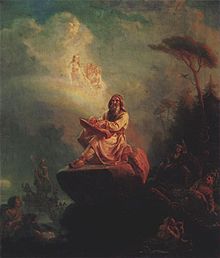
In Karelian and Finnish epic songs, Väinämöinen is the most popular character. It is also found in Ingermanland songs, but rather rarely [3] .
Content
Väinämöinen in Kalevala
According to Kalevala , Väinämöinen was born immediately after the creation of the world and became the first person. He is a hero, a prophetic rune-singer, a sower and a sage. Väinämöinen can be attributed to the most archaic type of epic heroes: he bears the obvious features of a shaman and acts more often with witchcraft than with a sword or spear (unlike the “typical” heroes Lemminkainen and Joukahainen, whom the “eternal soothsayer” often manages to shame). The heavenly origin of the first man is emphasized by the absence of his father [1] :
- The maiden suffered from the wind
- the wave became heavier.
- The maiden suffered from the wind
At the beginning of Väinämöinen’s biography there is an epic motive of “miraculous birth” - Ilmatar’s unusually long pregnancy (cf. Rostem “ Shahnameh ”) and the fact that the hero was born a 30-year-old man. Being in the womb of the mother, Väinämäinen calls to the Ursa Major ( Otava ) to come into the light and see the stars.
One of the first exploits of Väinämöinen is the shamanic duel with Jokahainen . The Lapland sorcerer remains alive only having promised Väinämäinen his sister Aino. But the bride sorrow drowns in the sea, not wanting to marry an old man. Väinämäinen's mother consoles her son, advising her to find a wife in Pohjöl . Despite the machinations of Jokahainen , Väinämäinen still ends up in Pohjöl. There Väinämäinen is a rival to Ilmarinen Pohjele: the mistress of Pohjela, the old woman Louhi, gives grooms difficult tasks - to get a star from the sky, to plow a serpent field, to turn a snake into a ball, to catch a black pike from the Tuonela river. But the old woman Louhi demands from him the Sampo magic mill [4] . Väinämöinen admits that no one can do it except the blacksmith Ilmarinen , but he still gets acquainted with the girl who sets him the test. During one of them, due to the machinations of HiCi, he cuts his leg [5] . With the help of the sorcerer, Väinämäinen heals the wound and returns home.
According to some runes, Väinämäinen still copes with the tasks using his magical abilities, and leads the bride Ilmarinen after the marriage tests. [6]
In the 17th rune of Kalevala it is described how Väinämöinen awakens the dead sage giant Antero Vipunen from the grave in order to gain magical knowledge. Väinämöinen not only defeats the dead giant, but at first it is swallowed by them. A significant deed of Väinämäinen is the abduction of Sampo from Pohjela, together with Ilmarinen and Lemminkainen [1] . In 42 runes, he plays the kantele and all the inhabitants of Pohyol fall asleep [2] , which allows the heroes to kidnap Sampo . The awakened old woman Louhi sets off in pursuit, Sampo breaks up and Väinämäinen loses a kantele of bones of a magic pike. Then the hero makes a kantele of birch and bride’s hair [7] . Sea king Ahti and his wife Vellamo are music lovers and lovers of the wonderful game of Väinämöinen. Ahti drives fish in Väinämöinen's net and, by the way, a pike that has swallowed fire. However, the wealth of the Sea King is incalculable because it consists of large pieces of the Sampo mythical jewel, which fell precisely from the boat of musician Väinämöinen to the bottom of the sea.
In Culture and Society
After the publication of Kalevala by Elias Lönroth in 1849, Väinämöinen became a frequent hero of works of art by sculptors and artists.
In 1873, a statue of Väinämöinen by Johannes Takanen , lost during the Second World War and restored in 2007, was installed in the Vyborg Monrepos park. In addition, in the city of Sortavala there is Väinämöinen Square with a monument to the rune singer .
Under the pseudonym "Grandfather Väinämöinen" was known the Karelian public figure Vasily Sidorov (1855-1942), the leader of the anti-Soviet Karelian uprising of 1921.
Notes
- ↑ 1 2 3 Kiuru, Mishin (trans.), 1998 .
- ↑ 1 2 RusFin . www.rusfin.org. Date of treatment January 21, 2019.
- ↑ Kiuru, 1998 .
- ↑ RusFin . www.rusfin.org. Date of treatment January 21, 2019.
- ↑ RusFin . www.rusfin.org. Date of treatment January 21, 2019.
- ↑ Petrukhin V. Ya. Myths of Finno-Ugric peoples. - Astrel: AST: Transitbook, 2005.
- ↑ RusFin . www.rusfin.org. Date of treatment January 21, 2019.
Literature
- Kiuru E. S. List of actors, mythological characters, epic place names : [ arch. April 5, 2016 ] // Kalevala : [ arch. March 8, 2016 ] / Lönnrot E .; Per. with fin. Eino Kiuru and Armas Mishin . - Petrozavodsk: Karelia, 1998.
- Lönnrot E. Kalevala : [ arch. March 8, 2016 ] / Per. with fin. E. S. Kiuru and A. I. Mishin . - Petrozavodsk: Karelia, 1998.