Primary motor cortex , or primary motor cortex ( Eng. Primary motor cortex ) - an area of the motor cortex located in the middle-posterior part of the precentral gyrus adjacent to the central sulcus . Corresponds to the cytoarchitectonic field of Broadman 4 and the caudal part of field 6 . Contains Betz cells and other motor neurons whose axons reach segments of the spinal cord . One of the main functions of the primary motor cortex is the control of arbitrary discrete movements performed by muscle groups.
| Primary motor cortex | |
|---|---|
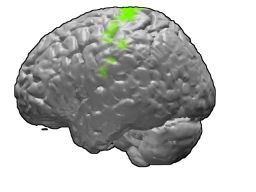 Primary motor cortex ( Broadman Field 4 ) | |
 Primary motor cortex is marked in green | |
| Part | Cerebral cortex |
| Catalogs | |

In the primary motor cortex there is a topographic representation of various areas of the body ( ) in an inverted form, from the legs (top of the hemisphere) to the mouth (lower part of the hemisphere). The primary motor cortex of each hemisphere controls the muscles on the opposite side of the body. The surface area of the areas of the primary motor cortex that control various parts of the body is proportional not to the physical surface of these parts, but to the number and degree of complexity of their motor reactions. Because of this, about 3/4 of the main volume of the primary motor cortex is represented by insignificant (by mass), but performing subtle non-stereotypical movements of the muscles of the hands, fingers, facial muscles of the face, lips, tongue [1] .
Along with the primary, there is a secondary motor cortex, which includes premotor cortex and the additional motor region .
Structure
The primary motor cortex is located along the anterior wall of the central sulcus , and also extends forward from the central sulcus to the precentral gyrus . The front part of the primary motor cortex borders on the lateral part of the premotor cortex . The central sulcus separates the primary motor cortex from the primary somatosensory cortex , which is located along the posterior wall of the central sulcus. The ventrally primary motor cortex is bounded by the islet lobe , dorsally stretches to the upper part of the hemisphere and then continues on the medial surface of the hemisphere.
Histologically, the region of the primary motor cortex differs from other regions by the presence of Betz cells . Layer V of the primary motor cortex contains giant (70-100 microns ) pyramidal neurons , which are called Betz cells. The axons of these neurons go to the contralateral motor nuclei of the cranial nerves and the lower motor neurons of the anterior horns of the gray matter of the spinal cord . Betz cell dendrites reach the surface molecular layer, the axons of these neurons transmit information to the basal ganglia, trunk and spinal cord, forming a corticospinal tract. It should be noted that Betz cells make up only a small part of the corticospinal tract - about 10% of all neurons of the primary motor cortex [2] and about 2-3% of the total cortical projection for the spinal cord [3] . Despite a small fraction of Betz cells in the total volume of neurons of the motor cortex, they are a clear marker that defines the primary motor cortex [4] .
Pathways
Approximately 30% of the fibers of the pyramidal tract originate in the V layer of the primary motor cortex (field 4), another 30% are sent from the premotor cortex ( field 6 ) and the additional motor region, in which there are motive signals preceding the movement, and the remaining 40% from somatosensory areas ( parietal lobe , fields 3, 2, 1 ).
Clinical Importance
Lesions of the precentral gyrus cause paralysis of a certain group of muscles on the opposite side of the body (facial paralysis, monoparesis of the arm or leg, hemiparesis).
Motion Encoding
Evarts [5] suggested that each neuron in the motor cortex contributes to muscle effort. According to his theory, the greater activity of neurons in the motor cortex corresponded to greater muscle effort.
Georgopoulos and colleagues [6] [7] [8] suggested that “muscle effort” is too simple a description of the functioning of the motor cortex. They studied the activity of neurons in the brain of monkeys during their various movements and found that each neuron in the motor cortex was most active during a specific direction of hand movement, and was weaker activated during movements in other, neighboring directions. Based on this, they concluded that the effect of neurons in the motor cortex is summed up, as a result of which a certain direction of movement is calculated.
The hypothesis that the neurons of the motor cortex encode the direction of movement was perceived ambiguously in the scientific community. Scott and Kalaska [9] showed that each neuron in the motor cortex is more associated with joint movement or muscle effort than with direction of movement. Schwartz and his colleagues [10] showed that neurons of motor pestilence are closely related to the speed of movement of the arm. Strick and his colleagues [11] found that some neurons of the motor cortex were activated in conjunction with muscle effort, while other neurons of the same cortex were activated in connection with the direction of movement in space. Todorov [12] suggested that many possible correlations between neurons and types of arm movements are associated with muscle “control”, in which motion parameters are associated with muscle effort.
In general, the parameters that determine the exact mechanism for encoding movements of the motor cortex remain the subject of discussion and various hypotheses.
Some progress in understanding the mechanisms of functioning of the motor cortex was obtained in the study of the rodent brain. Thus, the motor cortex of rodents, as in primates, may contain separate areas responsible for various types of motor actions [13] [14] . For example, one of the areas of the motor cortex is responsible for the rhythmic control of vibrissae [13] [15] [16] . Neurons in this area are associated with a specific subcortical nucleus, in which the central generator of ordered activity coordinates the cyclic rhythm of vibrissa movement. This core sends motor commands to the muscles that perform vibrissa movement.
Additional Images
Precentral groove
Central furrow
Motor (motor) tract
See also
- Motor bark
- Upper motor neuron
- Brain structures
Notes
- ↑ Erofeev N.P. Physiology of the central nervous system. Tutorial. - Moscow: SpetsLit, 2017 .-- S. 146. - ISBN 78-5-299-00841-8.
- ↑ Rivara CB, Sherwood CC, Bouras C., Hof PR Stereologic characterization and spatial distribution patterns of Betz cells in the human primary motor cortex (Eng.) // The Anatomical Record Part A: Discoveries in Molecular, Cellular, and Evolutionary Biology : journal. - 2003. - Vol. 270 , no. 2 . - P. 137-151 . - DOI : 10.1002 / ar.a.10015 . - PMID 12524689 .
- ↑ Lassek, AM The pyramidal tract of the monkey (Eng.) // J. Comp. Neurol. : journal. - 1941. - Vol. 74 . - P. 193-202 . - DOI : 10.1002 / cne.900740202 .
- ↑ Erofeev N.P. Physiology of the central nervous system. Tutorial. - Moscow: SpetsLit, 2017 .-- S. 145-146. - ISBN 78-5-299-00841-8.
- ↑ Evarts, EV Relation of pyramidal tract activity to force exerted during voluntary movement (Eng.) // J. Neurophysiol. : journal. - 1968. - Vol. 31 , no. 1 . - P. 14-27 . - PMID 4966614 .
- ↑ Georgopoulos, AP, Kalaska, JF, Caminiti, R. and Massey, JT On the relations between the direction of two-dimensional arm movements and cell discharge in primate motor cortex (Eng.) // J. Neurosci. : journal. - 1982. - Vol. 2 , no. 11 . - P. 1527-1537 . - PMID 7143039 .
- ↑ Georgopoulos AP, Kettner, RE and Schwartz, AB Primate motor cortex and free arm movements to visual targets in three-dimensional space. II. Coding of the direction of movement by a neuronal population (English) // J. Neurosci. : journal. - 1988. - Vol. 8 , no. 8 . - P. 2928-2937 . - PMID 3411362 .
- ↑ Georgopoulos AP, Schwartz, AB and Kettner, RE Neuronal population coding of movement direction (Eng.) // Science. - 1986. - Vol. 233 , no. 4771 . - P. 1416-1419 . - DOI : 10.1126 / science.3749885 . - PMID 3749885 .
- ↑ Scott, SH; Kalaska, JF Changes in motor cortex activity during reaching movements with similar hand paths but different arm postures (English) // J. Neurophysiol. : journal. - 1995. - Vol. 73 , no. 6 . - P. 2563-2567 . - PMID 7666162 .
- ↑ Moran, DW; Schwartz, AB Motor cortical representation of speed and direction during reaching ( J. ) // J. Neurophysiol. : journal. - 1999. - Vol. 82 , no. 5 . - P. 2676-2692 . - PMID 10561437 .
- ↑ Kakei, S., Hoffman, D. and Strick, P. Muscle and movement representations in the primary motor cortex (Eng.) // Science: journal. - 1999. - Vol. 285 , no. 5436 . - P. 2136-2139 . - DOI : 10.1126 / science.285.5436.2136 . - PMID 10497133 .
- ↑ Todorov, E. Direct cortical control of muscle activation in voluntary arm movements: a model (Eng.) // Nat Neurosci : journal. - 2000. - Vol. 3 , no. 4 . - P. 391-398 . - DOI : 10.1038 / 73964 . - PMID 10725930 .
- ↑ 1 2 Haiss, F .; Schwarz, C. Spatial segregation of different modes of movement control in the whisker representation of rat primary motor cortex (Eng.) // J. Neurosci. : journal. - 2005. - Vol. 25 , no. 6 . - P. 1579-1587 . - DOI : 10.1523 / JNEUROSCI.3760-04.2005 . - PMID 15703412 .
- ↑ Ramanathan, D., Conner, JM and Tuszynski, MH A form of motor cortical plasticity that correlates with recovery of function after brain injury (English) // Proceedings of the National Academy of Sciences of the United States of America : journal. - 2006. - Vol. 103 , no. 30 . - P. 11370-11375 . - DOI : 10.1073 / pnas.0601065103 . - PMID 16837575 .
- ↑ Brecht, M., Schneider, M., Sakmann, B. and Margrie, TW Whisker movements evoked by stimulation of single pyramidal cells in rat motor cortex (Eng.) // Nature: journal. - 2004. - Vol. 427 , no. 6976 . - P. 704-710 . - DOI : 10.1038 / nature02266 . - PMID 14973477 .
- ↑ Cramer, NP; Keller, A. Cortical control of a whisking central pattern generator (English) // J. Neurophysiol. : journal. - 2006. - Vol. 96 , no. 1 . - P. 209-217 . - DOI : 10.1152 / jn.00071.2006 . - PMID 16641387 .
Links
- Brain Info Article