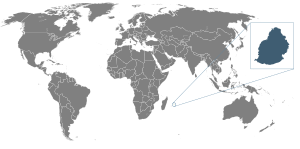
Dutch Mauritius ( Dutch : Nederlands-Mauritius ) - owned by the Dutch East India Company on the island of Mauritius between 1638 and 1710 , when it was used as a transfer point for merchant ships. It has already been opened by Dutch sailors since 1598 , but only the first settlement on the island was founded only in 1638 in order to prevent the French and British from first to establish power on the island. [one]
| Dutch colony | |||||
| Dutch Mauritius | |||||
|---|---|---|---|---|---|
| niderl. Nederlands-mauritius | |||||
| |||||
 | |||||
 → →1638 - 1710 | |||||
| Capital | Port de Warwick ( Maebur ) | ||||
| Languages) | Dutch | ||||
| Currency unit | Reyksdalder , Netherlands guilder | ||||
| Governor | |||||
| • 1638–1639 | Cornelius Goyer | ||||
| • 1639–1645 | Adrian van der Stel | ||||
| • 1673–1677 | Hubert Hugo | ||||
| • 1703-1710 | Abraham Momber van de Velde | ||||
| Story | |||||
| • August 29, 1638 | Arrival of troops at Fort Frederick Hendrick | ||||
| • February 1710 | Dutch leave the island | ||||


Content
History
It has often been suggested that Mauritius was first discovered by the Arabs, who named the island of Dina Harobi. The first historical evidence of the existence of the island, now known as Mauritius, can be seen on a map compiled by Italian cartographer Alberto Cantino in 1502 . [2] Mauritius was also visited by the Portuguese between 1507 and 1513 . However, they were not interested in this isolated island. Their main African colony was located in Mozambique , so the Portuguese sailors preferred to use the Mozambique Channel for a trade route to India. Comoros in the north proved to be more practical for these purposes. Thus, the Portuguese did not create a permanent colony on the island.
Dutch sailors (1598-1637)
In 1598, a Dutch expedition consisting of eight ships set sail from the port of Texel ( Netherlands ) under the leadership of Admirals Jacob Cornelis van Sheck and Vibrend van Warwick towards the Indian subcontinent. Eight ships collided with inclement weather after they sailed the Cape of Good Hope and they split. Three ships traveled northeast of Madagascar , while the other five regrouped and sailed in a southeast direction. On September 17, five ships, by order of Admiral Van Warwick, reached the island. September 20, they entered the sheltered bay, which they called “Port de Warwick” (now called the “ Grand Port ”). They landed and decided to name the island “Prince Moritz van Nassawayland”, after Prince Moritz ( lat . Mauritius ) from the Nassau house became the Holder of Holland and Zealand , with the exception of Friesland , but also by the name of the main flagship of the fleet, which bore the name "Mauritius". Since then, the modern name of the island has appeared - Mauritius. On October 2, the ships set sail again.
From that moment on, the Port de Warwick Bay was used by the Dutch as a transshipment point after long months at sea. In 1606, two expeditions first moored at the site that would later become the city of Port Louis in the northwestern part of the island. The expedition, consisting of eleven ships and 1,357 people on the orders of Admiral Kornil, entered the bay, which they called "Rad de Tortez" (literally means "Harbor of turtles") due to the large number of land turtles that lived in those places. [3]
From this date on, Dutch sailors emphasized Rad de Tortez as the island's main harbor. In 1615, the shipwreck and death of Governor Peter Bot , who was returning from India with four richly loaded ships, forced the Dutch sailors to consider the route through the island damned, and they tried to avoid it. Meanwhile, the British and Danes launched an invasion of the Indian Ocean . Those who sailed to the island freely cut down and took with them the precious bark of ebony , which grew in abundance on the island.
Dutch Colonization (1638-1710)
Dutch colonization of the island began in 1638 and ended in 1710 with a short break between 1658 and 1666 . Numerous governors were appointed, but continuous difficulties, such as cyclones, droughts, diseases, food shortages, made themselves felt, the island was finally abandoned in 1710 .
The island was not permanently inhabited for forty years after its discovery by the Dutch, but in 1638 Cornelius Goyer founded the first permanent Dutch settlement in Mauritius with a garrison of twenty-five people. Thus, he became the first governor of the island. In 1639, another thirty people arrived on the island to strengthen the Dutch colony. Goyer was instructed to develop the commercial potential of the island, but he did not take any measures for this, so he was recalled from the island. His successor was Adrian van der Stel, who took up his duties with due zeal, developing the export of ebony. For this purpose, van der Stel delivered 105 Malagasy slaves to the island. [4] During the first week, about sixty slaves were able to escape into the woods; only about twenty of them were returned.
In 1644, the islanders had to face many months of difficulty due to the delayed arrival of stocks, poor yields and cyclones. During these months, the colonists could rely only on themselves, fishing and hunting. However, van der Stel ensured the transport of another 95 slaves from Madagascar before being appointed governor in Ceylon . His replacement was Jacob van der Meersch. In 1645, he delivered another 108 Malagasy slaves. Van der Meersch left Mauritius in September 1648 and was replaced by Rainier Pore.
In 1652, the colonists, craftsmen and slaves suffered even more suffering. The population of the island at that time was about a hundred people. The ongoing difficulties associated with the commercial potential of the island were not resolved by 1657 . On July 16, 1658, almost all the inhabitants left the island, with the exception of one young colonist and two slaves who took refuge in the forests. [5] Thus, the first attempt at colonization by the Dutch failed.
A second attempt was made in 1664 , but it was also unsuccessful, as people who arrived at work left their sick Governor Van Niveland without proper treatment, and he died.
From 1666 to 1669, Dirk Janss Smart managed a new colony at Grand Port , exporting ebony and slaves as an development of the island's trading potential. When Dirk Janss Smart left the island, he was replaced by George Friedrich Uriden. The latter died in 1672 , also this year five more colonists drowned during an reconnaissance expedition. His replacement was Hubert Hugo. Later he became a man who wanted to turn the island into an agricultural colony. His visions were not shared by his leadership, and ultimately he was not able to fully realize his plans.
Isaac Johannes Lamozy became the new governor when Hugo left his post in 1677 . Lamotius ruled until 1692 , when he was sent to Holland for trial. Thus, in 1692, the new Governor Ruelof Deodati was appointed. Deodati has faced many problems, such as cyclones, diseases, and droughts. Disappointed, Deodati eventually resigned, and his replacement was Abraham Momber van de Velde. The latter could not improve the situation on the island and in the end he became the last Dutch governor of the island for the entire period of Dutch colonization. Thus, the Dutch abandoned the management of the island in 1710 .
Legacy
The Dutch gave a name to the country and many regions around the island. They also brought sugar cane from Java to the island. The most detrimental consequence of Dutch colonization was the destruction by the Dutch of local dodo populations and a giant population of turtles, which was also facilitated by the introduction of competing species on the island. Large areas of forests were cut down for export of ebony bark.
The foundations of Fort Frederick Hendrick have survived on the island. [6] On November 18, 2010, the Museum of Frederick Hendrick was opened by the Ambassador of the Netherlands to Tanzania and the Minister of Culture of Mauritius Mukesswur Chone. [7]
Notes
- ↑ De VOC site - Mauritius
- ↑ Toorawa. The medieval Waqwaq islands and the Mascarenes. - Hassam Toorawa Trust. - Port Louis, Mauritius, 2007.
- ↑ Auguste Toussaint. Histoire des îles Mascareignes. - S. 24.
- ↑ Dr A. Satteeanund Peerthum, Resistance Against Slavery. Slavery in the South West Indian Ocean (Eng.) // MGI. - S. 25 .
- ↑ Albert Pitot. T'Eyland Mauritius, Esquisses Historiques (1598-1710). - 1905 .-- S. 116.
- ↑ The Vieux Grand Port Heritage Site (link not available) . Portal of the Government of Mauritius (08.30.2010). Date of treatment December 2, 2018. Archived on July 21, 2011.
- ↑ Opening Frederik Hendrik Museum op Mauritius (Link unavailable) . Tropenmuseum.nl (07/21/2011). Date of treatment December 2, 2018. Archived on July 21, 2011.