Pronghorn ( Latin Antilocapridae ) - a family of ruminant artiodactyl mammals, endemic to North America , beyond which they never penetrated. Probably the sister group for the bovids , sometimes included in the same superfamily with deer [1] . The first pronghorn appeared in the Late Oligocene [2] . The only modern species is pronghorn , distributed in the steppes of the western part of the USA , southwest Canada and northern Mexico [3] .
| Pronghorn |

Pronghorns ( Montana ) |
| Scientific classification |
|---|
| No rank : | Bilateral symmetrical |
|
| International scientific name |
|---|
Antilocapridae
(Gray, 1866 ) |
Geochronologyappeared 28 million years | million years | Era | F-d | Era |
|---|
| | Th | TO
but
th
n
about
s
about
th | | 2,588 | | | 5.33 | Pliocene | N
e
about
g
e
n | | 23.03 | Miocene | | 33.9 | Oligocene | P
but
l
e
about
g
e
n | | 55.8 | Eocene | | 65.5 | Paleocene | | 251 | Mesozoic |
◄ Nowadays◄ Cretaceous-Paleogene extinction |
|---|
|

Skeleton
Merycodus nectatus
Skeleton
Capromeryx minor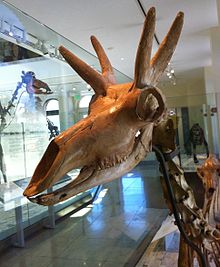
Skull
Stockoceros conklingi
Osbornoceros osborni (reconstruction)

Skeleton
Ramoceros osborni
Ramoceros osborni (reconstruction)

Tetrameryx shuleri (reconstruction)
Pronghorn shaped like a antelope . The horns of the pronghorn, as well as the horned ones , are bone rods covered with horn covers. But, unlike canids, these covers are discarded annually after the end of the breeding season, and then grow back. Also, in contrast to the bovids, the prongholes gradually decreased in the pronghorn; only the metatarsal bone remained. The dental formula and complex four-chamber stomach are the same as in the rest of the ruminants .
Pronghorn evolved in North America, where it occupied the ecological niche of the horned animals that developed in the Old World. During the Miocene and Pliocene, they were a diverse and successfully developing group with many different species. Some members of the family had 4 ( Hayoceros ) and even 6 horns. In some, for example, Osbornoceros , the horns were even, slightly curved, in others, Paracosoryx , flattened with forked ends, or fan-shaped ( Ramoceros ). [4] [5]
There are 2 subfamilies in the family with 22 genera. Currently, about 70 fossil species are known.
- Subfamily Antilocaprinae
- Tribe Antilocaprini
- Genus Antilocapra - Pronghorns
- Antilocapra americana - Pronghorn
- Genus Texoceros †
- Texoceros altidens †
- Texoceros edensis †
- Texoceros guymonensis †
- Texoceros minorei †
- Texoceros texanus †
- Texoceros vaughani †
- Tribe Ilingoceratini †
- Genus Ilingoceros †
- Ilingoceros alexandrae †
- Ilingoceros schizoceros †
- Genus Ottoceros †
- Ottoceros peacevalleyensis †
- Genus Plioceros †
- Plioceros blicki †
- Plioceros dehlini †
- Plioceros floblairi †
- Genus Sphenophalos †
- Sphenophalos garciae †
- Sphenophalos middleswarti †
- Sphenophalos nevadanus †
- Tribe Proantilocaprini †
- Genus Proantilocapra †
- Proantilocapra platycornea †
- Genus Osbornoceros †
- Tribo Stockoceratini †
- Genus Capromeryx (= Breameryx ) †
- Capromeryx arizonensis (= B. arizonensis ) †
- Capromeryx furcifer (= B. minimus , C. minimus) †
- Capromeryx gidleyi (= B. gidleyi ) †
- Capromeryx mexicana (= B. mexicana ) †
- Capromeryx minor (= B.minor ) †
- Capromeryx tauntonensis †
- Genus Ceratomeryx †
- Genus Hayoceros †
- Hayoceros barbouri †
- Hayoceros falkenbachi †
- Genus Hexameryx †
- Genus Hexobelomeryx †
- Hexobelomeryx fricki †
- Hexobelomeryx simpsoni †
- Genus Stockoceros †
- Stockoceros conklingi (= S. onusrosagris ) †
- Genus Tetrameryx †
- Tetrameryx irvingtonensis †
- Tetrameryx knoxensis †
- Tetrameryx mooseri †
- Tetrameryx shuleri †
- Tetrameryx tacubayensis †
- Subfamily Merycodontinae †
- Genus Cosoryx †
- Cosoryx agilis †
- Cosoryx cerroensis †
- Cosoryx furcatus †
- Cosoryx ilfonensis †
- Cosoryx trilateralis †
- Genus Merriamoceros †
- Merriamoceros coronatus † - Middle Miocene of California [6]
- Genus Meryceros †
- Meryceros crucensis †
- Merycerus crucianus †
- Meryceros hookwayi †
- Meryceros joraki †
- Meryceros major †
- Meryceros nenzelensis †
- Meryceros warreni †
- Genus Merycodus †
- Merycodus furcatus †
- Merycodus grandis †
- Merycodus necatus †
- Merycodus prodromus †
- Merycodus sabulonis †
- Genus Paracosoryx †
- Paracosoryx alticornis †
- Paracosoryx burgensis †
- Paracosoryx dawesensis †
- Paracosoryx furlongi †
- Paracosoryx loxoceros †
- Paracosoryx nevadensis †
- Paracosoryx wilsoni †
- Genus Ramoceros †
- Ramoceros brevicornis †
- Ramoceros marthae †
- Ramoceros merriami †
- Ramoceros osborni †
- Ramoceros palmatus †
- Ramoceros ramosus †
- Genus Submeryceros †
- Submeryceros crucianus †
- Submeryceros minimus †
- Submeryceros minor †


