Miankal or Miyankal ( Uzbek Miyonqol ; Uzbek Miyonkol ; Uzbek Miyonkolot ) is the center of the fruitful valley of Zeravshan , located on a long but narrow island formed by the bifurcation of the Zeravshan River not far from Samarkand into two channels - Kara-Daria and Ak-Daria, which merge again near Khatyrchi [1] . The length of the island reaches 100 km and an average width of 15 km.
| Miancal Miyankal | |
|---|---|
| Uzbek Miyonqol , Uzbek Miyonkol , Uzbek Miyonkolot | |
| Location | |
| A country |
|

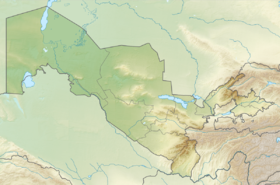

Since ancient times, Miankal Island was the most mastered part of the Zeravshan Valley by humans [2] .
In colloquial terms, Miankal denotes the Zeravshan valley between the cities of Samarkand and Khatyrchi, which, in essence, does not diverge from the first definition [1] [3] [4] . In a broader sense, it is the Zeravshan valley in its middle course.
Content
- 1 History
- 2 History of the Chinese and Kipchaks of Miancal
- 2.1 Miankal uprising
- 3 Interesting Facts
- 4 notes
- 5 Literature
History
In ancient times, the territory of Miankal was known under the names Sogd of Samarkand, Nim Sugd (part of Sogd), Sugdi Khurd (Small Sogd) [1] .
During the conquest of the cities of Maverannahra by the Arabs, Sogd was captured by Kuteiba , the governor of the Umayyads in Khorasan . Ihshid Sogd and his subjects, on the orders of Kuteyba, were to leave Samarkand . As the residence of the subsequent rulers, Sogd Balazuri calls the city of Ishtykhan 7 farces from Samarkand, north of Zeravshan. A district and a city under this name exists to this day in the Samarkand region of Uzbekistan , in the island of Miankal. Nesefi says that ichshid, having left Samarkand, built a new city 4 farces from Samarkand and named him Ferenkent in honor of his brother Afarun. The sources also include the name Afarunkent and Afarinkent. This message about the origin of the city is confirmed in Fichrist, it says that the city of Farankent is populated by Turks and that its inhabitants are partly dualists, partly Christians [5] . During the reign of the Timurids, the city of Afarinkent was the center of the tyumen located in the northern part of Miankal.
After the campaigns of Sheybani Khan to Maverannahr, the Afarinkent tyumen of Samarkand province or region was located entirely on the island. Of the famous governors in the Afarikent Tyumen were Iskander Khan and Abdullah Khan II, who were later chosen by the Khan of the Bukhara Khanate .
Under the rule of the Bukhara Khan Abulfeiiz Khan , an uprising rises here, which later came to Bukhara , which was crushed by an army led by Muhammad Rakhim Khan , who later founded the Uzbek Mangyt dynasty in Bukhara. He introduced the struggle against the separatists from Miankal, the nobility of the Uzbek tribes Bahrin, Kipchak, Keneges and Getty-Urug. The lands of the rebellious clans were confiscated, and the people were resettled closer to Bukhara.
During the Bukhara emirate, Miyankal was the most densely populated and economically developed region of the country, the inhabitants of which were engaged in irrigated agriculture and cattle breeding.
The History of the Chinese and Kipchaks of Miankal
The most numerous tribe of the Miankal valley were the Uzbek tribes of China and Kipchaks. Kitai (Ktai, Kytai, Khitai, Khtai), the descendants of the ancient Khitan , came to the valley of Zeravshan in the XVI century. Kipchaks moved to these places in the 13th century, and according to Pardaev, from the Syr-Darya basin at the end of the 17th - beginning of the 18th centuries [6] . Over the years of joint coexistence, the Chinese and Kipchaks formed a strong military-political alliance. European scholars of the beginning of the 19th century, as well as some local authors of this time, even ranked them as one tribe - the Chinese Kipchaks. According to the testimony of the Russian oriental scientist V. V. Radlov , who visited the Miankal Valley in 1868, the representatives of these tribes themselves answered the question of what kind of family they belonged to, "I am from the Chinese Kipchaks" [7] . However, both tribes had an excellent clan structure, their own war cries (uraniums) and economic activities were carried out separately [8] . The Chinas occupied the territory from Kermine to Kattakurgan . Kipchaks wandered east of them to Samarkand. The number of both tribes by different authors was evaluated differently. Mirza Shems Bukhari brings their number to 120 thousand people [9] .
Miancal Rebellion
In 1821, the largest uprising in Miankal in the 19th century began with the participation of Uzbek tribes and Karakalpaks against the policy of the Bukhara emir. After numerous attempts by Emir Haidar and Prince Nasrullah in 1825, they manage to crush the rebellion. After that, according to Muhammad Mir Alim Bukhari, "the emir began to rule calmly."
Interesting Facts
The name "Miyonkol" is the Uzbek football team representing the city of Kattakurgan .
Notes
- ↑ 1 2 3 National Encyclopedia of Uzbekistan , MYENҚOL. p. 511 in the Uzbek language.
- ↑ Archeology of the USSR from ancient times to the Middle Ages, 1985 , p. 273.
- ↑ Khoroshkhin A.P., Collection of articles relating to the Turkestan Territory, St. Petersburg, 1876, p. 157
- ↑ V.V. Bartold, On the History of Turkestan Irrigation, St. Petersburg, 1914, p. 113
- ↑ V.V. Bartold, Works, Volume 5, Nauka Publishing House, Moscow 1968, pp. 305-306
- ↑ Pardaev K.K. Ethnic and migration processes in Miankale (XVI-XVIII centuries). Historicus article
- ↑ Quoted from an article by V.V. Radlov The average Zeravshan valley. Notes of the Russian Geographical Society for the Department of Ethnography. T. 6. St. Petersburg. 1880, p. 61.
- ↑ Ivanov, 1937 , p. thirty.
- ↑ Notes by Mirza-Shems Bukhari. / About some events in Bukhara, Kokand and Kashgar. / Ed. in the text with per. and note. V.V. Grigoryeva // Kazan: University, 1861.S. 7.
Literature
- Repl. ed. Koshelenko G.A. The oldest states of the Caucasus and Central Asia // Archeology of the USSR from ancient times to the Middle Ages: in 20 tons . - Moscow, 1985. - T. 8. - 496 p.
- National Encyclopedia of Uzbekistan . - Tashkent, 2000-2005. ( Uzbek )
- Pardaev K.K. Ethnic and Migration Processes in Miankale (XVI — XVIII centuries). An article in the journal Historicus;
- V.V. Radlov Middle Zeravshan Valley. Notes of the Russian Geographical Society for the Department of Ethnography. T. 6. St. Petersburg. 1880;
- Trever K.V., Yakubovsky A.Yu., Voronets M.E .: History of the peoples of Uzbekistan, volume 2. - Tashkent: Academy of Sciences of the Ukrainian SSR, 1947. - 517 p.