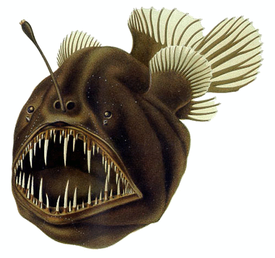
Deep-water anglers constantly live at great depths, 1,500–3,000 m, deep in ocean waters. They are characterized by a spherical, flattened laterally shaped body and the presence of "fishing rods" (in females). The absence of pelvic fins distinguishes them from other anglers. Skin camouflage color - black or dark brown, naked; in several species, it is covered with transformed scales - spines and plaques. Traditionally, in appearance, deep-sea fish are swollen bodies with bulging eyes and ugly forms. In fact, it is not. Deepwater fish take on the appearance of bloated bodies when they are lifted to the surface in fishing nets, due to excessive internal pressure, which amounts to 150-300 atmospheres at depths of 1500-3000 meters.
Anglerfish are distinguished by pronounced sexual dimorphism. Females are much larger than males and are predators, having a large mouth, powerful teeth and a strongly stretching stomach. The first ray of the dorsal fin in females is turned into a “fishing pole” ( illite ) with a luminous “ bait ” (eskoy) at the end. But the most strongly sexual dimorphism is manifested in size. If the length of the females range from 5 cm to 1 m ( Ceratias holboelli ), then the length of the males from 16 mm to 4 cm.
Illyse in females of various species varies in shape and size and can be supplied with various skin appendages. Thus, for example, illitece in the form of Ceratias holboelli is able to move forward and retract into a special channel on the back. Luring prey, this angler gradually moves the luminous bait to his mouth until he swallows his prey. The luminous organ is a gland filled with mucus in which bioluminescent bacteria are enclosed. Due to the expansion of the walls of the arteries supplying the gland with blood, the fish can arbitrarily cause the luminescence of bacteria that need an oxygen supply for this, or stop it, narrowing the vessels. Usually, the glow occurs in the form of a series of consecutive flashes, individual for each species. At the bottom Galateatum ( Galatheathauma axeli ), from a depth of about 3600 m, the glowing "bait" is located in the mouth. Unlike other deep-sea anglers, it hunts, apparently, lying on the bottom.
Adult anglerfish females feed on deep-water fish ( gonostomy , Howliods , hatchets , melamphs, etc.), crustaceans, and less often cephalopods ; males have copepods and bristle maxillaries . The females stomach is able to stretch very strongly, so that they can swallow prey, often surpassing their own size. The gluttony of the anglers sometimes leads to the death of them. We found dead angler fish with swallowed fish, more than double their size. Having captured such a large prey, anglerfish can not release it because of the structure of their teeth and chokes.
Males parasitism
Some families of anglers ( Caulophrynidae , Ceratiidae , Neoceratiidae and Linophrynidae ) have very unusual relationships between the sexes, which are not found among other fish and vertebrates. They are expressed in the fact that dwarf males live in the form of parasites on the body of females. Before the transition to parasitism, males have well-developed eyes and large olfactory organs. This allows them to look for females by the smell of pheromones , traces of which are preserved in almost still water of great depths for a long time. Having approached the female, the male, apparently, visually recognizes her species by the structure of the eski or by the color and frequency of her flashes. Then the male clings to the side of the female with his sharp teeth. Soon it grows together with the female's lips and tongue, and its jaws, teeth, eyes and intestines are reduced so that in the end it turns into a simple appendage that produces sperm. Feeding of the male is carried out due to the blood of the female, since their blood vessels also grow together. On the same female can simultaneously parasitize up to three males. Once attached, they completely lose their independence. The biological significance of this phenomenon, apparently, is associated with the facilitation of the presence of each other by the sexes during reproduction and with the limited food at great depths [4] .
Despite the fact that adult angler fish live in the depths where there are no seasonal changes, all species breed in spring or summer. Spawning occurs at depth. Females sweep millions of small (no more than 0.5—0.7 mm in diameter) eggs, which gradually rise upwards. 2-3 mm long larvae hatch in the surface layer of 30–200 m, where they feed on copepods and bristles. By the beginning of the metamorphosis, the young have time to descend to a depth of over 1000 m. In the layer of 1500–2000 m, the angler fish already live, have passed the metamorphosis and have reached maturity. These vertical migrations are of adaptive importance, since only in the surface layer slow-moving and numerous larvae can find enough food to accumulate reserves for the upcoming metamorphosis.
Larvae of deep-sea anglerfish are found only in the tropical and moderately warm zones of the World Ocean, lying between 40 ° C. sh. and 35 ° S. sh. and limited to summer isotherms of 20 ° C in surface waters. In higher latitudes, including subarctic and subantarctic waters, there are only adult individuals that get there due to their removal by currents.
There are 11 known families, including almost 120 species:
- Caulophrynidae - Caulophrin
- Centrophrynidae - Centrofrin
- Ceratiidae - Ceratia
- Diceratiidae - Diteratia
- Gigantactinidae - Long probe
- Himantolophidae - Himatolophic
- Linophrynidae - Linofrin
- Melanocetidae - melanocete
- Neoceratiidae - Novoceratium
- Oneirodidae - Oneurodovye
- Thaumatichthyidae - Thaumaticht