The house of the playwright Tarnovsky is a monument of cultural heritage of regional significance in Bolshoy Gnezdnikovsky Lane, 3/5, Tverskoy district of Moscow. The history of the house is connected with the name of the playwright Konstantin Augustovich Tarnovsky, in which the mansion became the center of the cultural life of the capital [1] . The building was erected at the end of the 18th - beginning of the 19th centuries on the basis of stone chambers of 1738, expanded twice with wings and built on the third floor [2] [3] .
| Sight | |
| House of playwright Tarnovsky | |
|---|---|
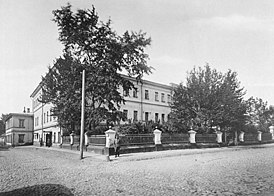 Tarnovsky House in 1913 | |
| A country | |
| Location | Moscow , Bolshoi Gnezdnikovsky per. 3/5, p. 2 |
| Architectural style | Empire |
| Famous inhabitants | Konstantin Augustovich Tarnovsky (1826–1892) |
| condition | Rebuilt |
From the end of the 19th century until the revolution, the mansion belonged to the police department of the Russian Empire , it contained the archive, search , editorial office and printing house of a departmental newspaper. Since 1908, the head was the famous investigator Arkady Koshko [3] [4] .
In 2005-2006, during the construction of the administrative-residential complex in Bolshoi Gnezdnikovsky Lane, Tarnovsky’s house was completely dismantled and rebuilt, a small part of the original brick was partially preserved [3] .
Content
- 1 History
- 1.1 First information
- 1.2 Tarnowski
- 1.3 Further history
- 2 Modernity
- 3 notes
- 4 Literature
History
First Information
Land ownership on the site of the modern Bolshoi Gnezdnikovsky Lane according to the census of 1738-1742 belonged to Chief Secretary Matvey Kozmin [5] . Later, his son, Privy Councilor Sergei Kozmin , bought the neighboring estate of the Vetoshnikov merchants , and then resold the combined plot to the 3rd guild merchant Andrei Dmitrievich Kondikov [6] .
Already in 1830, the documents on the Tarnovsky house said "this house was built for a long time", but information about the first owners was not preserved. It is known that the building survived the fire of 1812 , and it was based on the chambers of the XVII century. Since 1815, the headquarters captain Anna Ogaryova, who leased the building, owned the house. Later, it was bought by a college adviser Mikhail Nikolaevich Eropkin , and the mansion passed from him to his daughter Anna [2] .
Tarnowski
In the middle of the XIX century, the house belonged to Anna Mikhailovna (nee Eropkina) and her husband Peter Alexandrovich Nashchokin . By the order of the new owner, the building was expanded with a two-story extension and redesigned facades in the Empire style . The Nashchokins' daughter Elizabeth was married to the famous metropolitan playwright Konstantin Tarnovsky [7] . He became famous as a writer, translator from French , author of numerous productions for the theater, held a high post of inspector of the repertoire and was one of the founders of the Moscow Artistic Circle [3] . The building went down in history as an outstanding music salon: the Tarnowski constantly hosted evenings where prominent artists were invited, among them were Vasily Zhivokini , Mikhail Schepkin , Glykeria Fedotova , Peter. Tchaikovsky , Nikolai Rubinstein [8] . During this period, the second two-story outbuilding was attached to the mansion [9] .
Further History
In the late XIX - early XX centuries, the building was given to it under the police station, under the guidance of architect Alexander Popov Jr. , the third floor was built on [5] . An address desk, a detective and security bureau, an archive, as well as a printing house and the editorial board of the newspaper Vedomosti of the Moscow City Police , about which Vladimir Gilyarovsky wrote in his book Moscow and Muscovites , were written about the fact that "nobody read this newspaper." At that time, the agency was in a protracted crisis: the number of crimes grew rapidly, and the detection rate was close to zero [3] . To remedy the situation in 1908, the investigator Arkady Koshko, nicknamed the “Russian Sherlock Holmes ”, was appointed the head of the detective department. Under his leadership, over the past five years, the situation in the capital has radically changed - thefts and robberies, the peak of which used to be on holidays, have practically come to naught. To solve crimes, they began to use the method of fingerprinting , they began to entrust the patrol of dangerous areas with special "flying squads" of the city. During this period, from the center of cultural life, the former Tarnovsky mansion became a place where citizens could turn for help, and "the criminals were afraid even to mention the 5/3 house in Gnezdnikovsky" [4] [10] .
After the revolution, the search was abolished by a special decree of the new government . In March 1917, a massacre began in the Bolshoi Gnezdnikovsky - the crowd took out all the archival documents from the building and burned them right in the yard, blocking access to firefighters [3] . Soon the building was given to the Moscow Criminal Investigation Department [3] . During the Stalinist reconstruction of Moscow in the 1930s, the Tarnovsky wing was dismantled. In the 1970s, in the immediate vicinity of the Tarnovsky house, a new building of the Gorky Moscow Art Theater was built [4] .
Modernity
| External Images | |
|---|---|
| The house before the restoration , 2005 | |
| Collapsed Building , 2005 | |
| Historic Masonry , 2005 [4] | |
In the early 2000s, the Tarnovsky house was recognized as an object of cultural heritage of regional importance and received the corresponding protective status. In 2004, the mayor's office issued a permit for repair and restoration work, while examining the structure of the building under the volumes of the 19th and 18th centuries, traces of stone chambers of the 17th century were discovered. Despite the wide resonance in the media and the protests of the architectural community, the building was destroyed. According to the reviews of the construction workers at the Meridge firm, "it fell by itself." In 2008, an administrative-residential complex was erected at the site of a cultural monument, designed by architects Sergei Tkachenko , N. Rybin, O. Dubrovsky, L. Shevchenko [11] [12] . The building resembles the original, however, it differs significantly stylistically, the facades are partially composed of bricks of the original structure [13] .
Notes
- ↑ Vostryshev, 2010 , p. 119.
- ↑ 1 2 Savina, Lyapina, Stepanova, 2012 , p. 196-197.
- ↑ 1 2 3 4 5 6 7 Romanyuk, 2016 .
- ↑ 1 2 3 4 Maly Gnezdnikovsky Lane, d. 5/3. Chronicle of one house (inaccessible link) . The project “Moscow, which is not” (October 11, 2005). Date of treatment October 25, 2018. Archived on April 2, 2015.
- ↑ 1 2 Savina, Lyapina, Stepanova, 2012 , p. 196.
- ↑ Mirzoyan, 2013 .
- ↑ Amphitheater, 2016 , p. 16-19.
- ↑ Vaskin, 2008 .
- ↑ Residential building, XVIII - first half of the XIX century., Rebuilt in the 1890s. (recreation). House of playwright K.A. Tarnovsky, who was often visited by M.S. Schepkin, G.N. Fedotova, P.I. Tchaikovsky, N.G. Rubinstein and many other prominent figures of Russian culture. . Portal “Architectural Monuments of Moscow and the Moscow Region”. Date of appeal October 25, 2018.
- ↑ Cat, 1992 .
- ↑ Wilkinson, 2007 , p. 108-109.
- ↑ Malinin, 2009 .
- ↑ Maly Gnezdnikovsky Lane, d. 5/3. Chronicle of one house (inaccessible link) . Moscow, which is not. Date of treatment March 23, 2015. Archived April 2, 2015.
Literature
- Amphitheaters A.V. From ancient years ... / ed. Surisa A. M .. - Moscow-Berlin: Direct-Media, 2016. - P. 16-19. - ISBN 978-5-4475-8196-1 .
- Vostryshev M.I. Moscow: all streets, squares, boulevards, side streets. - M .: Algorithm , Eksmo, 2010 .-- S. 118-119. - ISBN 978-5-699-33874-0 .
- Malinin N.S. Architecture of Moscow. 1989-2009: A Travel Guide. - M .: Ulei, 2009 .-- S. 380 .-- 400 p. - ISBN 978-5-91529-017-3 .
- Koshko A.F. Essays on the criminal world of Tsarist Russia. Memoirs of the former head of the Moscow detective police and the head of the entire criminal investigation department of the Russian Empire Arkady Frantsevich Koshko. - M .: Capital, 5-7055-1019-5. - ISBN 507055-1019 -5.
- Wilkinson, A. 10 Factors That Threaten Historical Moscow // Moscow Architectural Heritage: The Point of No Return / Ed. Harris E. .. - M .: SAVE Europe's Heritage, 2007 .-- T. 1 . - S. 108-109 .
- Moscow, which is: 100 examples of restoration / I. A. Savin, M. V. Lyapin, E. I. Stepanova. - Moscow: ZAO United Humanitarian Publishing House, 2012. - S. 196—197. - ISBN 978-5-94282-690-1 .
- Romanyuk S.K. Lanes of old Moscow. Story. Architectural monuments. Routes / ed. Yantseva L.I. - Moscow: Centerpolygraph, 2016 .-- 831 p. - ISBN 978-5-227-06422-6 .
- Vaskin A. My dear Nests ... // Literary newspaper. - 2008. - November 19 ( No. 47 (6199) ).
- Mirzoyan G. Moscow Armenian // Noah's Ark: Journal. - 2013. - November 16-30 ( No. 21 (227) ).
- Moleva N. Literary trails of Moscow. - Moscow textbooks and cartolithography, 1997. - S. 91. - 256 p. - ISBN 5-7853-0048-6 .