Siamese cobra [1] (lat. Naja siamensis ) - a species of snakes from the genus real cobras of the family of aspids, living in Southeast Asia.
| Siamese cobra |
 |
| Scientific classification |
|---|
| No rank : | Bilateral symmetrical |
| Infraclass : | Lepidosauromorphs |
| Infrastructure : | Caenophidia |
|
| International scientific name |
|---|
Naja siamensis Laurenti , 1768 |
| Area |
|---|
|
| Security status |
|---|
Vulnerable speciesIUCN 3.1 Vulnerable : 177488 |
|
Content
This is a medium-sized cobra with a rather thin body compared to other cobras. Color varies from gray to brown and black, with white spots or stripes. The white pattern can be so developed that it covers most of the body of the snake. Black and white is widespread in central Thailand, individuals from western Thailand are mostly black, and individuals from other countries are usually brown. The pattern on the hood can be shaped like a spectacle, be shapeless or absent, especially in adults [2] . Adults average 0.9 to 1.2 meters in length [3] and can reach a maximum of 1.6 meters, although very rarely [4] .
This species should not be confused with a monocle cobra ( Naja kaouthia ), living with it in the same range and having a similar size and appearance.
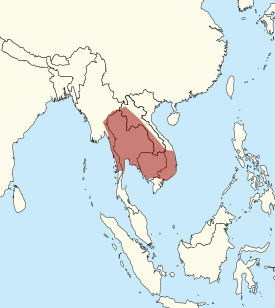
Naja siamensis lives in Southeast Asia, including Thailand, Cambodia, Vietnam and Laos [2] . It is found in a number of landscapes, including lowlands, hills, plains and forests. It is also found in the jungle, and it is sometimes attracted to settlements due to the large populations of rodents in these places [5] .
These are mainly nocturnal snakes [5] . They behave differently depending on the time of day. If a person encounters this snake during the day, it is usually shy and tries to hide in the nearest hole. However, when a person encounters it in the dark, it is more aggressive and more likely to stay in place, having risen and inflated its hood and can spit poison [6] . If the poisonous spit doesn’t work, she may bite. With a bite, she often digs into the victim and, as it were, “chews” it. It feeds mainly on rodents, toads and other snakes [3] [5] .
Naja siamensis is an egg laying snake. The female makes clutches of 13-19 eggs [3] every 100 days. Cubs hatch after 48-70 days depending on the incubation temperature. Offspring become independent from the moment of hatching. The body length of newborns is 12–20 cm and, since they have fully developed poisonous teeth and glands, they should be treated with the same respect as adults [6] .
- ↑ Species of wild fauna and flora falling within the scope of the Convention on International Trade in Endangered Species of Wild Fauna and Flora, restricted to movement across the customs border of the Customs Union (neopr.) . ved.customs.ru. Date of treatment January 26, 2019.
- ↑ 1 2 Wüster, W .; DA Warrell MJ Cox; P. Jintakune; J. Nabhitabhata. Redescription of Naja siamensis Laurenti, 1768 (Serpentes: Elapidae), a widely overlooked spitting cobra from Southeast Asia: geographic variation, medical importance and designation of a neotype. (English) // Journal of Zoology : journal. - Wiley-Blackwell 1997. - Vol. 243 . - P. 771-788 . - DOI : 10.1111 / j.1469-7998.1997.tb01975.x . Archived December 20, 2016.
- ↑ 1 2 3 O'Shea, Mark. Venomous Snakes of the World. - United Kingdom: New Holland Publishers (UK) Ltd., 2005 .-- P. 94. - ISBN 0-691-12436-1 .
- ↑ Naja siamensis - General Details, Taxonomy and Biology, Venom, Clinical Effects, Treatment, First Aid, Antivenoms (neopr.) . WCH Clinical Toxinology Resource . University of Adelaide. Date of treatment January 14, 2012.
- ↑ 1 2 3 Naja siamensis (neopr.) . Armed Forces Pest Management Board . United States Department of Defense. Date of treatment January 14, 2012. Archived January 11, 2012.
- ↑ 1 2 O'Shea, Halliday. Reptiles and Amphibians. - California, USA: Topeka Bindery, 2002. - ISBN 0-613-53093-4 .

