The Battle of Magersfontein ( Battle of Magersfontein ) is one of the key battles during the Second Boer War , which occurred on November 29 ( December 11 ), 1899 near the farm within the former Orange Republic , at the junction of roads from Jacobsdal and de Aara at Kimberley. Two groups of hills are located to the west of Magersfontein, of which the closest is named after the farm, and the more remote group is called the Spitfontein Heights.
| Battle of Magersfontein | |||
|---|---|---|---|
| The main conflict: Second Boer War | |||
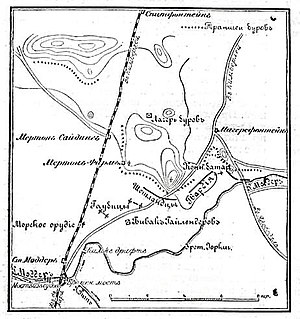 Battle pattern | |||
| date of | November 29 ( December 11 ), 1899 | ||
| A place | South Africa] | ||
| Total | The victory of the Boers | ||
| Opponents | |||
| |||
| Commanders | |||
| |||


Content
- 1 Background
- 2 battle
- 3 Summary
- 4 notes
- 5 Literature
- 6 References
Background
After a battle on the General Coos de la Rey , despite the successes achieved, had to retreat to Spitfontein positions for strategic reasons; Pete Arnold Cronier arrived with 1,500 drills and 4 guns, taking over the general command of the troops; the strength of the Boers reached 4-5 thousand people, with 6 artillery pieces [1] .
At the Spitfontein heights, the main forces of the Boers were located, and at the Magersfontein heights, posts and small advanced units were put up. The main position of the Boers intercepted the railway to Kimberley. Convinced that the British could not move away from the railway, Cronier calmly awaited them in their positions, taking no action and confined himself to sending 1,000 people to Jacobsdal, Commander Prinsloo, who approached Graspan Station on November 26 ( December 8 ), 1899 , attacked two her English company, destroyed the railroad track and withdrew with the arrival of reinforcements to the British [1] .
The English division of Lord Paul Sanford Matthew , located at Modder Station, reached a strength of 12,000 with 29 guns. On November 27 ( December 9 ), 1899, the British brought a 4.7-inch naval gun 9,000 meters to the Magersfontein heights and fired at them with rare fire, which the Boers did not respond to. November 28 ( December 10 ), 1899 in the afternoon, the British artillery, approaching 4.800 meters to the same heights, heavily bombarded them for two and a half hours; the Boers again did not answer and did not appear [1] .
In the evening of November 28 ( December 10 ), 1899, Matthewen ordered the attack at dawn on November 29 ( December 11 ), 1899, by the Scottish brigade of the Maghersfontein Upland, with the artillery supporting the attackers, opening fire as soon as possible, and with the guards, infantry and cavalry, the brigades were ordered to speak at night to cover the rear and right flank of the Scots. The 9th brigade was left to cover the camp. The Scottish brigade in closed columns, not having a vanguard ahead, marched at half past one in the pouring rain, in pitch darkness. The direction to the Magersfontein Upland was kept by compass , and the hour of the performance was calculated so as to approach the positions at dawn at about half past three in the morning. Detailed orders were given in advance regarding the deployment of combat order, and places were indicated for all units [1] .
Battle
The column was late due to darkness and it was only about 4 o’clock in the morning, at the first glimpses of the dawn, that it approached the sole of the Magersfontein Heights, where the deployment to battle formation was to begin; but at that moment the Boers unexpectedly opened strong rifle fire, from about two hundred meters, from the trenches, the existence of which the British did not suspect. The head battalion rushed back in disarray to the remaining units, which they carried away with them; the brigade commander, General Yoshon, fell mortally wounded. Several officers managed to gather people and make an unsuccessful attempt to master the trenches, to which they approached 50 meters, but were soon forced to move back 450-500 meters and lay down, hiding behind the bumps in the terrain. Frustrated and shocked, the Scottish brigade was not able to continue the offensive [1] .
English artillery opened fire only when the Scots were already thrown back, with the mortar battery located 3,500 meters from the Maghersfontein height, three mobile batteries were located outside the center of the Scottish brigade, and the 4.7-inch gun did not change its place. General Colville, with units intended to cover the right flank of the main attack, marched at midnight and reached his destination without interruption in the morning (between the Magersfontein High and the Modder River), where he was ordered by Matthew to stop and send everything that was possible to the support of the Scottish Brigade perhaps. Colville decided to support the Scots only with the regiment from the reserve and two companies from the battle line, which, of course, could not have a significant impact on the course of the matter. At noon, Matthew ordered the Scots to be supported by the Glendon Highlanders Battalion, which was under cover of the convoys; This battalion went on the attack at the position of the Boers in half-battalion columns and also failed [1] .
Meanwhile, the Boers, having received reinforcements from Spitfontein, began to bypass the Scots right flank for about 13 hours and forced them to retreat beyond the fold of terrain that was 500 meters behind; here the Scots lasted until the night. Boer artillery began to operate only at about half past five in the evening, firing at the English charging boxes. Such a late opening of artillery fire is explained by the fact that the Boers did not have artillery at the Magersfontein position, which, however, was occupied only by small detachments advanced forward. With the onset of darkness, the battle ceased. The Scottish brigade was arranged under the guise of a guard brigade; units staged a bivouac at the battlefield. The Boers did nothing to prevent the retreat of the British [1] .
The next morning, Matthewan was convinced that the Boers had not cleared their positions, and decided to retreat. During this retreat, the Colville brigade came under fire from enemy artillery. The entire division of Matthewn returned to the camp at Modder River [1] .
In this battle, the British lost: 23 officers and 182 lower ranks were killed, 45 officers and 645 lower ranks were wounded and 76 soldiers were missing; the Scottish brigade was the most affected, with losses of about 85% of its personnel and which lost half of its officers [1] .
Summary
The battle at Magersfontein had a great influence on the entire course of the further operations of the British, since they were not able to continue the attack on Kimberley and had to stand for two months in view of the heights at which they suffered this failure. On the other hand, this victory did not bring much benefit to the Boers, because, instilling in them confidence in their invincibility and the weakness of the British troops, they led to the fact that they did not take any measures to counter the maneuver of the British troops, as a result of which at the beginning February 1900, they were forced not only without haste to hastily withdraw from their impregnable positions at Magersfontein, but even to lift the siege of Kimberly [1] .
On the tactical side, the mistakes of the British are interesting: a blind commitment to the use of nightly maneuvers, which, being necessary in a well-known area, should have been used only as a last resort; after the failure of the Scottish Brigade, partial and fragmented strikes in small parts and at the same time in the same position; lack of coordination between artillery and infantry and lack of communication between them; non-compliance with the security measures of maneuvering units at night, which was the main reason for the defeat of the British troops at Magersfontein [1] .
Notes
- ↑ 1 2 3 4 5 6 7 8 9 10 11 Magersfontein // Military Encyclopedia : [in 18 vol.] / Ed. V.F. Novitsky [et al.]. - SPb. ; [ M. ]: Type. t-va I. D. Sytin , 1911-1915.
Literature
- The Anglo-Transvaal War. Notes by General Villebois de Mareil. SPb.
- Vinogradsky A. The Anglo-Boer War in South Africa (Issue II, 1902).
- "The war of the British with the Boers." Compiled by the French General Staff. Translation by N. Bolotov .
- Fr Maurice . History of The war in South Africa, 1899-1902, 1906 (English) .
Links
- The Battle of Magersfontein Neopr . BritishBattles.com. (eng.) .
- Laffin, John . Brassey's Battles: 3,500 Years of Conflict, Campaigns and Wars from AZ. London: Brassey's Defense Publishers. p. 150 (1986). ISBN 0080311857 .