Earl of Oxford is one of England 's oldest earl titles. For five and a half centuries, this title was owned by representatives of the house de Vere ( English de Vere ). The most famous title holder was probably Edward de Ver, 17th Earl of Oxford , who has been in popular culture since the 20th century. attributed to the authorship of the works of William Shakespeare . Until January 16, 2011, the title of Earl of Oxford and Asquith belonged to Julian Asquith (1916–2011), grandson of British Prime Minister Herbert Henry Asquith . After the death of Julian Asquith, the title passed to his eldest son Raymond Asquith (born 1952).
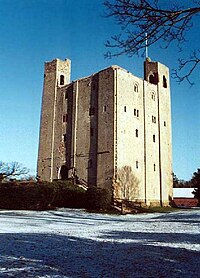
The Earls of Oxford from the de Vere clan were the Earls of Normandy Headingham Castle in Essex . The headquarters of the modern Earls of Oxford and Asquith is located in Frome , Somerset .
Oxfords of the de Ver family did not have secondary titles, and the fictitious designations “Lord Ver” and “Viscount Balbek” were used as the courtesy title of the heirs. The Earls of Oxford and Asquith use the courtesy title Viscount Asquith, a minor title awarded to Henry Asquith before the Earl.
Content
- 1 Title History
- 2 List of Counts of Oxford
- 3 List of Counts of Oxford and Counts of Mortimer
- 4 List of Counts Oxford and Asquith
- 5 Links
Title History
The title of Earl of Oxford was established in 1141 by Empress Matilda for Aubrey de Vera , the son of one of her supporters during the civil war in England from 1135-1154. After the accession to the English throne of Henry II Plantagenet, Aubrey de Vera's right to this title was confirmed in 1156, and until 1703 representatives of the de Vera family continued to wear it. In the hereditary possession of the Earls of Oxford was also the post of Lord of the great chamberlain , one of the highest court posts in England. Earls of Oxford from the end of the fourteenth century played leading roles in the political life of the country. Thus, Robert de Ver, the 9th Earl of Oxford (1362–1392), was a favorite of King Richard II and the first in England to hold the title of Marquis and Duke , not belonging to the royal family. During the War of the Scarlet and White Roses, the Earls of Oxford were among the most loyal supporters of the Lancaster and contributed greatly to the victory of Henry VII and the establishment of the Tudor dynasty in England. Under Elizabeth I, Edward de Ver, the 17th Earl of Oxford (1554–1604), a talented poet, playwright and patron of the arts, whom in the 20th century became famous, became famous. popular authorship began to be attributed to the works of William Shakespeare .
The male line of the House of De Verov was suppressed in 1703. In 1711, the new title of Earl of Oxford and Earl of Mortimer was established in the British title system, which was granted to Robert Harley , a prominent statesman of the early 18th century, speaker of parliament and leader of the English Whigs . The descendants of Robert Harley continued to wear this title until 1853.
In 1925, the title of Earl of Oxford and Asquith , who now bears his great-grandson, was established for the former British Prime Minister Herbert Henry Asquith , who led the country during the First World War . The double form of the official title is explained by the fact that distant descendants of the house of de Ver opposed the appropriation of the title of Earl of Oxford to a man who is not related to de Vera. As a compromise, the king instituted a new double title in the United Kingdom title system. In everyday life, however, Asquiths are usually referred to simply as Earls of Oxford.
Oxford Count List
- Aubrey de Ver, 1st Earl of Oxford (c. 1110–1194);
- Aubrey de Ver, 2nd Earl of Oxford (d. 1214), son of the previous;
- Robert de Ver, 3rd Earl of Oxford (d. 1221), brother of the previous;
- Hugh de Ver, 4th Earl of Oxford (c. 1208–1263), son of the previous;
- Robert de Ver, 5th Earl of Oxford (1240–1296) (title confiscated in 1265, restored soon after confiscation), son of the previous one;
- Robert de Ver, 6th Earl of Oxford (1257–1331), son of the previous;
- John de Ver, 7th Earl of Oxford (1312–1360), nephew of the previous one;
- Thomas de Ver, 8th Earl of Oxford (1337–1371), son of the previous;
- Robert de Ver, 9th Earl of Oxford (1362–1392) (title confiscated in 1388), son of the previous one;
- Aubrey de Ver, 10th Earl of Oxford (1340-1400) (title restored in 1393), uncle of the previous;
- Richard de Ver, 11th Earl of Oxford (1385-1417), son of the previous;
- John de Ver, 12th Earl of Oxford (1408-1462), son of the previous;
- John de Ver, 13th Earl of Oxford (1442-1513) (title confiscated in 1475, restored in 1485), son of the previous one;
- John de Ver, 14th Earl of Oxford (1457-1526), nephew of the previous one;
- John de Ver, 15th Earl of Oxford (1482-1540), cousin of the previous one;
- John de Ver, 16th Earl of Oxford (1516-1562), son of the previous;
- Edward de Ver, 17th Earl of Oxford (1550-1604), son of the previous;
- Henry de Ver, 18th Earl of Oxford (1593-1625), son of the previous;
- Robert de Ver, 19th Earl of Oxford (1575-1632), cousin of the previous;
- Aubrey de Ver, 20th Earl of Oxford (1627–1703), son of the previous one.
List of Counts of Oxford and Counts of Mortimer
- Robert Harley, 1st Earl of Oxford and Earl of Mortimer (1661-1724);
- Edward Harley, 2nd Earl of Oxford and Earl of Mortimer (1689-1741), son of the previous;
- Edward Harley, 3rd Earl of Oxford and Earl of Mortimer (1699-1755), cousin of the previous;
- Edward Harley, 4th Earl of Oxford and Earl of Mortimer (1726-1790), son of the previous;
- Edward Harley, 5th Earl of Oxford and Earl Mortimer (1773–1849), nephew of the previous one;
- Alfred Harley, 6th Earl of Oxford and Earl of Mortimer (1809-1853), son of the previous.
List of Counts Oxford and Asquith
- Herbert Henry Asquith, 1st Earl of Oxford and Asquith (1852-1928);
- Julian Edward George Asquith , 2nd Earl of Oxford and Asquith (1916–2011), grandson of the previous one.
- Raymond Benedict Bartholomew Michael Asquith , 3rd Earl of Oxford and Asquith (born 1952), eldest son of the previous.