The Airborne Army (abbreviated as the Airborne Forces ) is an association of airborne troops found in the armed forces of states in past historical stages.
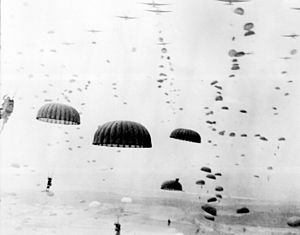
Landing formations of the 1st Allied Airborne Army
History
Throughout military history, airborne armies were created only four times, of which three associations were created during the Second World War . In this case, for its intended purpose (the implementation of operational and strategic tasks behind enemy lines), only one association was used. The remaining associations performed combat missions as ordinary field troops [1] .
Germany
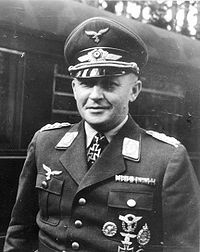
The first airborne army in military history was created in the Third Reich in November 1943, by order of the Luftwaffe Commander Hermann Goering , as the 1st Parachute Army ( German: 1. Fallschirm-Armee ).
Initially, the army included the 1st and 2nd parachute (airborne) corps ( German. Fallschirmkorps ), into which 8 parachute divisions and the Luftwaffe armored division Hermann Goering ( German Luftwaffen-Panzer-Division Hermann) Göring " ) [1] .
The management of the association was created in France in Nancy from November 5, 1943 to April 1, 1944. The basis for the creation of the army headquarters was the management of the 11th air corps . After the allies landed in Normandy , the 1st Parachute Army was transferred to the Wehrmacht Supreme Command . Since September 1944, the 1st Parachute Army took part in the hostilities as an association of ground forces [2] .
The union ceased to exist with the declaration of surrender on May 8, 1945.
The composition of the 1st Parachute Army was constantly changing. Only parts of the army set remained unchanged in the army [3] .
At different times, the commanders of the 1st Parachute Army were [3] :
- Colonel General Kurt Student - March - November 18, 1944;
- Parachute General Alfred Schlemm - November 18, 1944 - March 20, 1945;
- Infantry General Gunter Blumentritt - March 20 - April 10, 1945;
- Colonel General Kurt Student - April 10 - April 28, 1945.
- Infantry General Erich Straube - April 28 - May 8, 1945. He surrendered the association.
UK and USA
Lewis G. Brirton
Commander of the 1st Allied Airborne Army
on November 1944
Since the spring of 1944, the military leadership of Great Britain and the United States realized the need for an early opening of the Second Front . The main reason for this was the confident offensive of the Red Army in Europe on all fronts, which threatened to increase the zone of post-war influence of the USSR in the territories liberated from the Third Reich. In this regard, the joint Anglo-American command began planning the large strategic operation Overlord . The operation itself was the landing of allied troops from transport ships on the English Channel and the airborne landing on the territory of the province of Normandy (northern France). During this operation, which took place on June 6, 1944, a large landing force (13,000 men) was made from 2 US Airborne divisions.
For the next major operation planned for the second half of September 1944, during which it was supposed to land an airborne assault on the territory of Holland and Germany, it was decided to jointly engage the airborne troops of Great Britain and the USA.
The airborne landing was planned to be carried out in two ways: by parachute throwing and landing on gliders . For the implementation of the airborne assault were involved 3 airborne divisions of the US Army and 2 airborne divisions of the United Kingdom [1] . The American divisions were reduced to the 18th airborne corps [4] . British formations were consolidated in the 1st Airborne Corps . Subsequently, the British Corps was supplemented by the , , and the Special Operations Brigade (SAS) , which included, in addition to the British, Belgian and French regiments. The 52nd Infantry Division was trained to land in gliders [5] .
In order to control the troops participating in the airborne assault, the Allied command decided to create ( eng. First Allied Airborne Army ). To deliver and ensure the landing of the allied forces (about 35,000 military personnel), the Allied Command allocated over 2,300 transport aircraft and 2,600 gliders.
On August 2, 1944, by order of the commander of the Allied Forces, Colonel General Dwight Eisenhower , the 1st Allied Airborne Army was created. Lieutenant General was appointed commander of the airborne army, who had previously commanded the 9th Air Army [6] [7] .
After the Dutch operation, the formations of the 1st Allied Airborne Army were brought in for the Ardennes operation and the Rhine Airborne Operation .
At the end of hostilities on May 20, 1945, the 1st Allied Airborne Army was disbanded [7] .
USSR
In the history of the USSR Armed Forces , the airborne army was first created during the Great Patriotic War , and the second time in the post-war years [8] .
Airborne Army (1st formation)
During the years of World War II, numerous reforms were carried out to create and reform the airborne assault formations. Initially, from February 1941, a corps organization of troops was proposed, in which the Airborne Forces were represented by several airborne corps , which consisted of 3 airborne brigades . With the outbreak of hostilities, a reform was carried out on the transfer of troops to a divisional structure in which the created airborne brigades were reorganized into parachute airborne regiments, and the control of the airborne corps became the control of the airborne divisions [2] .
The difficult situation on the fronts forced the command of the Red Army to turn all the created airborne divisions, which were intended for airborne offensive operations, to reorganization into rifle divisions for defense on different sections of the fronts.
With a turning point in the situation on the fronts and a general transition from defense to an offensive on all fronts, the leadership of the Red Army again returned to the idea of conducting large airborne offensive operations. The main reason for this was the positive result of the landing of the allied forces in Normandy on June 6, 1944. In July 1944, the creation of new airborne divisions began.
On August 9, 1944, the Resolution of the State Defense Committee on the creation of 3 guards airborne corps based on rifle corps with the preservation of the general military serial number of the formation was issued. Unlike the previously created buildings, consisting of brigades, the new buildings had a divisional organization. Each corps consisted of 3 divisions, which in turn consisted of 3 brigades and parts of the division set.
On October 4, 1944, the State Defense Committee issued Decree No. 6650ss on the “Introduction of the Red Army Airborne Forces into the Long-Range Aviation (ADD) and Submission to the ADD Commander”. According to the decree, for more operational control of the airborne troops of the Red Army, all 3 guards airborne corps were brought into the Separate Guards airborne army (OGVDA). The OGVDA Directorate was created on the basis of the 7th Army of the Karelian Front. The commander of the army was appointed deputy commander of the Airborne Forces of the Red Army, Major General I. Zatevakhin. [8]
On December 8, 1944, an order was issued to reform the OGVDA until February 15, 1945, into the 9th Guards Army . During the transformation, all airborne divisions became rifle divisions, and brigades in their composition became rifle regiments. During the reorganization, Colonel General V. Glagolev was appointed commander . By February 27, the 9th Guards Army in full force was sent to the 2nd Ukrainian Front .
Airborne Army (2nd formation)
With the end of hostilities in the Great Patriotic War, in 1945-1946, a gradual transformation of the remaining airborne divisions into rifle divisions began. Only 3 airborne brigades and 1 training airborne regiment remained subordinate to the Airborne Forces Directorate, which was part of the USSR Air Force.
At the beginning of 1946, formations of the 9th Guards Army, the successor of the OGVDA, were redeployed to the territory of the USSR.
On June 3, 1946, a Decree of the Council of Ministers of the USSR was issued according to which the Airborne Troops were withdrawn from the Air Force and included in the composition of the reserve forces of the Supreme High Command with direct subordination to the Minister of the Armed Forces, with the establishment of the post of Commander of the Airborne Forces.
To create new formations of the Airborne Forces, the departments of the 8th, 15th, 37th, 38th and 39th Guards Rifle Corps were involved. All guards rifle divisions that were part of them (76th, 98th, 99th, 100th, 103rd, 104th, 105th, 106th, 107th and 114th) were reorganized into guards airborne divisions with the preservation of military numbers, honorary titles and military awards. Of the 5 hulls, 3 hulls had previously been airborne (37th, 38th and 39th).
The difference from the period of the Great Patriotic War was the inclusion in the composition of the Airborne Forces of the formations and units of military transport aviation:
- 5 aviation transport divisions (1st ATD, 12th ATD, 281st ATD, 3rd Guards ATD and 6th Guards ATD);
- 4th aviation glider regiment;
- 45th separate aviation training glider regiment;
- 37th separate aeronautical regiment;
- 60th separate aviation technical regiment.
On December 31, 1948, the Order of the Minister of Defense of the USSR No. 0048 on the transformation of the Airborne Command into the Separate Guards Airborne Army was issued. The OGVDA was re-created 4 years after the abolition of the same association of the Great Patriotic War.
The OGVDA included all the formations of the airborne troops except the 1st Air Transport Division and the 37th Guards Airborne Corps deployed in the Far East. On the basis of the Directive of the Chief of the General Staff on October 24, 1950, separate special-purpose companies (in the future, GRU Special Forces military units) were formed at each building of the OGVDA [9] .
In different years, the OGVDA (2nd formation) commanded:
- Colonel General of Aviation Rudenko S.I. - from January to September 1949;
- Colonel General A. Gorbatov - from September 1949 to April 1953.
In April 1953, by a resolution of the Council of Ministers and the Ministry of Defense of the USSR, the Directorate of Internal Affairs was abolished and reorganized into the Directorate of Airborne Forces [8] .
Notes
- ↑ 1 2 3 Collective of authors. article “Army (operational association)” // Military Encyclopedia / Ed. I.N. Rodionova . - M .: Military Publishing , 1994. - T. 1. - S. 248-249. - 639 p. - 10,000 copies. - ISBN 5-203-01655-0 .
- ↑ 1 2 Feskov V.I., Golikov V.I., Kalashnikov K.A. "The Red Army in the victories and defeats of 1941-1945." / Ed. Chernyak, E. I. .. - Tomsk: Publishing House of Tomsk University, 2003. - P. 83–84, 572, 577. - 631 p. - ISBN 5-7511-1624-0 .
- ↑ 1 2 3 Zalessky K. A. article “The First Parachute Army” // “Luftwaffe. Air Force of the Third Reich. " - M .: Eksmo, 2005 .-- S. 361-362. - 736 p. - 5,000 copies. - ISBN 5-699-13768-8 .
- ↑ 1 2 Blair Clay. Ridgway's Paratroopers - The American Airborne in World War II. - New York: The Dial Press, 1985. - S. 508-525. - 573 p. - ISBN 0-385-27888-8 .
- ↑ 1 2 Barry Gregory. British airborne troops 1940-1945. - London: The Book Service Ltd, 1974. - 161 p. - ISBN 0-385-04247-7 .
- ↑ Nenakhov Yu. "Special Forces in the Second World War." - Minsk: Harvest, 2000 .-- S. 74-78. - 736 p. - ISBN 985-13-0024-1 .
- ↑ 1 2 Monograph by John C. Gwinn “Scratched: World War II Airborne operations that never happened” . www.dtic.mil. Date of treatment November 16, 2018.
- ↑ 1 2 3 4 5 Shaikin V. I. “The History of Creation and the Development Path of the Airborne Troops”. - Ryazan : Printing house of the Russian Military High School of Internal Affairs, 2013 .-- S. 69–74, 88–97. - 299 p. - ISBN UDC 355.23 BBK C 4.6 (2) 3 W17.
- ↑ Feskov V.I., Golikov V.I., Kalashnikov K.A., Slugin S.A. Chapter 6.1 “Airborne troops of the Soviet army” // “Armed Forces of the USSR after the Second World War: from the Red Army to the Soviet. Part 1: Ground Forces ".. - Tomsk: Publishing House of Tomsk University, 2013. - S. 234-260. - 640 s. - ISBN 978-5-89503-530-6 .
See also
- Army (association)