Salangana-algae eater ( Latin: Aerodramus fuciphagus ) - a species of bird family swifts .
| Salangana Algae Eater | |||||||||||||||||||||||||||||||||||||
 | |||||||||||||||||||||||||||||||||||||
| Scientific classification | |||||||||||||||||||||||||||||||||||||
|---|---|---|---|---|---|---|---|---|---|---|---|---|---|---|---|---|---|---|---|---|---|---|---|---|---|---|---|---|---|---|---|---|---|---|---|---|---|
| |||||||||||||||||||||||||||||||||||||
| International scientific name | |||||||||||||||||||||||||||||||||||||
Aerodramus fuciphagus ( Thunberg , 1812 ) | |||||||||||||||||||||||||||||||||||||
| Area | |||||||||||||||||||||||||||||||||||||
| |||||||||||||||||||||||||||||||||||||
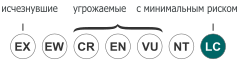
| Security status | |||||||||||||||||||||||||||||||||||||

Content
Description
A medium-sized swift with a forked tail . The plumage from above is mostly homogeneous black-brown, glossy, with some subspecies the sides are slightly gray. The throat is gray; the rest of the plumage is brownish-gray below. The inside of the wing is blackish. Feathering on the legs is absent, or it is very small [1] . The tail cut depth is shallow [2] - 10–19 % of the tail length, while the black-nested salangana ( Aerodramus maximus ) and Aerodramus salangana are even less - up to 13% [1] . Subspecies A. f. inexpectatus is on average slightly less than nominal, but similar to plumage, A. f. dammermani is paler than nominal, while in A. f. perplexus is clearly visible purple shine of primary fly and tail feathers [1] .
Subspecies A. f. fuciphagus , A. f. vestitus and A. f. perplexus are capable of echolocation [1] , with the help of which they navigate in dark caves [2] . Subspecies A. f. micus and A. f. dammermani constantly repeat "rree-deew". There is no documented description of the sound signals of other subspecies [1] .
Distribution
Salangana algae eater lives on the Andaman and Nicobar Islands in India, as well as on the Lesser Sunda Islands [3] . Abundance on the Andaman Islands is higher than on the Nicobar Islands [2] . The species is widespread on the islands of Flores and Timor , but usually nests in Wallace . Birds fly far above the sea and can travel through it between the islands [1] . However, they do not carry out seasonal migrations and lead a sedentary lifestyle [1] [4] .
According to the International Union for Conservation of Nature (IUCN) , the area of salangana-algae eater is 8,910,000 km² and includes the territory of such countries as Brunei , Cambodia , China , India , Indonesia , Malaysia , Myanmar , the Philippines , Singapore , Thailand , East Timor , Vietnam [4 ] , however, unlike the International Union of Ornithologists [4] , IUCN includes both subspecies of edible salangana ( Aerodramus germani ) in this taxon [3] .
Salangana algae eater has a diverse habitat from open spaces to forests and from coast to inland areas. Altitude varies from zero to 2800 meters in Sumatra . A decrease in the number of nests in many areas indicates a decrease in the population of this species [1] . Despite the decline in numbers, the International Union for Conservation of Nature classifies algal eater salangana as the least worrisome species [4] .
Nutrition
Salangana algae eater feeds on flying insects . Birds often gather in large flocks, including representatives of their species, as well as other swifts and swallows [1] .
The excrement of the inhabitants of the upper tiers of the cave, including swifts and bats, supports the development of animals that seek food on the lower tiers. The latter, in turn, are eaten by snakes and giant carnivorous grasshoppers, also hunting chicks. A closed ecosystem has only one exit: birds and bats, which bring nutrients to the cave [2] .
Reproduction
The breeding season varies greatly: in the Andaman and Nicobar Islands it falls on March-April, on the islands in the northern part of the Flores Sea (sea) - in early December [1] .
Birds form nesting colonies deep in caves or similar structures [1] . The nest is attached to the wall of the cave and is made of opaque saliva with very rare impurities [1] . Salangans use a large amount of saliva to build a nest, while nests of algae-algae eater are almost completely built from saliva [5] , during the breeding season they remain soft and moist and have a white color [2] . The construction of the nest takes 39–55 days (according to other sources, about 20 days [6] ), its dimensions are 65–69 by 30–38 mm. One socket can be used for three consecutive broods [1] .
With an interval of three days, the birds lay two dull white eggs (sometimes one) measuring 19.6–20.6 by 12.8–13.4 mm and weighing 1-2 g. The incubation period is 25.5 days for the first egg and 22.5 days for the second, another 43 days the parents feed the chicks. Being on the nest of the bird emits a lot of soft mournful sound signals “wee-we-we-wee-wee ...”, dry “chi-chit”, as well as a series of quick clicks. The probability of success of the clutch is 49%, that is, 0.9 chicks on average survive in each clutch [1] . Studies in Malaysia showed that birds on average lay almost the same number of eggs during the first, second, and third clutches [5] , but repeated laying is usually less successful [1] .
A female can lay eggs on average for five years [4] .
Human Interaction
Salangana algae eater is one of four species of birds whose nests are edible (others are Aerodramus germani , Aerodramus maximus and Aerodramus unicolor ) [6] , they are elements of traditional Chinese medicine , and also are part of the soup. For medical purposes, bird nests have been used for centuries, it is believed that they reduce the risk of disease and contribute to longevity. The main ingredients of an edible bird's nest are sialic acid - 9%, galactosamine - 7.2%, glucosamine - 5.3%, galactose - 16.9%), fructose - 0.7%, amino acids ( aspartic , glutamic , proline , threonine , valine ) and mineral salts (mainly sodium and calcium). Scientific evidence of the medical efficacy of edible bird nests is still limited [6] .
Nests of pure white color without impurities collected during the breeding season are considered especially valuable [6] . Nests are collected from the walls of caves [2] . It is believed that during the harvest in only one cave in the 1950s, more than 500 thousand eggs and chicks were lost. On the Nicobar Islands, 35 caves breed from 1244 to 1791 pairs; according to some estimates, in 1987-1995, the number of birds decreased by 85% on this island [1] . Recent studies have shown that it is possible to organize collection of nests in such a way that damage from it will be significantly reduced. Estimated restrictions include collecting nests twice a year: when only 10-15% of the nests have eggs and the second - when the chicks of the second clutch flew out of the nest [1] .
Birds can nest in purpose-built structures in close proximity to urban development. Nests can be built on harvested sites twice a season [1] . In Southeast Asia, including Vietnam , Indonesia, and Thailand , nest packers began to build structures on which birds could build their nests. Various birds are attracted to such nests, including those whose nests are inedible. Producers destroy such nests with eggs in order to eventually obtain bird colonies that produce the “right” nests. Moreover, such nests are still rated lower than nests from caves [2] .
Systematics
The species was first described by the Swedish naturalist Karl Peter Tunberg in 1812 on the basis of a specimen obtained on the island of Java . It was originally attributed to swallows and received the name Hirundo fuciphaga [1] . For a long time belonged to the genus Salangan ( Collocalia ). In 1970, the South African ornithologist divided the genus into three groups, one of which - Aerodramus (from the Greek. Αερος - "air", Greek. Δρομος - "racer" [7] ) - included unshiny swifts capable of to echolocation [8] . At different times, this species was combined with other taxa, in particular with the Mauritian salangana ( Aerodramus francicus ) and Aerodramus unicolor . Some scientists also refer to this species as Aerodramus salangana aerophilus . The closest related taxon is Aerodramus vanikorensis amelis , with which the species is combined into a subspecies, with the greatest connections being observed in subspecies A. f. perplexus [1] .
Some scientists also include in this taxon the edible salangana ( Aerodramus germani ), divided into two subspecies. Nominal subspecies A. g. german (Oustalet, 1876) lives on the coast from Hainan Island in the west, along the Malacca Peninsula, including the Miei archipelago located south of Myanmar, the northern coast of Kalimantan , the western Philippines from the island of Palawan to the islands of Panay and . Subspecies A. g. amechanus (Oberholser, 1912) - on the Anambas archipelago southeast of the Malacca peninsula. [1] .
At present, algal eater salangana is referred to the genus Aerodramus of the Swine family [1] [3] . The International Union of Ornithologists identifies six subspecies [3] :
- Aerodramus fuciphagus inexpectatus ( Hume , 1873) - Andaman and Nicobar Islands.
- Aerodramus fuciphagus vestitus ( Lesson , 1843) - the islands of Sumatra, Belitung and Kalimantan (except for the northern shores).
- Aerodramus fuciphagus perplexus ( Riley , 1927) - Deravan Islands northeast of Kalimantan.
- Aerodramus fuciphagus fuciphagus (Thunberg, 1812) - Java, Kangean and Bali , the western part of the Lesser Sunda Islands to Sumbawa . Some scientists distinguish the subspecies Aerodramus fuciphagus bartelsi as part of the nominal [1] .
- Aerodramus fuciphagus dammermani ( Rensch , 1931) - Flores island in the central part of the Lesser Sunda Islands . Private scientists refer to the nominal subspecies.
- Aerodramus fuciphagus micans ( Stresemann , 1914) - Sumba , Sava and Timor in the central part of the Lesser Sunda Islands . Private scientists refer to the nominal subspecies.
Notes
- ↑ 1 2 3 4 5 6 7 8 9 10 11 12 13 14 15 16 17 18 19 20 21 22 23 HBW Alive: Edible-nest Swiftlet .
- ↑ 1 2 3 4 5 6 7 Edible-nest Swiftlet . Birds and birding in india . Date of treatment November 17, 2018.
- ↑ 1 2 3 4 Gill F. & Donsker D. (Eds.): Owlet-nightjars, treeswifts, swifts . IOC World Bird List (v9.2) (June 22, 2019). doi : 10.14344 / IOC.ML.9.2 .
- ↑ 1 2 3 4 5 Aerodramus fuciphagus (English) . The IUCN Red List of Threatened Species .
- ↑ 1 2 HBW Alive: Family Apodidae , Breeding.
- ↑ 1 2 3 4 Shun Wan Chan. Review of Scientific Research on Edible Bird's Nest (English) (2006). Date of treatment November 17, 2018.
- ↑ Jobling JA The Helm Dictionary of Scientific Bird Names. - London: A&C Black Publishers Ltd, 2010 .-- P. 77. - 432 p. - ISBN 978-1-4081-2501-4 .
- ↑ HBW Alive: Family Apodidae , Systematics.
Literature
- Edible-nest Swiftlet ( Aerodramus fuciphagus ) / Chantler P., Kirwan GM, Boesman P. // Barn-owls to Hummingbirds. - Barcelona: Lynx Edicions, 1999. - (Handbook of the Birds of the World: [16 v.] / In: J. del Hoyo, A. Elliott, J. Sargatal; 1992-2013, vol. 5). - ISBN 978-84-87334-25-2 .
Links
- Chantler P., Kirwan GM, Boesman P. Edible-nest Swiftlet ( Aerodramus fuciphagus ) . Handbook of the Birds of the World Alive (October 19, 2017). Date of treatment November 7, 2018.
- Chantler P. Family Apodidae (English) . Handbook of the Birds of the World Alive (10 September 2014). Date of treatment November 15, 2018.