Visegrad or Hisarya - the ruins of an ancient fortress on the southeastern outskirts of Kardzhali (Bulgaria), on a rocky hill on the right bank of the Arda .
| Fortress | |
| Visegrad | |
|---|---|
| Visegrad, Hisarya | |
| A country |  Bulgaria Bulgaria |
| Location | |
| condition | ruins |
A small, about 600 m², building was erected between the 4th century BC. e. and I century BC e. and in all probability belonged to one of the Thracian tribes. Traces of late outbuildings show that in the XII century the fortress was again used. Under the name Visegrád, it is mentioned in the Byzantine chronicles. Historians suggest that it served as a feudal castle - the residence of the governor of the region of Ahrid .
The name Visegrád of Slavic origin ( high city ), among the local Turkish population, the ruins are known as Hisar Yustyu ( upper / high fortress ).
Archaeological excavations in the fortress were carried out in 1971-74. The fortress wall was cleared, which in places reached a height of 8 m and a thickness of 2 m. The wall was built of untreated stone, the voids were filled with small stones and soil [1] . The entrance was located on the east side, 2 m wide. 17 burials of the Roman era, II – III centuries, were found outside the fortress [2] .
Inside the fortress, the remains of dwellings and stoves, as well as fragments of ceramics, tools and weapons, were discovered [3] [1] . The oldest materials relate to the transition from the Bronze Age to the Iron Age [3] .
The crusaders of the fourth crusade took place in this area - and on the left bank of the Arda, under the fortress Meyakos ( Monyak ), there was a camp in which Henri was elected regent of the Latin Empire , later crowned and known as Henry I of Flanders . In the fall of 1207, the troops of Boniface of Monferratsky crossed the Rhodope Mountains from Thessaloniki , seduced by rumors of the wealth of the Ahrid region. The locals, however, ambushed, killed Boniface, and sent his head to the Bulgarian king Kaloyan .
The fortress was abandoned in the XIV century.
Nearby on the same bank of the river was found the Monastery of St. John the Baptist , the likely center of the Diocese of Ahrid [4] .

The fortress wall on the background of the pipes of the Kardzhali SCS

Fortress, general view
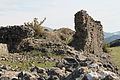
Type of fortress

View of the city of Kardzhali from the Visegrad fortress


Notes
- ↑ 1 2 Yordan Iliev. The Rhodope of Antiquity, Book II: Antiquity of the Society in the Rhodope . - izdavam.com, 2014-02-28. - 236 p. - ISBN 9786191623525 .
- ↑ Georgi Nekhrizov. Grave Necropolises in Expose Rhodope. Mound necropoli in East Rhodope Mountains (Eng.) // Parvi International Symposium “Sevtopolis”, “Tombstone graves in South-Eastern Europe”, II, 1996, 7-18 ..
- ↑ 1 2 Dremsizova-Nelchinova, Ts. Trakiyskata fortress region s. Visegrad, Kardzhali. (bulg.) // Thracia. - 1984. - Br. 6 . - S. 104-133 .
- ↑ Nikolai Ovcharov, Daniela Hadzhieva. Medieval Manastir in gr. Kardzhali, center on the bishopric of Ahridos: (XI - XIV century) . - Publishing House at the Bulgarian Academy of Sciences on Naukite, 1992. - 139 p. - ISBN 0205-0722.