Insulin-like growth factor 1 ( IGF-1 , somatomedin C , English insulin-like growth factor 1, IGF1 ) is a protein from the family of insulin-like growth factors similar in structure and function to insulin . He is involved in the endocrine, autocrine and paracrine regulation of the processes of growth, development and differentiation of cells and tissues of the body . IGF-1 consists of one polypeptide chain with a length of 70 amino acid residues with three intramolecular disulfide bridges . The molecular weight of IGF-1 is 7.6 kDa [1] . It is believed that this protein plays an active role in the aging process of an organism: mutations of the IGF-1 gene led to an increase in life expectancy in laboratory animals [2] .
| Insulin-like growth factor 1 (somatomedin C) | |||||||||||||
|---|---|---|---|---|---|---|---|---|---|---|---|---|---|
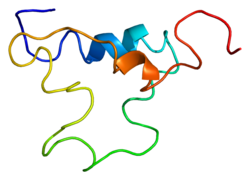 PDB 1bqt File Based Structure | |||||||||||||
| |||||||||||||
| Identifiers | |||||||||||||
| Symbol | ; IGF-I; IGF1A; IGFI | ||||||||||||
| External IDs | GeneCards : | ||||||||||||
| |||||||||||||
| RNA expression profile | |||||||||||||
 | |||||||||||||
 | |||||||||||||
 | |||||||||||||
| Orthologists | |||||||||||||
| View | Person | Mouse | |||||||||||
| Entrez | |||||||||||||
| Ensembl | |||||||||||||
| Uniprot | |||||||||||||
| RefSeq (mRNA) | |||||||||||||
| RefSeq (protein) | |||||||||||||
| Locus (UCSC) | |||||||||||||
| Search PubMed | |||||||||||||
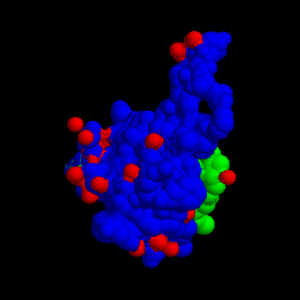
The human insulin-like growth factor 1 is encoded by the IGF1 gene [3] [4] .
IGF-1 is the most important endocrine mediator of the action of growth hormone , therefore it is also called somatomedin C. IGF-1 is produced by hepatocytes in the liver in response to stimulation of their growth hormone receptors . In peripheral tissues, it is IGF-1 that provides almost all the physiological effects of growth hormone. Its effects were called "uncontrolled insulin-like activities." [ specify ] .
Action
IGF-1 also provides feedback with the hypothalamus and pituitary gland along the somatotropic axis: the secretion of somatotropin-releasing hormone and somatotropic hormone depends on the level of IGF-1 in the blood. With a low level of IGF-1 in the blood, the secretion of growth hormone-releasing hormone and growth hormone increases, while at high it decreases. Also, IGF-1 regulates the secretion of somatostatin : a high level of IGF-1 leads to an increase in the secretion of somatostatin, low - to its decrease. This mechanism is another way to regulate the level of growth hormone in the blood. But the action can be inhibited by malnutrition, insensitivity of growth hormone, lack of reaction of the receptors, or unsuccessful, below the required minimum signaling pathway, communication of receptors. In experiments on rats, it was found that the amount of IGF-1 and RNA in the liver is positively associated with a lack of casein and negatively associated with a lack of protein in food [5] . It was also found that with a lack of IGF-1 in the blood, it can be produced in the muscles themselves.
The level of IGF-1 in the blood depends on the effect on the liver of not only growth hormone, but also sex steroids and thyroid hormones , glucocorticoids , insulin . In this case, insulin, androgens , estrogens increase the secretion of IGF-1 by the liver, and glucocorticoids reduce it. This is one of the reasons for the synergism of insulin, growth hormone, sex and thyroid hormones in relation to the processes of growth and development of the body, tissue growth and differentiation, and one of the reasons for the characteristic inhibitory effect of glucocorticoids on the processes of linear growth, puberty, etc. IGF-1 affects development throughout life, but its level in the blood is not constant: the lowest level of IGF-1 production in childhood and old age, and the highest - during adolescence.
History
IGF-1 as such was opened in 1978 and 10 years later it was used by athletes as an element of training. He gained immense popularity due to the fact that he absolutely does not need additional recharge (steroid courses, insulin, etc.). But recently, side effects have also been removed: an increase in the liver, spleen , and the number of malignant cells .
IGF1 Cascade
The GR / IGF1 cascade is highly conserved in various groups of animals (vertebrates and invertebrates). In general terms, it means that IGF1, through its receptor, triggers a cascade of reactions leading to inhibition of transcription factors (DAF-16 in C. elegans or FOXO1 in mice). These transcription factors probably regulate the expression of genes that increase life span [6]
If insulin / IGF1 is the only path in invertebrate animals, this pathway is divided into two in higher vertebrates, including mammals. These two pathways have overlapping functions, but insulin is mainly involved in the regulation of metabolism, and the GR / IGF1 pathway plays an important role in the processes of growth, development and, possibly, longevity. [7]
It was the IGF cascade genes that became the first open “ aging genes ” - that is, genes whose damage led to an increase in life expectancy [8] .
.
The role of the cascade in the aging of various animals
Various animals (vertebrates and invertebrates) are convenient models for studying aging, due to their relatively short lifespan, the possibility of genetic manipulation, and the study of their lengths of life.
Caenorhabditis elegans
A cascade that regulates both increased life expectancy and diapause [9] . was first investigated for the nematode Caenorhabditis elegans . In response to adverse external conditions, this worm transforms into a juvenile form, which is called ("sleeping"). In this form of Caenorhabditis elegans , development, reproduction does not occur. This form becomes resistant to oxidative stress [10] . Fat accumulates in the body to store energy. When environmental conditions are restored, the nematode returns to the state of fertile adults. In dauer, only a young individual who has not reached puberty can go over the form.
Restoring environmental conditions stimulates the activation of the insulin / IGF-1 signaling pathway. If the insulin receptor / IGF-1, mutated (or later components of the cascade, PI3-kinase / PDK / Akt ), then Caenorhabditis elegans transforms into a dauer form even under satisfactory environmental conditions. The insulin / IGF-1 cascade is aimed at inhibiting the DAF-16 protein, which is a transcription factor of a block of genes that stimulate the transition to the dauer form [9] . Mutations in the pathway that lead to an increase in life expectancy should be weak. With strong mutations and inadequate activity of the insulin / IGF1 cascade, a young individual can “get stuck” in a dauer form.
It has been shown that in addition to life expectancy, the described cascade of reactions also affects fertility and movement of individuals. Some daf-2 mutants went into juvenile form and lost their ability to move. However, such manifestations cannot be associated with life expectancy, since there are long-lived daf-2 mutants whose mobility and fertility are normal (compared to the wild type). The insulin / IGF1 pathway can regulate the body's hormonal signaling. In organisms with daf-2 gene mutations only in certain lines, an increased lifespan of the whole organism was observed. [10] [11]
Drosophila sp.
Drosophila (fruit fly) has several advantages for studying aging: this animal is a well-studied model organism with developed genetic engineering methods for working with it and also a good object for genetic knockout . Fruit flies have more similarities with humans (with mammals) than Caenorhabditis elegans (nematode) - they have a brain, heart, and homologs of the kidneys. Drosophila also has complex behavior. However, most biological processes have been studied at the embryotic stage and before metamorphosis. The adult fly, a model object of gerontology, has been studied worse than the embryonic stage. Despite this, Drosophila is one of the main model organisms in the study of aging.
As with Caenorhabditis elegans , for Drosophila mutations that reduce the effectiveness of the IGF1 cascade lead to an increase in life expectancy. This was shown by reducing the amount of insulin-like proteins and knocking out the substrates of the IGF receptor (chico and Lnk) [2] . At the same time, an increase in the expression of the DAF-16 FOXO homolog ( transcription factor regulated by the IGF cascade) also leads to an increase in the life span of the flies. With a decrease in the expression of another inverse regulator FOXO (14-3-3ε), the duration of flies also increases.
The Drosophila nervous system and fat body are involved in the regulation of longevity. So, some insulin-like proteins (IPBs) are produced by neurosecretory cells. Under stress, a Jun-N-terminal kinase ( kinase ) is activated, which leads to a decrease in the expression of some of these proteins (IPB2 and IPB5), and, as a result, to a decrease in the efficiency of the IGF1 cascade. When this kinase is activated by molecular methods, an increase in the life expectancy of flies is observed.
In the adipose body (equivalents of white adipose tissue and liver in mammals), a reduction in the IGF1 cascade occurred. However, in 2004 it was shown that an increase in the expression of FOXO can increase the life span of an organism. The mechanisms of this effect require further study [2] .
In all cases of inhibition of the IGF1 cascade, it was noted that the activity of genes involved in cascades of cellular detoxification increases.
In previous experiments, it was shown that inhibition of the IGF1 cascade increases lifespan, however, does this inhibition slow down the aging process?
A decrease in the activity of the IGF1 cascade leads to a decrease in female fertility, which is not surprising, because this cascade plays one of the key roles in regulating the growth, proliferation, and survival of stem cells , the precursors of eggs. However, while restricting the nutrition of wild-type flies, which leads, inter alia, to limiting the operation of the IGF1 cascade, it increases the number of germ cells.
On the other hand, with a decrease in the efficiency of the cascade (in conjunction with the reduction of the TOR signal chain ), the decrease in cardiac functions slows down, and negative geotaxis is less often observed. For flies serving as models for the study of Alzheimer's disease, it was shown that the reduction of the components of the IGF1 pathway led to a decrease in the pathology progression. Similar results have been shown for a number of other neurodegenerative diseases (e.g., Parkinson's disease). [2] [12]
Mammals
Evidence of the effect of IGF1 cascade on life span has been shown in various mammalian models. A good example would be dwarf mutant mice deficient in growth hormone . Such mice not only live long, they have slowed down the aging of the immune system ( cell aging ), cross-linking of collagen, slowed down the aging of lethal diseases and random pathological processes such as arthritis. [8] [13] .
Also, in rodents that were put on a diet (limited diet), a decrease in insulin and IGF1 levels was observed. The amount of stored fat decreased, the immune system was stimulated. Life expectancy increased by 30–40% [7] . Genetic models have also shown the effect of IGF1 cascade on life expectancy.
Mice Alzheimer's Study
To create a system for studying Alzheimer's disease, β-amyloid was expressed in mice. A healthy person expresses this protein, and normally this protein is not toxic, however, β-amyloid can form dimers and oligomers that are neurotoxic and cause Alzheimer's disease. During the reduction of the IGF1 cascade in mice, aggregation of β-amyloid into larger ensembles was observed, which reduced their toxicity and slowed down the development of the disease [14] .
By analogy with other animals, in mammals, the IGF1 cascade negatively regulates FOXO gene translation factors. FOXO is a highly conserved mammalian family of genes necessary for the body to survive under stressful conditions. Moreover, when the IGF1 signal was reduced, the mice showed greater resistance to oxidative stress. Thus, in mice simulated to study Alzheimer's disease, the complex effect of the IGF1 cascade on the body's defense systems was shown [14] .
The role of the cascade in human aging
In 2009, a study was conducted on a group of elderly Caucasians. 30 genes of the insulin / IGF1 signaling pathway were examined. In the course of this study, SNPs reliably associated with life expectancy were found. One of these SNPs was found in the AKT1 gene. And two more SNPs in the FOXO3A gene were associated with life expectancy in women.
AKT1 is one of the tyrosine kinases that is able to phosphorylate FOXO3A. Phosphorylated protein cannot penetrate the nucleus and activate the genes of the FOXO family . FOXO3A is one of three human homologues to the DAF-16 translation factor in Caenorhabditis elegans . Interestingly, SNPs affecting longevity were found in introns whose functions are not yet known. [15]
For humans, the ratio of GR / IGF1 plays an important role. With a relatively large amount of growth hormone (with a lack of IGF1), symptoms such as obesity, mental retardation, glucose intolerance ( Laron's syndrome ) can develop [7] .
Research
Cancer susceptibility
The IGF signaling pathway has a pathogenic role in cancer development. Studies have shown that with elevated levels of IGF, cancer cell growth is enhanced. [16] [17] In addition, people with Laron syndrome have a significantly lower risk of developing cancer. [18] [19] Changes in diet, in particular, a vegan diet, which reduce the activity of IGF-1, may be associated with a reduced risk of cancer. [20] However, despite significant research, anticancer therapies affecting IGF-1 have not shown impressive results in clinical trials. [17] [21] [22] [23]
Stroke
The efficacy of IGF-1 in stroke in mice in combination with erythropoietin has been shown. Behavioral and cellular improvements were recorded. [24]
Neurodegenerative diseases
Клинические испытания вещества ибутаморен , которое повышает уровень ИФР-1 у пациентов, не продемонстрировало улучшений симптомов болезни Альцгеймера . [25] Другое исследование продемонстрировало отсутствие замедления прогрессирования болезни у пациентов с БАС , однако другие исследования показали значительные улучшения при ИФР-1-заместительной терапии у пациентов с БАС, [26] поэтому ИФР-1 имеет потенциал для лечения БАС. [27] Однако, в целом исследования показали противоречивые результаты. [28]
Фармакологическое использование
Пациенты с тяжелым первичным дефицитом ИФР-1 могут лечиться либо ИФР-1, либо ИФР-1 вместе с IGFBP3 (ИФР-связывающий белок типа 3). [29] Мекасермин (выпускается под брендом Инкрелекс) — синтетический аналог ИФР-1, утверждённый для лечения нарушений роста. [29] ИФР-1 производится в промышленных масштабах с использованием дрожжей или E. coli .
References to sources
- https://www.ncbi.nlm.nih.gov/gene/3479
- Ageing in Drosophila: the role of the insulin/Igf and TOR signalling network, Partridge L, Alic N, Bjedov I, Piper MD, 2011
- Endocrine regulation of ageing, Russell SJ, Kahn CR, 2007
- Drosophila melanogaster in the Study of Human Neurodegeneration, Frank Hirth, 2010
- Reduced IGF-1 signaling delays age-associated proteotoxicity in mice, Cohen et al, 2009
- The insulin/IGF-1 signaling in mammals and its relevance to human longevity, Rincon M et al, 2005
- Association of common genetic variation in the insulin/IGF1 signaling pathway with human longevity, Pawlikowska L, 2009
- A Conserved Regulatory System for Aging, Cynthia Kenyon, 2001
- Genetic pathways that regulate ageing in model organisms Leonard Guarente & Cynthia Kenyon .
- Role of the GH/IGF-1 axis in lifespan and healthspan: lessons from animal models, Berryman DE, Christiansen JS, Johannsson G, Thorner MO, Kopchick JJ., 2008
- Dwarf mice and the ageing process, Brown-Borg HM, Borg KE, Meliska CJ, Bartke A. 1996
- В. Н. Анисимов «Молекулярные и физиологические механизмы старения» — Спб: Наука 2003 — ISBN 5020261998
Notes
- ↑ Insulin-like Growth Factor-I (E3R) human >95% (HPLC), recombinant, expressed in E. coli, lyophilized powder | Sigma-Aldrich . Дата обращения 27 марта 2013. Архивировано 27 марта 2013 года.
- ↑ 1 2 3 4 Partridge L. , Alic N. , Bjedov I. , Piper MD Ageing in Drosophila: the role of the insulin/Igf and TOR signalling network. (англ.) // Experimental gerontology. - 2011. - Vol. 46, no. 5 . — P. 376—381. — DOI : 10.1016/j.exger.2010.09.003 . — PMID 20849947 .
- ↑ Höppener JW , de Pagter-Holthuizen P. , Geurts van Kessel AH , Jansen M. , Kittur SD , Antonarakis SE , Lips CJ , Sussenbach JS The human gene encoding insulin-like growth factor I is located on chromosome 12. (англ.) // Human genetics. - 1985. - Vol. 69, no. 2 . — P. 157—160. — PMID 2982726 .
- ↑ Jansen M. , van Schaik FM , Ricker AT , Bullock B. , Woods DE , Gabbay KH , Nussbaum AL , Sussenbach JS , Van den Brande JL Sequence of cDNA encoding human insulin-like growth factor I precursor. (Eng.) // Nature. - 1983. - Vol. 306, no. 5943 . — P. 609—611. — PMID 6358902 .
- ↑ Miura Y. , Kato H. , Noguchi T. Effect of dietary proteins on insulin-like growth factor-1 (IGF-1) messenger ribonucleic acid content in rat liver. (англ.) // The British journal of nutrition. - 1992. - Vol. 67, no. 2 . — P. 257—265. — PMID 1596498 .
- ↑ Russell SJ , Kahn CR Endocrine regulation of ageing. (Eng.) // Nature reviews. Molecular cell biology. - 2007. - Vol. 8, no. 9 . — P. 681—691. — DOI : 10.1038/nrm2234 . — PMID 17684529 .
- ↑ 1 2 3 Rincon M. , Rudin E. , Barzilai N. The insulin/IGF-1 signaling in mammals and its relevance to human longevity. (англ.) // Experimental gerontology. - 2005. - Vol. 40, no. 11 . — P. 873—877. — DOI : 10.1016/j.exger.2005.06.014 . — PMID 16168602 .
- ↑ 1 2 Brown-Borg HM , Borg KE , Meliska CJ , Bartke A. Dwarf mice and the ageing process. (Eng.) // Nature. - 1996. - Vol. 384, no. 6604 . — P. 33. — DOI : 10.1038/384033a0 . — PMID 8900272 .
- ↑ 1 2 Kenyon Cynthia. A Conserved Regulatory System for Aging // Cell. — 2001. — Апрель ( т. 105 , № 2 ). — С. 165—168 . — ISSN 0092-8674 . — DOI : 10.1016/S0092-8674(01)00306-3 .
- ↑ 1 2 Guarente L. , Kenyon C. Genetic pathways that regulate ageing in model organisms. (Eng.) // Nature. - 2000. - Vol. 408, no. 6809 . — P. 255—262. — DOI : 10.1038/35041700 . — PMID 11089983 .
- ↑ Chen D. , Li PW , Goldstein BA , Cai W. , Thomas EL , Chen F. , Hubbard AE , Melov S. , Kapahi P. Germline signaling mediates the synergistically prolonged longevity produced by double mutations in daf-2 and rsks-1 in C. elegans. (англ.) // Cell reports. - 2013 .-- Vol. 5, no. 6 . — P. 1600—1610. — DOI : 10.1016/j.celrep.2013.11.018 . — PMID 24332851 .
- ↑ Hirth F. Drosophila melanogaster in the study of human neurodegeneration. (англ.) // CNS & neurological disorders drug targets. - 2010 .-- Vol. 9, no. 4 . — P. 504—523. — PMID 20522007 .
- ↑ В. Н. Анисимов «Молекулярные и физиологические механизмы старения»
- ↑ 1 2 Cohen E. , Paulsson JF , Blinder P. , Burstyn-Cohen T. , Du D. , Estepa G. , Adame A. , Pham HM , Holzenberger M. , Kelly JW , Masliah E. , Dillin A. Reduced IGF-1 signaling delays age-associated proteotoxicity in mice. (English) // Cell. - 2009. - Vol. 139, no. 6 . — P. 1157—1169. — DOI : 10.1016/j.cell.2009.11.014 . — PMID 20005808 .
- ↑ Pawlikowska L. , Hu D. , Huntsman S. , Sung A. , Chu C. , Chen J. , Joyner AH , Schork NJ , Hsueh WC , Reiner AP , Psaty BM , Atzmon G. , Barzilai N. , Cummings SR , Browner WS , Kwok PY , Ziv E. Association of common genetic variation in the insulin/IGF1 signaling pathway with human longevity. (англ.) // Aging cell. - 2009. - Vol. 8, no. 4 . — P. 460—472. — DOI : 10.1111/j.1474-9726.2009.00493.x . — PMID 19489743 .
- ↑ Arnaldez FI, Helman LJ Targeting the insulin growth factor receptor 1 (неопр.) // Hematol. Oncol. Clin. North Am.. — 2012. — Т. 26 , № 3 . — С. 527—542 . — DOI : 10.1016/j.hoc.2012.01.004 . — PMID 22520978 .
- ↑ 1 2 Yang Y., Yee D. Targeting insulin and insulin-like growth factor signaling in breast cancer (англ.) // J Mammary Gland Biol Neoplasia : journal. - 2012. - Vol. 17 , no. 3—4 . — P. 251—261 . — DOI : 10.1007/s10911-012-9268-y . — PMID 23054135 .
- ↑ Gallagher EJ, LeRoith D. Is growth hormone resistance/IGF-1 reduction good for you? (англ.) // Cell Metabolism : journal. — 2011. — April ( vol. 13 , no. 4 ). — P. 355—356 . — DOI : 10.1016/j.cmet.2011.03.003 . — PMID 21459318 .
- ↑ Guevara-Aguirre J. , Balasubramanian P. , Guevara-Aguirre M. , Wei M. , Madia F. , Cheng C.-W. , Hwang D. , Martin-Montalvo A. , Saavedra J. , Ingles S. , de Cabo R. , Cohen P. , Longo VD Growth Hormone Receptor Deficiency Is Associated with a Major Reduction in Pro-Aging Signaling, Cancer, and Diabetes in Humans (англ.) // Science Translational Medicine. — 2011. — 16 February ( vol. 3 , no. 70 ). — P. 70ra13—70ra13 . — ISSN 1946-6234 . — DOI : 10.1126/scitranslmed.3001845 . — PMID 21325617 .
- ↑ McCarty MF Vegan proteins may reduce risk of cancer, obesity, and cardiovascular disease by promoting increased glucagon activity (англ.) // Medical Hypotheses : journal. - 1999. - Vol. 53 , no. 6 . — P. 459—485 . — DOI : 10.1054/mehy.1999.0784 . — PMID 10687887 .
- ↑ Siddle K. Molecular basis of signaling specificity of insulin and IGF receptors: neglected corners and recent advances (англ.) // Front Endocrinol (Lausanne) : journal. - 2012. - Vol. 3 . - P. 34 . — DOI : 10.3389/fendo.2012.00034 . — PMID 22649417 .
- ↑ Girnita L., Worrall C., Takahashi S., Seregard S., Girnita A. Something old, something new and something borrowed: emerging paradigm of insulin-like growth factor type 1 receptor (IGF-1R) signaling regulation (англ.) // Cellular and Molecular Life Sciences : journal. - 2014 .-- Vol. 71 , no. 13 . — P. 2403—2427 . — DOI : 10.1007/s00018-013-1514-y . — PMID 24276851 .
- ↑ Singh P., Alex JM, Bast F. Insulin receptor (IR) and insulin-like growth factor receptor 1 (IGF-1R) signaling systems: novel treatment strategies for cancer (англ.) // Med. Oncol. : journal. - 2014 .-- Vol. 31 , no. 1 . — P. 805 . — DOI : 10.1007/s12032-013-0805-3 . — PMID 24338270 .
- ↑ Fletcher L., Kohli S., Sprague SM, Scranton RA, Lipton SA, Parra A., Jimenez DF, Digicaylioglu M. Intranasal delivery of erythropoietin plus insulin-like growth factor-I for acute neuroprotection in stroke. Laboratory investigation (англ.) // Journal of Neurosurgery : journal. — 2009. — July ( vol. 111 , no. 1 ). — P. 164—170 . — DOI : 10.3171/2009.2.JNS081199 . — PMID 19284235 .
- ↑ Sevigny JJ, Ryan JM, van Dyck CH, Peng Y., Lines CR, Nessly ML Growth hormone secretagogue MK-677: no clinical effect on AD progression in a randomized trial (англ.) // Neurology : journal. — Wolters Kluwer , 2008. — November ( vol. 71 , no. 21 ). — P. 1702—1708 . — DOI : 10.1212/01.wnl.0000335163.88054.e7 . — PMID 19015485 .
- ↑ Nagano I., Shiote M., Murakami T., Kamada H., Hamakawa Y., Matsubara E., Yokoyama M., Moritaz K., Shoji M., Abe K. Beneficial effects of intrathecal IGF-1 administration in patients with amyotrophic lateral sclerosis (англ.) // Neurol. Res. : journal. — 2005. — October ( vol. 27 , no. 7 ). — P. 768—772 . — DOI : 10.1179/016164105X39860 . — PMID 16197815 .
- ↑ Sakowski SA, Schuyler AD, Feldman EL Insulin-like growth factor-I for the treatment of amyotrophic lateral sclerosis (англ.) // Amyotroph Lateral Scler : journal. — 2009. — April ( vol. 10 , no. 2 ). — P. 63—73 . — DOI : 10.1080/17482960802160370 . — PMID 18608100 .
- ↑ Sorenson EJ, Windbank AJ, Mandrekar JN, Bamlet WR, Appel SH, Armon C., Barkhaus PE, Bosch P., Boylan K., David WS, Feldman E., Glass J., Gutmann L., Katz J., King W., Luciano CA, McCluskey LF, Nash S., Newman DS, Pascuzzi RM, Pioro E., Sams LJ, Scelsa S., Simpson EP, Subramony SH, Tiryaki E., Thornton CA Subcutaneous IGF-1 is not beneficial in 2-year ALS trial (англ.) // Neurology : journal. — Wolters Kluwer , 2008. — November ( vol. 71 , no. 22 ). — P. 1770—1775 . — DOI : 10.1212/01.wnl.0000335970.78664.36 . — PMID 19029516 .
- ↑ 1 2 Rosenbloom AL The role of recombinant insulin-like growth factor I in the treatment of the short child (англ.) // Curr. Opin. Pediatr. : journal. - 2007. - Vol. 19 , no. 4 . — P. 458—464 . — DOI : 10.1097/MOP.0b013e3282094126 . — PMID 17630612 .
Literature
- Butler AA, Yakar S., LeRoith D. Insulin-like growth factor-I: compartmentalization within the somatotropic axis? (англ.) // Physiology : journal. - 2002. - Vol. 17 . — P. 82—5 . — PMID 11909998 .
- Maccario M., Tassone F., Grottoli S., Rossetto R., Gauna C., Ghigo E. Neuroendocrine and metabolic determinants of the adaptation of GH/IGF-I axis to obesity (англ.) // Ann. Endocrinol. (Paris) : journal. - 2002. - Vol. 63 , no. 2 Pt 1 . — P. 140—144 . — PMID 11994678 .
- Camacho-Hubner C., Woods KA, Clark AJ, Savage MO Insulin-like growth factor (IGF)-I gene deletion (неопр.) // Reviews in endocrine & metabolic disorders. — 2003. — Т. 3 , № 4 . — С. 357—361 . — DOI : 10.1023/A:1020957809082 . — PMID 12424437 .
- Dantzer B., Swanson EM Mediation of vertebrate life histories via insulin-like growth factor-1 (англ.) // Biological Reviews : journal. - 2012. - Vol. 87 , no. 2 . — P. 414—429 . — DOI : 10.1111/j.1469-185X.2011.00204.x . — PMID 21981025 .
- Trojan LA, Kopinski P., Wei MX, Ly A., Glogowska A., Czarny J., Shevelev A., Przewlocki R., Henin D., Trojan J. IGF-I: from diagnostic to triple-helix gene therapy of solid tumors (англ.) // Acta Biochim. Pol. : journal. - 2004. - Vol. 49 , no. 4 . — P. 979—990 . — PMID 12545204 .
- Winn N., Paul A., Musaro A., Rosenthal N. Insulin-like growth factor isoforms in skeletal muscle aging, regeneration, and disease (англ.) // Cold Spring Harb. Symp. Quant. Biol. : journal. - 2003. - Vol. 67 . — P. 507—518 . — DOI : 10.1101/sqb.2002.67.507 . — PMID 12858577 .
- Delafontaine P., Song YH, Li Y. Expression, regulation, and function of IGF-1, IGF-1R, and IGF-1 binding proteins in blood vessels (англ.) // Arteriosclerosis, Thrombosis, and Vascular Biology : journal. - 2005. - Vol. 24 , no. 3 . — P. 435—444 . — DOI : 10.1161/01.ATV.0000105902.89459.09 . — PMID 14604834 .
- Trejo JL, Carro E., Garcia-Galloway E., Torres-Aleman I. Role of insulin-like growth factor I signaling in neurodegenerative diseases (англ.) // Journal of Molecular Medicine : journal. - 2004. - Vol. 82 , no. 3 . — P. 156—162 . — DOI : 10.1007/s00109-003-0499-7 . — PMID 14647921 .
- Rabinovsky ED The multifunctional role of IGF-1 in peripheral nerve regeneration (англ.) // Neurol. Res. : journal. - 2004. - Vol. 26 , no. 2 . — P. 204—210 . — DOI : 10.1179/016164104225013851 . — PMID 15072640 .
- Rincon M., Muzumdar R., Atzmon G., Barzilai N. The paradox of the insulin/IGF-1 signaling pathway in longevity (англ.) // Mech. Ageing Dev. : journal. - 2005. - Vol. 125 , no. 6 . — P. 397—403 . — DOI : 10.1016/j.mad.2004.03.006 . — PMID 15272501 .
- Conti E., Carrozza C., Capoluongo E., Volpe M., Crea F., Zuppi C., Andreotti F. Insulin-like growth factor-1 as a vascular protective factor (англ.) // Circulation : journal. — Lippincott Williams & Wilkins 2005. - Vol. 110 , no. 15 . — P. 2260—2265 . — DOI : 10.1161/01.CIR.0000144309.87183.FB . — PMID 15477425 .
- Wood AW, Duan C., Bern HA Insulin-like growth factor signaling in fish (англ.) // International Review of Cell and Molecular Biology : journal. - 2005. - Vol. International Review of Cytology . — P. 215—285 . — ISBN 9780123646477 . — DOI : 10.1016/S0074-7696(05)43004-1 . — PMID 15797461 .
- Sandhu MS Insulin-like growth factor-I and risk of type 2 diabetes and coronary heart disease: molecular epidemiology (англ.) // Endocrine development : journal. - 2005. - Vol. Endocrine Development . — P. 44—54 . — ISBN 3-8055-7926-8 . — DOI : 10.1159/000085755 . — PMID 15879687 .
- Ye P., D'Ercole AJ Insulin-like growth factor actions during development of neural stem cells and progenitors in the central nervous system (англ.) // Journal of Neuroscience Research : journal. - 2006. - Vol. 83 , no. 1 . — P. 1—6 . — DOI : 10.1002/jnr.20688 . — PMID 16294334 .
- Gomez JM The role of insulin-like growth factor I components in the regulation of vitamin D (англ.) // Current pharmaceutical biotechnology : journal. - 2006. - Vol. 7 , no. 2 . — P. 125—132 . — DOI : 10.2174/138920106776597621 . — PMID 16724947 .
- Federico G., Street ME, Maghnie M., Caruso-Nicoletti M., Loche S., Bertelloni S., Cianfarani S. Assessment of serum IGF-I concentrations in the diagnosis of isolated childhood-onset GH deficiency: a proposal of the Italian Society for Pediatric Endocrinology and Diabetes (SIEDP/ISPED) (англ.) // Journal of Endocrinological Investigation : journal. - 2006. - Vol. 29 , no. 8 . — P. 732—737 . — DOI : 10.1007/bf03344184 . — PMID 17033263 .
- Zakula Z., Koricanac G., Putnikovic B., Markovic L., Isenovic ER Regulation of the inducible nitric oxide synthase and sodium pump in type 1 diabetes (англ.) // Medical Hypotheses : journal. - 2007. - Vol. 69 , no. 2 . — P. 302—306 . — DOI : 10.1016/j.mehy.2006.11.045 . — PMID 17289286 .
- Trojan J., Cloix JF, Ardourel MY, Chatel M., Anthony DD Insulin-like growth factor type I biology and targeting in malignant gliomas (англ.) // Neuroscience : journal. — Elsevier , 2007. — Vol. 145 , no. 3 . — P. 795—811 . — DOI : 10.1016/j.neuroscience.2007.01.021 . — PMID 17320297 .
- Venkatasubramanian G., Chittiprol S., Neelakantachar N., Naveen MN, Thirthall J., Gangadhar BN, Shetty KT Insulin and insulin-like growth factor-1 abnormalities in antipsychotic-naive schizophrenia (англ.) // American Journal of Psychiatry : journal. — 2007. — October ( vol. 164 , no. 10 ). — P. 1557—1560 . — DOI : 10.1176/appi.ajp.2007.07020233 . — PMID 17898347 .