The Ferghana region is one of the five regions of the Turkestan ASSR as part of the RSFSR . It was formed on April 30, 1918 , instead of the region with the same name , which was part of the Turkestan Territory (Governor General) of the Russian Empire . The Ferghana region of the Turkestan ASSR occupied exactly the same territory as the Ferghana region of the Turkestan region of the Russian Empire. The name of the region comes from the Ferghana Valley .
| Ferghana region of Turkestan ASSR | |||||
|---|---|---|---|---|---|
| Uzbek فرغانا ولایاتی | |||||
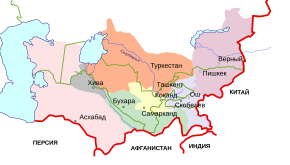 Map of Turkestan ASSR. Ferghana region is highlighted in gray-blue color. | |||||
| A country |  the USSR the USSR  RSFSR RSFSR | ||||
| Included in |  Turkestan ASSR Turkestan ASSR | ||||
| Includes | 5 counties | ||||
| Adm. Centre | Skobelev | ||||
| History and Geography | |||||
| Date of formation | April 30, 1918 | ||||
| Date of Abolition | October 14, 1924 | ||||
| Square | 160 141 km² | ||||
| The largest city | Kokand | ||||
| Dr. big cities | Namangan , Andijan , Osh , Margilan , Jalalabad | ||||
| Population | |||||
| Population | About 2 million people | ||||
| Nationalities | mostly Uzbeks , also Kyrgyz , Russians , Tajiks , Pamir peoples and others | ||||
| Denominations | mostly Muslims - Sunnis , also Christians and Zoroastrians | ||||
| official languages | Russian and Uzbek | ||||
| |||||
 | |||||
The Ferghana region of the Turkestan Autonomous Soviet Socialist Republic was abolished on October 14, 1924 , and its territory, along with the other regions of Central Asia, was divided between the newly formed union republics during the national-territorial demarcation . The territory of the Ferghana region was divided between the Uzbek SSR , the Tajik Autonomous Soviet Socialist Republic in its composition, and the Kara-Kyrgyz Autonomous Region as part of the RSFSR .
The administrative center of the region was the city of Skobelev (now Ferghana) . The largest city in the region was Kokand . Other large cities of the region: Namangan , Andijan , Osh , Margilan and Jalalabad . The region was divided into 5 counties : Andijan, Kokand, Margilan, Namangan and Osh, the administrative centers of which were Andijan, Kokand, Skobelev, Namangan and Osh, respectively.
In the north and north-west it bordered on the Syr Darya region of the Turkestan ASSR, in the north-east it bordered on the Dzhetysu region of the Turkestan ASSR, in the west on the Samarkand region of the Turkestan ASSR, on the south-west with the Bukhara emirate (then the Bukhara People’s Soviet Republic and the Bukhara Socialist Soviet Republic ), from the south with the Emirate of Afghanistan , and from the east with the Xinjian region of the Republic of China .
About 2 million people lived in the region. The bulk of the population were Uzbeks . Also, a significant number of Russians , Tajiks and Kara-Kyrgyz (i.e., Kyrgyz) , as well as the Pamir peoples , Uyghurs , Tatars and others lived . The population mainly professed Sunni Islam, but at the same time there were a fairly large number of Ismaili Muslims . Also, a large proportion of the population professed Christianity (mainly Orthodoxy ) and Zoroastrianism . The region was one of the main centers of Uyghur immigration from neighboring China.
Due to the very fertile soil and nature, the region’s economy was based on agriculture (mainly growing vegetables and fruits , cotton and wheat ), animal husbandry , silkworm breeding , beekeeping . Also, the textile industry , as well as folk crafts and crafts, such as carpet weaving , the production of clay and ceramic dishes and products, the manufacture of knives , goods and clothes from leather and wool and the like, also brought part of the region’s income.
The main part of the region was located on the territory of the very fertile Ferghana Valley , surrounded by highlands. The Pamir mountains surrounded the region from the south, and the Tien Shan mountains from the east and north. On the territory of the Ferghana region was the source of the longest river in Central Asia - the Syr Darya .
Literature
- History of the Uzbek SSR //. - Tashkent, 1958.- T. 2.
- National Economy of Central Asia //. - Tashkent, 1924. - T. 2-3.
- Turkiston autonomous council of socialist republican // National Encyclopedia of Uzbekistan. - Tashkent, 2000-2005.