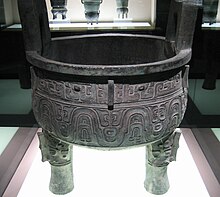
Jinwen ( Chinese 金文 ; pinyin : jīn wén) - cast or engraved inscriptions on Chinese bronze vessels for sacrifice or musical ritual instruments in the Shang - Zhou era (XIII-IV centuries BC).
The most common jinweni are found on tripods for ding meat 鼎, vessels for grain gui 簋, bells zhong 鐘. And also on bronze vessels for wine: “Yu” 卣, “Zong” 尊, “Gu” 觚, “Jia” 斝; and for water: “and” 匜, “pan” 盤, “hu” 壺.
Unlike Jiagueni甲骨文, which are divinatory inscriptions in the form of concise questions and answers, jinveni are ritual inscriptions that make up the finished text. In the Western Zhou era, they are located on the bottom or inner walls of vessels, thus, when filling with sacrificial food, the inscriptions were not visible, that is, they served as a means of communication between the living and the spirits of their ancestors. In the subsequent period, however, inscriptions are often made on the outside of the material medium, becoming part of the aesthetic appearance of the latter.
The largest in volume is the inscription on the bronze tripod " Mao-gong din " 毛公鼎, consisting of 497 characters.
According to statistics for 1985, there were 2420 deciphered hieroglyphs of the Jinwen category - among more than 3,000 known in all [1] . In the collection of the Shanghai Museum, published in 1987, the East Zhou period includes 392 inscriptions from 47 states [2] . The Jinwen indie catalog 5文 引得 (2001) contains 5,758 separate inscriptions of the Shang and Zhou eras on 9916 artifacts [3] .
In addition to paleographic and philological value, bronze inscriptions are unique as the earliest documents in the field of Chinese law.
Notes
- ↑ Rong Geng, Jinwen bian , 1985
- ↑ Mattos, Gilbert L. “Eastern Zhou Bronze Inscriptions”, p. 91 (New Sources of Early Chinese History, Shaughnessy ed. 1997)
- ↑ Kern, Martin. Bronze inscriptions, the Shijing and the Shangshu : the evolution of the ancestral sacrifice during the Western Zhou // Early Chinese Religion, Part One: Shang Through Han (1250 BC to 220 AD). - Leiden: Brill, 2009. - P. 143-200. - ISBN 978-90-04-16835-0 .
Literature
- Kryukov V.M. Text and ritual: Experience of interpretation of ancient Chinese epigraphy of the Yin-Zhou era. M .: Monuments of historical thought, 2000. ISBN 5-88451-093-4