Offensive grenade wz.24 - Polish- made fragmentation grenade used by the Polish Army during the German invasion in 1939 .
| Granat zaczepny wz.24 | |
|---|---|
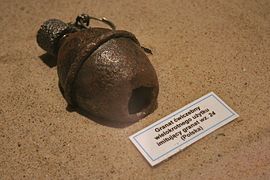 Offensive grenade wz.24 | |
| Type of | hand grenade |
| A country | Poland |
| Service history | |
| Years of operation | since 1924 |
| In service | Polish Army |
| Wars and conflicts | The Second World War |
| Production history | |
| Designed by | 1924 |
| Specifications | |
| Weight, kg | 360 gr |
| Length mm | 98 |
| Explosive | trinitrotoluene or picric acid |
| Explosive mass, kg | 150 gr |
| Explosion power | 10 m |
Content
Description
An oval-shaped grenade, resembling an egg, was made from thin sheet metal , bursting when detonated into a large number of small fragments. The garnet was filled with picric acid or trotyl [1] .
Originally using various types of fuses, in the early 1930s, a grenade began to be equipped with Zapalnik wz fuses. Gr. 31 [2] with a remote fuse, originally created for a defensive grenade wz.1933. Grenades, equipped with a fuse Gr. 31 is sometimes called wz. 24/31 to distinguish them from the original wz.24 grenade equipped with various fuses [1] .
Options
Grenade was produced in several versions:
- Explosive
- Smoke
- Incendiary: in incendiary grenades, instead of explosives, chemicals were used that ignited during detonation.
Notes
Literature
- Grzegorz Franczyk, Polskie granaty 1919-1939 . - Krakow, 2010. - ISBN 978-83-272-3200-7