Tsimanampetsutsa [1] [2] ( Malag. Tsimanapetsotsa, Tsimanampetsotse [3] ) - a national park in the south-west of Madagascar with an area of 432 km² , 90 km south of the city of Tuliara . It has the status of a protected zone since 1927, a national park - since 2002, an object of the Ramsar Convention since 1998. The main attraction is the salt lake of the same name , in addition, it includes dry spiny forests, sand dunes and swamps; from 72 to more than 110 species of birds, 12 species of mammals (including 4 species of lemurs ) and about 40 species of reptiles, most of which are endemic, live in the park.
| Cymanampetsutsa | |
|---|---|
| Malaga Tsimanampetsotsa | |
| IUCN Category II ( National Park ) | |
| basic information | |
| Square | 432 km² |
| Established | 1927 year |
| Location | |
| A country |
|
| Nearest town | Anacau , Tuliara |


Geography
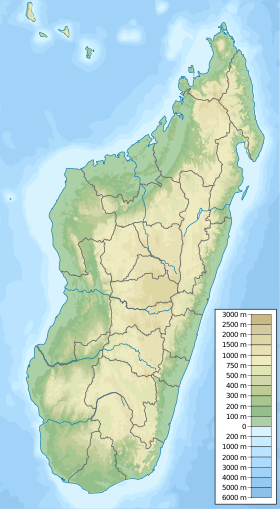
Tsimanampetsutsa National Park is located in the southwestern part of the island of Madagascar in the (the former province of Tuliara ). The nearest cities are Anakau and Tuliara ( 90 km to the north), the distance to the state capital, Antananarivo , is about 950 km [4] . The area of the national park, located off the coast of the island, is 432 km² ( 24 km long and 18 km wide) [5] . Near the border of the park runs national highway number 10, connecting Tuliara and Fo-Cap [6] . The park can be reached by road or boat from Tuliara and Anacau [3] .
On the territory of the national park there is a salt lake of the same name , the name of which is translated from Malagasy means "lake where dolphins do not live" [4] . An elongated shallow lake reaches a length of more than 20 km , due to the high concentration of calcium sulfate , fish do not live in it, but its waters are rich in shades of blue - from topaz to turquoise [3] . With the exception of the lake and a certain number of marshes [4] , the rest of the park consists mainly of two different natural zones - a limestone plateau covered with endemic xerophilous spiny forest, baobabs and banyan trees , and coastal sand dunes with grassy vegetation. Groundwater works due to the presence of numerous caves and dips in the park. The national park is located in the driest part of Madagascar, where only about 300 mm of precipitation falls annually. Daytime temperatures typically exceed 40 ° C, and at night the temperature drops to 20 ° C and lower [6] . The average annual temperature is 23 ° C, the dry season lasts from 7 to 9 months a year [5] .
Vegetation and fauna
From 75% [5] to 90% of biodiversity in the territory of the Tsimanampetsutsa National Park are endemic species [3] . The park has 185 plant species belonging to 132 genera of 65 families [5] .
According to various estimates, from Tsimanampetsutsa live from 72 [3] to more than 110 species of birds, including the only flamingos in Madagascar and five of the eight species of Madagascar cuckoos endemic for this island [4] . Other feathered inhabitants of the park include brown - fronted Newtonia , Madagascar Zuyok , desert narrow-billed wang , red-tailed wangs [6] , crested coot , gray-headed lovebird , crested Drongo and Madagascar kestrel [3] .
Of the 12 species of mammals living in the park, there is a rare endemic mungo Grandidier [6] and four species of lemurs , including the rare mouse lemur Microcebus griseorufus [4] . Another endemic to Madagascar is the almost extinct radiant tortoise , which is one of 39 reptile species that inhabit the park (according to other sources, herpetofauna includes 42 species [5] ). Although fish do not live in the salt lake Tsimanampetsutsa, the park still has an ichthyofauna represented by blind fish ( Typhleotris madagascariensis [5] ) that live in small cave lakes [6] .
Key Milestones
The conservation zone around Lake Cymanampetsutsa was established already in 1927, becoming the tenth in total in Madagascar and the first in the then province of Tuliara. In 2002, it was transformed into a national park [5] . In 1998, the Tsimanampetsutsa Nature Reserve became the first object of the Ramsar Convention in Madagascar [5] .
Notes
- ↑ Map sheet G-38-II (Yu.P.) .
- ↑ Map sheet G-38-A (Yu.P.) .
- ↑ 1 2 3 4 5 6 Tsimanampetsotsa National Park . Office National du Tourisme de Madagascar. Date of appeal October 26, 2018.
- ↑ 1 2 3 4 5 Nationalpark Tsimanampetsotsa (English) . MadaMagazine . Date of appeal October 26, 2018.
- ↑ 1 2 3 4 5 6 7 8 Parc National Tsimanapesotse (Fr.) . Madagascar National Parks. Date of appeal October 27, 2018.
- ↑ 1 2 3 4 5 Tsimanampetsotsa National Park . Travel Madagascar . Date of appeal October 26, 2018.