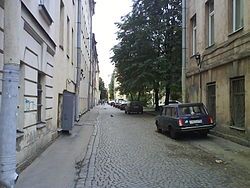
Repina Street - St. Petersburg Street, located between the First and Second Lines of Vasilyevsky Island . Passes from Rumyantsevsky Garden to Sredny Prospect , crossing Bolshoy Prospect . Her prospect closes the obelisk of " Rumyantsev Victory ", dedicated to the victories of Russian weapons of the 2nd half of the XVIII century under the leadership of Peter Alexandrovich Rumyantsev .
| Repin Street | |
|---|---|
 | |
| general information | |
| A country | Russia |
| City | St. Petersburg |
| Area | Vasileostrovsky |
| Historical district | Vasilievsky island |
| Length | 790 m |
| Width | 5,6 m |
| Underground |  Vasileostrovskaya Vasileostrovskaya |
| Former names | Sand Lane Solovievsky Lane |
| Police unit | Vasilievsky part |
Repin Street, with a width of 5.6 meters, is the narrowest of the named driveways of St. Petersburg that have street status.
Until recently [ when? ] it was also the only street in the historical center of the city where paving of the carriageway with stone (diabase) was preserved for almost its entire length. However, the narrow sidewalks were asphalted.
Content
History
The street arose in the 1720s as a road from the Menshikov Market, located on the territory of the modern Rumyantsev Garden , inland, to the French settlement. The road got this direction, possibly due to its high place. Here there is a bias towards the Neva, a sand mane. It was most convenient to make a path along it, and then a road. Initially, it did not have an official name; among the locals it was called Sand Lane.
As the 1st line of Vasilyevsky Island was built up, Pesochny Lane became the access road to the yards located here. On a neighboring street, houses were built according to standard designs that did not provide for entry into the courtyard from the main facade, so the lane was used to transport firewood.
On March 5, 1871, Pesochny lane began to be called Solovyovskiy, after the gold maker and philanthropist S.F. Solovyov, on whose money the Solovyevsky garden was defeated, to which the street goes.
During the blockade of Leningrad , in the winter of 1941-1942 , the lane was a morgue, corpses were brought here from all the surrounding streets.
In 1952, Solovyovsky Lane was renamed, since then it is Repin Street: the passage with its southern end goes to the Rumyantsev Garden adjacent to the historical building of the Academy of Arts , which houses the Institute of Painting, Sculpture and Architecture named after I.E. Repin , and in the Rumyantsev Garden from the embankment next to the bust of V.I. Surikov, a bust of I.E. Repin was installed.
Attractions
- 1st line , house 4 - Repin street, house 3 - the mansion of the merchant G. A. Corps. Initially, on this site there was a two-story stone house built in the 1720s on the model developed by Leblon (type - "house for eminent"). This house belonged to Ulyan Akimovich Sinyavin - the director of the city building structures of St. Petersburg, a close friend of Domenico Trezzini . In the 1730s, the building was rented by the Academy of Sciences, in the 1740s it passed to the College of Foreign Affairs, in 1757 to the Land Gentry Corps, and in the late 1760s to the Academy of Arts. In 1771, the site again passed into private hands. In the XIX century, the house was rebuilt twice: in 1842 by the architect L.F. Vendramini and in 1879 by V.A. Schröter . V. A. Schreter not only rebuilt the house, but also increased it by one floor.
- 2nd line , house 9 - Repin Street, house 10 - V.F. Strauss's apartment building, built in 1873 - 1874 . Architects - V. A. Schreter , I. S. Kitner .
- 1st line , house 26 - Repin street, house 27 - A.G. von Niedermiller's apartment building. 1913 - 1915 . Architect - M.F. Lane . A number of large rooms for various offices were designed in the house. In 1917, some of them were combined and cinema was arranged in the common room. In 1919, the working cinema "Thought" was located here. In the 1920s, the house was converted into a school. Since the 1970s, the Faculty of Journalism of the Leningrad (now St. Petersburg) University has been located here.
Literature
- City names today and yesterday: Petersburg toponymy / comp. S.V. Alekseeva, A.G. Vladimirovich , A.D. Erofeev et al. - 2nd ed., Revised. and add. - SPb. : Lick , 1997 .-- S. 104. - 288 p. - (Three centuries of Northern Palmyra). - ISBN 5-86038-023-2 .
- Architects of St. Petersburg. XIX - beginning of XX century / comp. V. G. Isachenko ; ed. Yu. Artemyev, S. Prohvatilova. - SPb. : Lenizdat , 1998 .-- 1070 p. - ISBN 5-289-01586-8 .
- Gorbachevich K. S. , Khablo E. P. Why are they so named? On the origin of the names of streets, squares, islands, rivers and bridges of St. Petersburg. - SPb. : Norint , 2002 .-- 353 p. - ISBN 5-7711-0019-6 .
- Nikitenko G. Yu. , Sobol V.D. Vasileostrovsky district. Encyclopedia of the streets of St. Petersburg (Reference Edition). - SPb. : White and Black , 2002 . - 534, ill. - ISBN 5-89771-030-9 .
Links
- Overview of street buildings on Citywalls