Lam Son 719 ( Lamshon 719 ; Vietnamese. Chiến dịch Lam Sơn 719 ) is the code name for the invasion of the South Vietnamese army in Laos in 1971 during the Vietnam War . The operation was accompanied by fierce hostilities and the first massive tank battles and ended in failure.
| Lam son 719 | |||
|---|---|---|---|
| Main Conflict: The Vietnam War Laos Civil War | |||
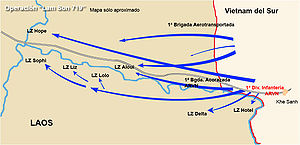 South Vietnamese Army Action Plan during Lam Son 719 | |||
| date of | February 8 - March 25, 1971 | ||
| A place | South Laos , South Vietnam | ||
| Cause | The desire to destroy the " Ho Chi Minh trail " | ||
| Total | Operation failure | ||
| Opponents | |||
| |||
| Commanders | |||
| |||
| Forces of the parties | |||
| |||
| Losses | |||
| |||


Content
- 1 Background
- 2 Name
- 3 Conduct
- 4 Summary
- 5 notes
- 6 Literature
Background
During the Vietnam War, the North Vietnamese army created the so-called “ Ho Chi Minh trail ” in Laos and Cambodia — a communications system that allowed large military units to be transferred to South Vietnam and supplied with them. Having begun the program of “ Vietnamese ” and the withdrawal of American troops from South Vietnam, Nixon believed that it was necessary to gain time for both events. In order to thwart the impending major offensive by the enemy, in May-June 1970, South Vietnamese and American forces invaded Cambodia , destroying part of the base camps and warehouses of the North Vietnamese located there. The operation was deemed successful. Influenced by success in Cambodia, planning began for a more ambitious operation against the Ho Chi Minh trail, this time in Laos.
The plan of operation Lam Son 719 [4] provided for the invasion of southern Laos along the French colonial road No. 9 (which ran through both Laos and South Vietnam), the capture of the village of A-Luoy (Bandong) and the development of the offensive on Chepon. It was supposed to cut the “Ho Chi Minh trail” for a short time and destroy the enemy’s bases in this area. The purpose of the operation was to postpone the coming North Vietnamese offensive, which would further strengthen the South Vietnamese army.
The Cooper-Church amendment passed by the US Congress prohibited the presence of any US ground units or even individual US troops in Laos and Cambodia. This meant that the operation of Lam Son 719 was to be carried out exclusively by South Vietnamese troops, and even without traditional control by American military advisers [5] . The United States could provide the South Vietnamese only with artillery and air support, as well as provide helicopters for the transfer of troops.
Title
The name of the operation was given in the village of Lamshon in North Vietnam - the birthplace of the national hero of Vietnam Le Loi . The number 719 included the year of operation - 1971, as well as the number of the direction (road) - 9.
Conduct
The preliminary phase of the operation, code-named "Dewey Canyon II", began on January 30, 1971 . During this phase, American units established control over the South Vietnamese section of road No. 9 and created several artillery bases [6] to support a future invasion (in particular, the Kheshan base abandoned three years ago was restored).
Already during this period there were leaks of information about the invasion of the American press. Despite the loss of an element of surprise, the main part of Lam Son 719 began on the morning of February 8, 1971, when the advanced units of the South Vietnamese forces (up to 20 thousand South Vietnamese troops participated in the invasion with the support of the M41 tank regiment) crossed the border. The blow was carried along the road number 9. To cover the main forces north and south of the road a series of artillery bases was created. In the early days, the attackers did not meet resistance, and without any difficulties occupied A-Loy. After that, the offensive stopped.
While the South Vietnamese forces stood still and strengthened their defensive positions, the North Vietnamese assessed the situation and sent reinforcements to the south of Laos. From mid-February, North Vietnamese troops began methodically destroying enemy bases north of road No. 9. A fierce battle took place for each artillery base, ending with the defeat of the units defending the base. In their attacks, the North Vietnamese used tanks ( PT-76 , T-54 , T-34-85 ).
As a result of these actions, the right flank of the South Vietnamese group in Laos very soon turned out to be bare, which created the prerequisites for its encirclement. Seeing that the operation was in jeopardy, the South Vietnamese command decided to carry out a symbolic action to capture Chepon. On March 6, two ranger battalions were deployed in American helicopters to Chepon, and then were evacuated. By “taking” Chepon, the goal of Operation Lam Son 719 was formally achieved. South Vietnamese troops began to withdraw from Laos, repulsing the constant attacks of the North Vietnamese and suffering heavy casualties. On the border, attacking northerners came under cover from US troops. In clashes with them, the North Vietnamese destroyed 17 American M551 tanks, 76 armored personnel carriers and 67 trucks [7] . By March 25, the withdrawal of troops was completed. For South Vietnamese, this operation cost 54 lost M41 tanks, 87 M113 armored personnel carriers, 96 artillery units, 211 trucks and 37 bulldozers [8] .
Summary
The success of the raid in Laos was announced by US officials, including President Nixon. In fact, the outcome of the operation was more than controversial. The unmotivated cessation of the offensive after the first few days led to the fact that in the future the initiative completely passed to the North Vietnamese army, which, moreover, had time to transfer additional units to the operation area. The attackers did not even have a numerical superiority over the enemy: there were about 20 thousand South Vietnamese troops in Laos, not counting the Americans whose ground troops did not participate in the operation, while the North Vietnamese only had losses of more than 20 (according to other sources, North Vietnam lost only 8349 people) thousand people. The failure of Lam Son 719 showed that the army of South Vietnam is not yet able to act independently, without American support.
The Americans, providing air support during the South Vietnamese operation, lost more than 100 units of aircraft downed and crashed. Also, more than 600 suffered combat damage, and a significant part (approximately 20% [9] ) of damaged aircraft was no longer repairable. [10]
Notes
- ↑ Chiến thắng của sức mạnh đoàn kết Việt-Lào
- ↑ Viện Sử học, Lịch sử Việt Nam 1965–1975, NXB Khoa học xã hội, Hà Nội - 2002.
- ↑ Davidson F. War in Vietnam (1946-1975). - M .: Izografus, Eksmo, 2002 .-- S. 631.
- ↑ Lam Son 719 is a South Vietnamese name. The operation did not have an American name, which emphasizes the auxiliary role of US forces in its conduct.
- ↑ Some Russian sources mistakenly claim that US ground units were involved in the operation. See: M.V. Nikolsky. US battle tanks. M .: AST; Astrel, 2001 . An excerpt from a book about Lam Son 719 operation is here. Archived on May 19, 2008. .
- ↑ FSB, Fire Support Base - fire support base.
- ↑ Lam Son 719. Major-General Nguyen Duy Hinh. Pickle Partners Publishing. 2015. P.126,131
- ↑ Lam Son 719. Major-General Nguyen Duy Hinh. Pickle Partners Publishing. 2015. P.126,131
- ↑ Lam Son 719 South Vietnam Invades Laos, 1971. James H. Willbanks
- ↑ Rattler One-Seven: A Vietnam Helicopter Pilot's War Story. Chuck Gross. University of North Texas Press. 2006. P.179,180
Literature
- Davidson F. B. War in Vietnam (1946-1975) = Vietnam at War: The History 1946-1975. - M .: Izografus, Eksmo, 2002 .-- S. 816.