Palefoot petrel ( Latin Ardenna carneipes , formerly Latin Puffinus carneipes ) is a medium sized petrel . The plumage is black, the legs are pale pink. Dull beak with a black tip. Together with another species, it forms a taxonomic group of large petrels Hemipuffinus , isolated today in a separate genus Ardenna [1] .
| Palefoot Petrel | |||||||||||||||||||||||||||||||||
| Scientific classification | |||||||||||||||||||||||||||||||||
|---|---|---|---|---|---|---|---|---|---|---|---|---|---|---|---|---|---|---|---|---|---|---|---|---|---|---|---|---|---|---|---|---|---|
| |||||||||||||||||||||||||||||||||
| International scientific name | |||||||||||||||||||||||||||||||||
Ardenna carneipes ( Gould , 1844 ) | |||||||||||||||||||||||||||||||||
| Security status | |||||||||||||||||||||||||||||||||
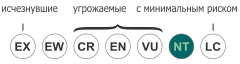
Propagated in colonies. The largest number of pairs nests in the Pacific Ocean in the region of Australia and New Zealand , although there are colonies in the Indian. In summer, birds fly into the northern part of the Pacific Ocean [2] . There, a potentially large number of individuals may be caught in by-catch networks as by-catch [3] [4] . Also, plastic debris floating on the surface of the oceans [5] [6] [7] is blamed for harming the pale-footed petrel population.
Notes
- ↑ Penhallurick, J., and Wink, M. (2004) Analysis of the taxonomy and nomenclature of the Procellariiformes based on complete nucleotide sequences of the mitochondrial cytochrome b gene. Emu 104: 125-147
- ↑ Bond AL and Lavers JL. 2015. Flesh-footed Shearwaters (Puffinus carneipes) in the north-eastern Pacific Ocean: a summary and synthesis of records from Canada and Alaska. Canadian Field-Naturalist 129: 263-267
- ↑ Reid T, Tuck GN, Hindell MA, Thalmann S, Phillips RA, Wilcox C (2013) Nonbreeding distribution of Flesh-footed Shearwaters and the potential for overlap with north Pacific fisheries. Biological Conservation 166: 3-10
- ↑ Lavers JL, Bond AL, Van Wilgenburg SL, and Hobson KA. 2013. Linking at-sea mortality of a pelagic shearwater to breeding colonies of origin using biogeochemical markers. Marine Ecology Progress Series 491: 265-275
- ↑ Bond AL, Lavers JL (2011) Trace element concentration in feathers of Flesh-footed Shearwaters (Puffinus carneipes) from across their breeding range. Archives of Environmental Contamination and Toxicology 61: 318-326
- ↑ Lavers JL, Bond AL, Hutton I (2014) Plastic ingestion by Flesh-footed Shearwaters (Puffinus carneipes): implications for fledgling body condition and the accumulation of plastic-derived chemicals. Environmental Pollution 187: 124-129
- ↑ Hutton I, Carlile N, Priddel D, 2008. Plastic ingestion by Flesh-footed Shearwaters, Puffinus carneipes, and Wedge-tailed Shearwaters, Puffinus pacificus. Papers and Proceedings of the Royal Society of Tasmania 142: 67-72