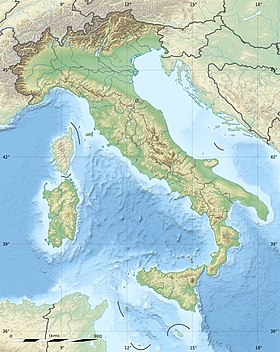
Marmore Falls ( Italian. Cascata delle Marmore ) is a man-made historic waterfall that is 7.5 km from Terni in the Italian region of Umbria . The highest waterfall of Umbria [1] ; according to some data, the highest man-made waterfall of Europe [2] or even of the whole world [3] . A popular attraction, the waterfall has both aesthetic and historical and engineering value. Included in the preliminary list of UNESCO World Heritage Sites [4] .
| Marmore Waterfall | |
|---|---|
| ital Cascata delle marmore | |
 | |
| Specifications | |
| Height | 160 m |
| Consumption | 15 m³ / s |
| Location | |
| A country |
|
| Region | Umbria |


Content
Description
The total height of the cascade is about 160 m, it consists of three steps, the highest is about 70 m in height. The source of the waterfall is the Velino River, which falls off a cliff near the commune of Marmore. Velino through a waterfall descends from the plain of Rieti ( Piana Reatina ) into the valley of the Nera River, flowing into the latter. Currently, the water supply to the waterfall is regulated by a certain schedule, which is designed to meet, on the one hand, hydropower needs, and on the other - the needs of tourists. Around the waterfall there are tourist routes with observation platforms.
History
Prehistoric Age
About 100 thousand years ago Velino merged with Nera, but as Nera deepened its valley, Velino enriched with calcium carbonate, on the contrary, formed a huge travertine plug on the border with the Nera valley [5] . As a result, a large lake was formed in the Rieti valley [6] . As a result of perennial fluctuations in its level, extensive wetlands have appeared, due to which the local population, Sabine , has suffered from malaria .
Antiquity
After conquest in 290 BC. er Sabatin Romans Reat (now Rieti ) has become an important strategic point on the Salt Road . In this regard, the conqueror of sabinov, Mani Kuriy Dentat , in 271 BC. er being a censor , he ordered to pierce a channel in the travertine rock to divert the lake waters ( Lacus Velinus , as the Romans called it) to the Nera valley. As a result of laying this channel with a length of 1000–1100 m, which was named Cava Curiana in honor of Mania Curia, a waterfall was formed [6] .
The work resulted in a significant drainage of the Reat valley (Rieti), which is confirmed, in particular, by modern paleoecology data [7] . New areas entered into agricultural use, and the epidemiological situation improved.
However, the canal and the waterfall caused a new problem: periodic floods in the Nera valley, which threatened the residents of the city of Interamna (now Terni ). It is known that in 54-53. BC er The Senate considered the litigation of municipalities - Reaty and Interamny. To resolve the issue, a commission of 10 senators arrived, headed by Consul Appius Claudius Pulchrome . The interests of Reaty in this litigation were represented by Cicero [8] . The flood problem was not solved either then or later, when it again worsened during the time of the empire [6] . The enmity of the two cities became chronic and later on reached bloodshed [9] .
Middle Ages and Renaissance
In the Middle Ages, the waterless structures that were left without care gradually became useless, which led to the shallowing of the waterfall and the new irrigation of the Rieti valley. By the fourteenth century, due to epidemics of malaria and a reduction in the area of agricultural land suitable for agricultural use, the Rieti Valley was depopulated.
In the late Middle Ages and the Renaissance, numerous attempts were made to restore the drainage system from the Rieti Valley:
- Cava Reatina (1385); architects - Favarone da Labro, Niccolo da Piediculo and Giovanni da Fermo;
- Cava Reatina (1422); the customer is Braccio da Montone , the architect is Fioravante Fioravanti (father of Aristotle Fioravanti );
- Cava Paolina (1547); customer - Pope Paul III , architect - Antonio da Sangallo the Younger (died during construction);
- Cava Farnesiana (1549), customer - Pope Paul III (the channel is named after the family to which it belonged);
- Cava Gregoriana (1575); the customer is Pope Gregory XIII ;
- Cava Clementina (1601); the customer is Pope Clement VIII , the architect is Giovanni Fontana (brother of Domenico Fontana ).
Of these channels, only the last one, built on the basis of the original channel, the ancient Roman Cava Curiana, was truly successful [6] .
New time
In the 18th – 19th centuries, the Marmore Falls became a popular attraction visited as part of the Grand Tour , as well as a fashionable location among landscape artists [6] . Among the famous visitors to the waterfall are Salvator Rosa , Koro , William Turner , George Byron and many others.
However, with the restoration of the canal, floods in the Nera valley resumed. In the second half of the 18th century, engineer Gaetano Rapini, who worked on the problem on behalf of Pope Pius VI , suggested closing Cava Clementina and returning to one of the previous versions of the channel, the flatter Cava Paolina . However, this proposal was rejected by the , in particular, for the reason that the waterfall had already become a famous landmark of the Papal State .
The last significant changes in the design were made in 1787-1793. commissioned by Pius VI under the direction of architect . As a result, the waterfall acquired its current form [6] .
The newest time
The flood problem was solved only in the 20th century, after dams regulating the water supply were built on the Velino's tributaries [6] .
In 1929, a hydroelectric power station Galleto was built in Terni, using the energy of a stream: water is supplied to it through an underground water conduit, bypassing a waterfall. For this reason, at present, the waterfall is included only for tourists, for several hours a day, according to the schedule [10] .
In 2006, the Marmore Falls was listed on the UNESCO World Heritage List .
In art
In addition to numerous incarnations in painting, the Marmore Falls is mentioned in Byron's Childe Harold Pilgrimage (4th Canto. Translation by V. Levik):
| But how water rustles! From the mountain to the valley Giant White Foam Wall - A wall of water! - Velino overthrows, Everything is overflowing with water ... |
Also, the waterfall can be seen in a number of films, including:
- " Interview " by Federico Fellini
- " Syndrome Stendal " Dario Argento
Notes
- ↑ European Waterfalls: Italy
- ↑ DK Eyewitness Travel. Umbria. P.14. Dorling Kindersley Limited. 2015. ISBN 978-1-46542-738-0
- ↑ Umbria: The Heart of Italy. Patricia Clough. Stones. Haus Publishing. 2009. ISBN: 978-1 909961 47 0
- ↑ UNESCO Tentative Lists: Cascata delle Marmore and Valnerina: Monastic sites and ancient hydrogeological reclamation works
- ↑ Marmore Falls: Geology
- ↑ 1 2 3 4 5 6 7 Laghi ed energia - ambiente storia economia dei laghi dell Italia Centrale. Il lago di Piediluco e la Cascata delle Marmore. Arpa Umbria, 2014
- ↑ 00 environmental Quaternary Science Reviews 116 (2015) 72-94
- ↑ Letters from Mark Tullius Cicero. July 27, 54, Att., IV, 15, 5.
- ↑ La cascata delle marmore (Terni-Umbria): storia ed evoluzione di un "geomorfosito". P. 324
- ↑ Schedule on the site of the waterfall
Links
- The official tourist site of the waterfall
- Laghi ed energia - ambiente storia economia dei laghi dell Italia Centrale. Il lago di Piediluco e la Cascata delle Marmore. Miro Virili (p. 33-73). Arpa Umbria, 2014
- L. Gregori, C. Troiani. La Cascata delle Marmore (Terni-Umbria): storia ed evoluzione di un "geomorfosito". EUT Edizioni Università di Trieste. 2016