With a bundle whose fibers are smooth manifolds (or smooth algebraic varieties ), we can associate some bundle with a flat connection , called the Gauss – Manin connection .
Definition
Let be 


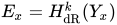


For simplicity, suppose for a moment that the layers are compact. The de Rham cohomology of a compact manifold is isomorphic to singular cohomology 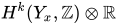


A description of the Gauss – Manin connection through flat sections provides a convenient way to visualize it, however, for its existence, the existence of an integer structure on cohomology is absolutely not necessary. She admits the following description. Choose in the bundle 

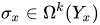


![{\displaystyle (\nabla _{v}s)_{x}=\left[\left(\mathrm {Lie} _{\widetilde {v}}\sigma \right)|_{Y_{x}}\right]\in H_{\mathrm {dR} }^{k}(Y_{x})}](https://wikimedia.org/api/rest_v1/media/math/render/svg/743f8c679bcab1b5416e1dd4db05e0feff7eeec8)


This definition of a Gauss-Manin connection is elegantly formulated in terms of differentially graded algebras . This allows us to transfer the definition of the Gauss - Manin connection to noncommutative geometry : Getzler [1] , and Kaledin [2] constructed the Gauss-Manin connection on periodic cyclic homology.
Application
Gauss - Manin connection in the first cohomology of a family of elliptic curves with equations over the punctured Riemann sphere parameterized by the complex parameter , defines a differential equation, known as the Picard-Fuchs equation . Gauss considered a similar equation for a family of curves ; a general description of such equations in the case when the base is an algebraic curve was given by Manin [3] , and in the general case by Grothendieck [4] . He belongs to the name “Gauss – Manin connection”, as well as an abstract algebraic-geometric description of this connection as one of the arrows in the Leray spectral sequence of for a suitable beam.
The Gauss - Manin connection is also used in symplectic geometry . Exactly let Is a bundle whose layers are Lagrangian tori. The tangent space to the base of such a bundle can be identified with a certain subspace in the space of sections of the normal bundle to the layer hanging above this point. But for a Lagrangian submanifold, the normal bundle is isomorphic to the cotangent, so that these sections define differential 1-forms on the layer. It turns out that these forms are closed, and their cohomology classes are all kinds of classes of the first cohomology of the layer. Thus, the tangent bundle to the base of the Lagrangian bundle is isomorphic to the bundle of the first cohomology of layers, and therefore has a canonical flat connection, Gauss – Manin connection. In mechanics, this statement has a corollary, known as the Liouville-Arnold theorem : for a Hamiltonian system having as many independent integrals in involution as there are degrees of freedom, equations of motion can be solved in quadratures. A holomorphic version of the Liouville-Arnold theorem defines a flat connection with monodromy outside some divisor on , the base of a holomorphic Lagrangian bundle on a hyperkähler manifold . The most obvious case when the total space is the K3-surface , the layers are elliptic curves, and the base is the Riemann sphere with 24 punctures, studied by Kontsevich and Soibelman [5] .