The deportation of Poles - the mass eviction of Poles who had in the territory of the USSR, in the areas of the Kazakh SSR and Siberia in 1936-1941. There were two waves of deportation - in April 1936 and 1940-1941. The first wave was the eviction of Poles and Germans from the border regions of the USSR. The second wave swept the Poles living in the newly joined areas of Western Belarus and Western Ukraine .
| Deportation of Poles | |
|---|---|
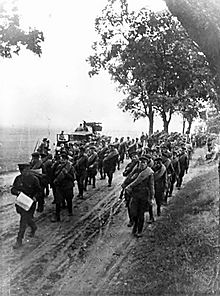
 Soviet and German zones of occupation of Poland | |
| Executor | NKVD |
| A place | border regions of the USSR |
| Result | deportation of settlers , refugees, “socially alien elements” |
Content
- 1 Background
- 2 Deportation
- 2.1 Deportation of 1936
- 2.2 Deportations of 1940-1941
- 2.3 After the amnesty
- 2.4 The crisis of Soviet-Polish relations
- 2.5 Relations with the local population
- 2.6 Results of deportations
- 3 Rehabilitation
- 4 See also
- 5 notes
- 6 References
Background
Siberia was a traditional place for the expulsion of Poles. In tsarist times , fighters for the independence of Poland often referred there. In 1920, the Polish 5th Siberian Rifle Division laid down its arms near Krasnoyarsk . Some of the soldiers of this division remained to live here [1] .
In 1920, Poland annexed Western Belarus and Western Ukraine . One of the consequences of this action was the oppression of Belarusians, Ukrainians, Russians . A concentration camp was created in Birch-Kartuzskaya , which contained thousands of representatives of the Eastern Slavs [1] .
In April 1936, the Soviet government "unreliable elements" from the western border regions of the USSR were evicted to the Kazakh SSR [2] .
On September 1, 1939, the refusal of the Polish leadership, supported by London and Paris , to conclude an agreement with Moscow provoked a German attack on Poland . On September 17, the Red Army entered the eastern regions of the country [1] .
Deportation
1936 Deportation
On April 28, 1936, the Council of People's Commissars of the USSR adopted a resolution which, in particular, stated:
| The Council of People's Commissars of the Union of Soviet Socialist Republics decides: To assign [to] the NKVD of the USSR resettlement and organization of settlements in the Karaganda region of the Kazakh Autonomous Soviet Socialist Republic for Polish and German farms resettled from the Ukrainian SSR in the amount of 15,000 households — 45,000 people according to the type of existing agricultural labor settlements of the NKVD. The relocated contingent is not limited in civil rights and has the right to move within the administrative district of resettlement, but does not have the right to leave the settlements [3] . |
According to this decree, 35,820 Poles were resettled, 99.8% of whom were in the northern regions of Kazakhstan. For the resettlement of arrivals, 13 villages were created near farms, which were settled by Poles from the Zhytomyr , Vinnitsa and Kirovograd regions [4] . The remaining deportees were settled in small groups in the districts of the RSFSR . 75.7% of the deportees were Poles, 23.4% - Germans , 0.8% - Ukrainians , 0.1% were representatives of other nationalities [2] .
Special resettlement farms were transformed into 28 collective farms . These collective farms were granted residential buildings, schools, children's institutions, hospitals in the form of a long-term loan for 8 years (until 1945). Due to economic weakness, farms could not make payments and develop. For this reason, the government of Kazakhstan appealed to the country's leadership with a request, firstly, to extend the full repayment of loans by 10 years; secondly, since the settlers did not receive compensation for their housing, reduce the cost of houses at the state expense by half [2] .
The authorities noted a number of shortcomings in the arrangement of the deportees:
| ... Medical assistance is insufficient and qualitatively unsatisfactory. The network of medical institutions is not equipped with medical workers ... The network of schools and political education institutions is not fully provided with appropriations for their maintenance and, moreover, is not provided with the necessary personnel. The situation is not better in the old villages of Osakarovsky , Telman districts of the Karaganda region , where due to the lack of allocations the authorities faced the need to close boarding schools, reading rooms, dissolution of students and teachers ... Polish and German schools are not equipped with textbooks in their native language [2] ... |
Deportations of 1940-1941
In 1939, the areas occupied by the Red Army became the western regions of the Byelorussian ( Vileyka , Baranovichi , Bialystok , Brest , Pinsk ), Ukrainian ( Volyn , Drohobych , Rivne , Stanislav , Lviv , Tarnopol ) and the Lithuanian SSR . The following year, the deportations of the Poles began [1] .
... successful work was considered when 2 kg of gold was mined within a month ... For the excavator to work, it was necessary to prepare the land, uproot the forest. This was done by the Poles. The dredge was electric. Electricity was carried out from the Kirovsky mine. Our huts were also lit by electricity. For two years, the dredge passed 2 kilometers. The power plant consumed 80 to 120 cubic meters of wood per day. The Poles needed to deliver this wood to the power plant. In the winter, so that the dredge's work continued as long as possible, we were ordered to chop and pull pieces of ice out of the water in a 40-degree frost. Two brigades were involved in this work, which replaced each other every half hour. When one worked, the other warmed itself near the furnace [1] .
The numerous nationalist-minded Polish diaspora , settled near the borders of the country, aroused concern of the Soviet leadership. The besiegers were deported to Siberia, which settled the eastern regions of Poland to consolidate the Polish presence [1] .
Another category of deportees was refugees who escaped from German occupation in the Soviet Union. Many refugees were able to take money, valuables, clothes, household items with them, which made it easier for them to live in a new place. Among the deportees there were also representatives of “socially alien” classes from among Belarusians , Ukrainians , and Jews . Entire families were deported people, thereby undermining the possibility of resistance to social changes in the newly annexed territories [1] .
The deportation was carried out in several stages: February 10, April 13 and June 29, 1940, in May-June 1941. Each stage was carried out in one day. The deportees were allowed to take up to a ton of property per family, the rest was surrendered to local authorities. Compensation was to be issued at the places of settlement. In the Krasnoyarsk Territory for 1940-1941 there were 15 538 settlers living in 48 special settlements, and 1459 refugees placed in 9 special settlements [1] .
The local government was obliged to provide housing and work, but on the ground this order of the center was not always carried out. Thus, the Krasnoyarsk Territory Executive Committee reported the unsatisfactory placement and economic structure of settler settlers in the region’s enterprises, families were housed in general barracks in conditions of high crowding, deportees were poorly provided even with basic foodstuffs, received insufficient medical care, which led to epidemic diseases [1] .
By Decree of the Council of People's Commissars of April 10, 1940 No. 497-178ss from Western Ukraine and Belarus to the Aktobe , Akmola , Kustanai regions , Pavlodar , North Kazakhstan and Semipalatinsk regions 60 667 (according to other sources 61 092) Poles were evicted. Of this number, 36,729 people were accommodated on collective farms, 17,923 on state farms, and 8,000 on workers' settlements in various industrial enterprises. 2036 Poles were placed in four special villages of the Stalin , Shortandinsky and Stepnyakovsky districts of the Akmola region and were used at the enterprises of the gold mining industry [2] .
After the amnesty
On August 30, 1941, the Sikorsky-Stalin treaty was signed, according to which the deported Poles were amnestied with the issuance of relevant certificates. However, in reality their situation has not changed. On the territory of the USSR, Polish government missions (delegates) were created. The delegates, together with the network of proxies of the embassy, were supposed to represent the interests of the Polish population. They organized and distributed charitable assistance of the Red Cross , material and financial assistance of the Polish government, sent volunteers to the Polish army [1] .
All children ate three times a day, and a group of kids (mine) received an additional lunch. Dinner was always cooked, and for other meals, mainly sandwiches with canned fish were served. The main products, such as canned fish and meat, flour, sugar, cereals, etc., were received in the framework of American assistance by UNRA, and the local collective farm gave us bread, milk and root crops for the workdays worked by senior pupils. Once a week, we organized a bath [1] .
In Siberia, delegates were created in Krasnoyarsk, Abakan , Minusinsk , Chernogorsk , Ust-Abakan , Krasnoturansk , Kazachinsky . Also in Krasnoyarsk and other large cities of the region, a network of warehouses was created that distributed humanitarian aid from the Polish embassy [1] .
In the first half of 1942, the Polish embassy managed to open guardianship and trusteeship institutions in the Krasnoyarsk Territory. Polish orphanages were established in Kazachinsky ( Porozhsky orphanage), Minusinsky ( Malominusinsky orphanage) and Bogradsky districts ( Bolsheerbinsky orphanage). In 1943, there were 150 children in the Bolsherbinsky orphanage, 171 children in Malominusinsky, and 250 children in Porozhsky. According to Boleslav Vlodarchik, one of the pupils of the Porozhsky orphanage, the main contingent of pupils were children of seriously ill parents who could not support them, children of invalids, children of military personnel of the Polish army, children of seasonal workers in logging farms, collective farms, and river fleets. In the spring of 1946, Polish orphanages moved to their homeland [1] .
The Polish delegation contributed to the creation of homes for the disabled in Aban and Agul , schools in Chernogorsk, Bograd , Krasnoturansk, Ust-Abakan, kindergartens in Chernogorsk and Ust-Abakan. Where the Poles worked on logging, canteens were opened: in Innokentyevka , Kozulka , Partizansky , Mansky districts . A pharmacy was opened in Minusinsk. In January 1942 - March 1943, the Polish embassy, through a local trading network, supplied its tribesmen with products, bread and grease cards, clothes, shoes [1] .
According to the statistics of the NKVD , in the beginning of 1943, 8471 adult Poles lived in the Krasnoyarsk Territory. In June of that year, there were already about 14 thousand Polish citizens in the region, including 4987 under the age of 16 years [1] .
The crisis of Soviet-Polish relations
After the beginning of the cooling of the Soviet leadership with the Polish emigrant government on January 26, 1943, by order of the Council of People's Commissars of the USSR , the closure of delegates began. The solution to the problems of the Polish population was now vested in the local Soviet bodies. Work began on the acceptance of property of the Polish representative office and charitable institutions. All cash was taken into account. For this reason, the supply of Polish citizens deteriorated, they stopped issuing food rations [1] .
On April 25, 1943, diplomatic relations with the Polish government in exile were officially broken. The formation of the Union of Polish Patriots (SPP), which pursued the policy of Soviet power, began. In the Krasnoyarsk Territory, the regional board of the SPP was created, which over time took over some of the functions of the delegate. To supply the Polish population in May 1943, the Commissariat of Commerce of the USSR created Uprosobtorg (Special Trade Directorate) [1] .
Relations with the local population
Simple Kazakhs treated the deported with compassion. For example, the deputy head of the agricultural department of the Central Committee of the All-Union Communist Party of Bolsheviks, Itskov, informed the secretary of the Central Committee, Andreev, that on one of the collective farms in the Kustanai region “they arranged such a cordial meeting that they gave them daily milk yield from the farm, so that even the children of collective farmers in the playground were left without milk” [2] .
Results of deportations
According to the USSR Prosecutor General A. Ya. Vyshinsky , 389 382 people were deported from November 1939 to June 1941. 52% (202.5 thousand) of this number were women, and 12% (46.7 thousand) were children. During the first year, approximately 10% of the total number of deportees (about 39 thousand people) died along the way and in the local area [5] . According to Polish researchers, who rely on indirect data, about one million [5] (according to other sources, about 1,200,000 [6] ) were deported by the sum of all the stages.
Rehabilitation
On November 14, 1989, the Declaration of the Supreme Soviet of the USSR “On the recognition of the repressive acts against people who were forcibly resettled and ensuring their rights” was unlawful and criminal ”was adopted, according to which all repressed peoples were rehabilitated, and the repressive acts against them were recognized illegal and criminal at the state level a policy of slander , genocide , forced displacement, the abolition of the national state entities, to establish a regime of terror and violence in places spetspose eny [7] .
On April 26, 1991, the RSFSR Law on the Rehabilitation of Repressed Peoples was adopted, which recognized the deportation of peoples as "a policy of slander and genocide." Among other things, the law recognized the right of repressed peoples to restore the territorial integrity that existed before the unconstitutional policy of forcibly redrawing borders, to restore national-state formations existing prior to their abolition, as well as to compensation for damage caused by the state [8] .
On April 14, 1993, the Law of the Republic of Kazakhstan On Rehabilitation of Victims of Mass Political Repressions was adopted. In 1997, speaking at a session of the Assembly of the People of Kazakhstan , President N. A. Nazarbayev said:
| There is not a single nation, not a single nation to which totalitarianism would not have caused devastating and, unfortunately, irreparable damage in some ways [4] . |
One of the consequences of the deportation was the emergence of the Polish diaspora in Kazakhstan .
See also
- Katyn execution
- Polish operation of the NKVD (1937-1938)
- The executions of prisoners of the NKVD and the NKGB (1941)
- Polish Siberians
Notes
- ↑ 1 2 3 4 5 6 7 8 9 10 11 12 13 14 15 16 17 krskstate .
- ↑ 1 2 3 4 5 6 Shotbakov .
- ↑ V. Molotov , I. Mezhlauk . Decree of the Council of People's Commissars of the USSR No. 776-120ss . Historical materials (April 28, 1936). Date of appeal October 13, 2018.
- ↑ 1 2 articlekz .
- ↑ 1 2 secret .
- ↑ AFP / Expatica (30 August 2009), Polish experts lower nation's WWII death toll, Expatica Communications BV
- ↑ Art. 2 of the Law “On the rehabilitation of repressed peoples”
- ↑ Law of the RSFSR of 04/26/1991 "On the rehabilitation of repressed peoples" (as amended and supplemented) . base.garant.ru (April 26, 1991). Date of treatment February 14, 2018.
Links
- Ethnic deportation of Poles . Encyclopedia of the Krasnoyarsk Territory (September 17, 2014). Date of appeal October 13, 2018.
- Shotbakova L.K. From the history of the deportation of Poles to Kazakhstan (first half of the 20th century) . National digital library of Kazakhstan . Date of appeal October 13, 2018.
- R.M. Zhumashev, S.V. Eleukhanova. Deportation of Poles to Kazakhstan in the 30s and 40s of the 20th century: analysis of historical sources . Scientific articles of Kazakhstan (2014). Date of appeal October 13, 2018.
- Maxim Petrov. Deportation of Poles (2008). Date of appeal October 15, 2018.