The White Lake is a self-cleaning lake in the middle of the Volga Upland , on a high watershed plateau with an absolute height of 320 m. It is a monument of the ice age, the age of the lake is estimated at 250 thousand years. Protected areas since 1974 [2] .
| White lake | |
|---|---|
 | |
| Morphometry | |
| Absolute height | 327.7 [1] m |
| Dimensions | 1.6 [2] × 1 [2] km |
| Deepest | 6 [2] m |
| Average depth | 3,7 m |
| Hydrology | |
| Transparency | 0.8 m |
| Location | |
| A country |
|
| The subject of the Russian Federation | Ulyanovsk region |


Content
Location
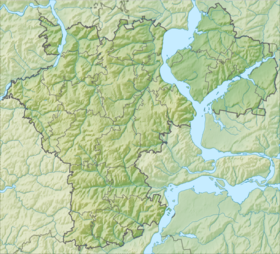
White Lake is located 260 km from Ulyanovsk on the territory of the Nikolaev district of the Ulyanovsk region [2] . The resort is located 12 km south of the Moscow-Samara-Ufa-Chelyabinsk motorway. A railway runs parallel to the motorway.
Description
Named for exceptionally clean water and white sand at the bottom. The form is oval, the water is clear with little mineralization. The silt of the lake consists mainly of dead algae, pollen of conifers and other plants, shells of rotifers and lower crustaceans, plant debris and a small amount of sand. The shores are low, flat, in some places boggy. The lake is not flowing, water is supplied by atmospheric and groundwater. The thickness of ice in winter reaches 0.5-0.6 m.
The lake is of great scientific interest, since representatives of the flora of the ice ages have been preserved here. On the shores you can find perennial pines, maples, lindens, as well as dwarf birch, mosses and lichens. This peculiarity is explained by the significant height of the place, so the area has lower temperatures and increased rainfall.
Academician B.A. Keller , visiting the lake in 1911, called it a corner of Finland, due to the nature of nature, characteristic of the more northern regions. Professors of the Kuibyshev Medical Institute P.N. Klimovitsky and V.N. Shikleev found that the air in the lake area is enriched with light aerons and their amount is 2.3 times higher than in the Kislovodsk resort.
The uniqueness of the nature of White Lake made it possible to declare it a natural monument.
Limbai
Limbai is a swamp of White Lake adjacent to the eastern side. The area of this swamp is 0.075 square kilometers. The peat deposit with a thickness of 2 m is composed of sphagnum and sedge-sphagnum peat . The age of the alloy, determined according to the spore-pollen analysis, is about 6000 years, that is, it was formed in the middle of the Atlantic period of the Holocene . The dominant plant communities of the Limbay swamp belong to the reed-hairy-sphagnum association. In the moss cover, bulging sphagnum predominates, less commonly found: one-sided sphagnum, Magellan sphagnum, sinuous sphagnum, central sphagnum.
Plant World
Vegetation is represented by a large mass of mixed forest with a predominance of conifers and centuries-old oaks. They play the main role in creating a favorable climate, improving the natural environment (in regulating heat and moisture, increasing the oxygen content and level of ionization of the air, increasing its phytoncidity).
The main forest-forming species around the lake is pine, it accounts for 58% of the forest stands.
Fauna
Phytoplankton of the lake has 34 species [2] . The ichthyofauna is represented by pike , perch , loach , tench [2] and bream.
History
In the past, the lake was surrounded on all sides by a sphagnum rafting . However, in the 40-50s of the 19th century, the landowner Saburov lowered part of the water through a ditch into the Kadadu river, where the mill was built. As a result, the water level in White Lake dropped sharply, and the bulk of the float remained on the dry shore.
The remains of this rafting still found in the years 1904-1906 B.I. Dixon and B.A. Keller . The edges of the former rafting had the appearance of a shaft or ridge separated by sandbanks from a water mirror. In 1912, the forestry scientist G.M. Gan decided to flood the White Lake, for which he dug a series of ditches along which meltwater could flow. As a result, the water level in the lake increased and sandbanks were flooded.
To date, rafting has been preserved only in places. Such is the Limbay swamp , the western side adjacent to the lake.
In the early 1930s, they began to build pioneer camps and rest homes. In the late 1980s and early 1990s, three rest houses, one sanatorium, 12 pioneer camps and recreation centers, and auto-camping were built. During the summer season, up to 30 thousand people rest. The White Lake District is a place for treating children with pulmonary and cardiovascular diseases. In 1990, a conclusion was received by geological organizations on the likelihood of revealing mineral waters and peat muds with medicinal and balneological properties in the lake zone. At present, almost the entire coast of the lake, which is about 70 hectares, has been developed under the health resorts that form the resort area.
Ecology
In the late 1980s, the resort area began to increasingly experience the negative impact of the anthropogenic factor . A large number of untreated effluents led to a change in the hydrochemical composition of the lake water. Aquatic vegetation appeared, and active overgrowing of the lake began. Water transparency decreased from 3 m to 0.8 m. The ground vegetation around the lake began to die as a result of trampling of the surface soil layer.
When comparing the modern description of vegetation with the description of B.A. Keller , made at the beginning of the century, it is possible to trace significant changes in the nature of vegetation: over the past period, marsh cranberries and bog myrtles have almost completely disappeared, the roundwort has become less abundant and more oppressed. All these three species are located in the Ulyanovsk region on the southern border of distribution, therefore they are rare and require comprehensive protection.
The species composition of sphagnum mosses has not undergone significant changes.
2010
Due to abnormal heat and careless handling of fire, a fire occurred in late July. The Limbay swamp and most of the coastline burned. The lake noticeably crushed for 2009-2010, the water left the shore by 8-10 meters.
Notes
- ↑ Map sheet N-38-106 Kuznetsk . Scale: 1: 100,000. 1976 edition.
- ↑ 1 2 3 4 5 6 7 White Lake . mpr73.ru. Date of treatment April 13, 2016.