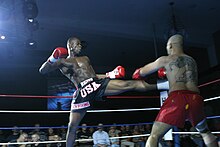

Kickboxing (from kick , from the English. - “ kick ”; boxing - “ boxing ”) - martial arts, which originated in the 1960s. It is divided into American kickboxing (full-contact, full-contact with low-kick , seven-contact, light contact, kick-light), Japanese kickboxing ( K-1 format ), solo compositions (musical forms). In the broad sense of the word, kickboxing is sometimes understood to mean various martial arts, the rules of which allow punches and kicks using boxing gloves ( Thai boxing , boxing , sanda , savat , etc.).
Content
- 1 History
- 1.1 American kickboxing
- 1.2 Japanese kickboxing (K-1)
- 2 Rules
- 2.1 Kicking
- 2.2 Sweeps (foot sweeps)
- 2.3 Kicks
- 2.4 Forbidden punches
- 2.5 Outfit in kickboxing
- 3 Kickboxing in Film
- 4 Kickboxing in computer and video games
- 5 Kickboxing in Russia
- 6 notes
- 7 References
History
American kickboxing
The homeland of the "American" branch of kickboxing is the United States. Here, in the 1960s, in the wake of the popularity of martial arts, full-contact fights began to be practiced, where, unlike most of the rules common at that time, taekwondo and karate-setokan , there were no restrictions on the strength of strikes, the referee did not stop the fight after the technical action (having reached the goal of the strike), punches to the head were allowed (for which purpose the equipment and equipment - gloves were borrowed from boxing). Initially, the new sport was called “full-contact karate” ( English full-contact karate , full-contact karate). Moreover, the term "karate" refers to any martial arts, be it karate , taekwondo or wushu . Soon, due to protests by traditional karate functionaries, the name had to be abandoned by adopting a new term - kickboxing. As for the “full contact”, this name has been preserved for one of the kickboxing sections. In 1974, the first professional kickboxing organization was founded - PKA (Professional Karate Association), which actually became the date of kickboxing's birth as an established sport.
American kickboxing very quickly penetrated into Europe. It was in Europe in 1976 that the oldest amateur kickboxing organization WAKO (World Association of Kickboxing Organizations) was founded. [one]
On November 30, 2018, WAKO gained membership in the (IOC) for the next three years. The decision was made at a meeting of the IOC Executive Committee in Tokyo. And this means that kickboxing is temporarily recognized as an Olympic sport.
Outstanding representatives of American kickboxing: Bill Wallace, Benny Urkides , Don Wilson , Maurice Smith, Dennis Alexio, Stan Longinidis, Marek Petrovsky, Jean-Yves Terrier, Rick Rufus.
Japanese Kickboxing (K-1)
The “Japanese” branch of kickboxing is related to the penetration of Thai boxing into Japan, which, despite competing with karate-kyokushin , was able to occupy its very vast niche, but not in its pure form, but in a modified one. In fact, Japanese kickboxing is a redesigned Thai boxing rule. Significant differences were the ban on elbow strikes (it was believed that dissections often inflicted by the elbow harm entertainment, since the public prefers “clean” knockouts rather than stopping fights due to injuries) and a different approach to scoring (balanced assessment of punches and kicks in contrast from Thai boxing, where kicks are rated higher). In the 1970s, three main organizations developed Japanese kickboxing: AJKBA (All-Japan Kick-Boxing Association), WKBA (World Kick-Boxing Association) and Kakutogi League. After a number of Japanese kickboxers became involved in crime relations in 1981, Japanese organizations fell into decay, losing the first role to the American WKA. Since the end of the 1980s, local kickboxing functionaries began to appear again, and in 1993 K-1 appeared , turning Japanese kickboxing into one of the most developed professional martial arts in the world.
Together with Thai boxing, Japanese kickboxing came to Europe, first of all, to Holland, which has become one of the world's major kickboxing centers (it is worth noting that out of 18 K-1s in the heavy weight, 15 won by the Dutch).
Outstanding representatives of Japanese kickboxing: Toshio Fujiwara, Rob Kaman, Ivan Hippolit, Peter Arts , Ernesto Host , Andy Hoog, Remy Bonyaski, Masato Kobayashi, Andy Sauver, Mirko Filipovich , Buakhau Banchamek , Gevorg Petrosyan .
Rules
Kickboxing Sections
1. Family Contact (Limited Contact)
A kickboxing section in which strong, punctuated kicks and kicks are prohibited. Due to these limitations, the pace of the battle is higher than in full contact. Victory is awarded to an athlete who has demonstrated the best technique for working arms and legs and, accordingly, has inflicted a greater number of kicks and arms. The fight is intermittent, because after a clean kick or kick the referee stops the fight and scores points.
2. Light contact (Light contact)
The kickboxing section, which is characterized by the prohibition of strong kicks (except when the opponent unexpectedly started to hit), this counts knockout or knockdown (if any), but points are not counted. Kicking is preferred, and jumping kicks are the highest among them. Unlike seven-contact, in this style, fighters do not stop after striking. Referees score points for every hit that reaches the goal.
3. Full contact (Full contact)
The kickboxing section, in which kicks and arms are applied without force limitations, is in full contact. As in boxing, knockdowns and knockouts are counted. Kicks are allowed only above the waist.
4. Full contact with low kick
The kickboxing section, which allows kicks on the outside and inside of the thigh, is FORBIDDEN to hit a low kick in the knee and strike in the calf muscle. It is allowed to hook into the ankle (hook).
5. K-1
A kickboxing section where knees and joints can be kicked. It is also allowed to strike the back of the glove with a 360 ° turn (backfist), both in the head and in the body. K-1 is considered the toughest section in kickboxing.
6. Solo compositions
A kickboxing section in which competitions held to music include three kinds. Compositions are performed in a “hard” style, in a “soft” style and with objects, including fragments of traditional complexes of formal exercises of martial arts. Compositions in the "hard" style reproduce the characteristic plastic of the "shadow boxing" of traditional martial arts, such as karate - do, taekwondo and others. Compositions in the “soft” style are based on the technique of martial arts such as wushu. Compositions with objects are performed as a “shadow fight” with any melee weapon - a sword, knife, stick, nunchaku, sickle, mace, etc.
Kicks
Kicks are impulsive, explosive, ballistic, with a rectilinear or curvilinear trajectory, reciprocating movements of the kickboxer's legs, reaching the opponent’s body tightly with the inside or outside of the foot. The following types of kicks are used in a duel:
Back kick (back kick) - This kick is more often delivered with the legs farthest from the opponent and a turn. First, a 180 ° turn is made on the supporting (closest to the opponent) leg. At the same time, over the shoulder (the right one when hitting with the right foot), you need to see the target. Further, the shock leg, unbending in the knee and amplified by the push of the supporting leg and the movement of the pelvis in the direction of the target, strikes with the heel. The movement is like a kick of a kicking horse. This is a very powerful blow used to solve a variety of combat missions in the ring. After contact with the target, a turn can be made further, up to 360 °, in order to occupy the position of the fighting stance. With a 180 ° turn of the leg, a shock movement in a jump can occur. This is a very beautiful and quick punch. A blow can be applied both to the head and to the body of the enemy.
Jumping kick (kicks in a jump) - Almost all kicks (and punches including) can be applied in a jump. This gives them a certain originality. However, such strikes are infrequent. They are spectacular, but ineffective. The exception, perhaps, is only a kick back. In addition, jumps violate the rhythm of the battle and take a lot of energy. Speaking of kicks, it should be noted that they are used extremely unevenly. The most commonly used are semicircular, reverse round kicks with a turn, chopping strokes are used very rarely, and in many battles athletes do without them.
Crescent kick (reverse side kick) is one of the easiest kicks to the upper level, which does not require perfect twine. This blow is applied by the external or internal edge of the foot, depending on its direction (external or internal). A blow can be applied both from the front and from the foot farthest from the opponent. Despite the fact that he is not very beautiful, he is loved by many for his simplicity and speed.
Low kick - a circular (usually) blow is applied to the opponent’s inner or outer thigh. Such attacks reduce the speed of the opponent’s movement, with good performance - they injure the lower limbs, which leads to the cessation of the battle. Among all types of round kicks or any similar kick, low kick is not permitted in all kick boxing rules. But if it is already used, then as a very effective, knockout technique. This blow is very fast and very stable, which allows it to be included in any combination and start an attack with it. At the same time, sometimes they forget about this simple technique without seeing the whole variety of ways and moments for its application.
Round kick (roundhouse kick) (round kick) - this kick is usually applied to the head, which allows you to use the force of bending the legs. Such an implementation creates difficulties in protecting against this blow, since the leg can bypass the blocking arm. At the beginning of the strike, the upper part of the body unfolds along the path along which the strike will be delivered, after which the supporting leg is turned 90 ° (sometimes 180 °), the knee of the bent leg rises to the chest, and an extension of the knee is struck by raising the foot or lower leg. A blow can be struck at all levels, in this case the word “round” is not pronounced, but a prefix is added (high-kick - from the English. “High” - “high”, the middle-kick - from the English. “Middle” - “medium” (in height), low-kick - from the English “low” - “low.” According to the application technique it can be easy, but fast (“click”), and can be slower, but more powerful (“with carry”) .
Side-kick (side kick) - At the beginning of the kick, the knee of the striking leg is brought to the level of the chest with its bending at the knee joint. The blow is made by twisting the movement of the leg with its simultaneous extension in the knee joint. At the same time, the pelvis, moving forward, in the direction of the impact, strengthens and lengthens it, increasing the momentum coming from the push of the supporting leg. In the final position of the impact, the outer surface of the impact leg is facing up (thigh and lower leg). The shock leg and torso should lie in the same vertical plane. The impact location for this strike may be the heel, sole or “rib of the foot”. This blow can be applied both to the head and to the body, both from the leg farthest from the enemy, and from the nearest. In the latter case, it is more often applied with the foot stepping farthest from the enemy.
Ex-kick (hit from above) - A hit with the heel from top to bottom, as if with an ax - a rather amplitude hit. It’s not easy to knock them out, but you can embarrass, scare the enemy. The audience who came to see the show performed by professionals is delighted with this beautiful blow, from the side it looks like a stretch on a longitudinal twine. This technique is often misleading to opponents. The leg, which drops sharply from top to bottom, is often not noticeable. With good execution, there is a chance to break the opponent’s collarbone. A kick can be applied with a turn, like a hook-kick, with the difference that the leg will end to move perpendicular to the ground, and not parallel. In this case, the strike can also be applied in a jump (there is no support, therefore a weak damaging moment).
Front kick (direct kick) - In the ring, it is quite difficult to punch an opponent with a direct kick or kick to the side (the reason for this is the rules prohibiting any kick to the lower abdomen, as well as the training of fighters who can both beat and take such punches). You can apply these blows to the head, but more often they are used to control the distance with the enemy, stopping the opponent’s attacks and starting their attacks. A blow is applied by the heel or cushion of the foot. In the direction it can be ascending, parallel to the ground or descending, in the latter case the usually “kicking” blow to the head is inflicted.
Hook-kick (hit-hook) - It is produced by a movement having a trajectory opposite to a circular blow. The beating leg is carried forward - up - to the side and then hit with the heel or the entire foot (like a slap in the face). The trajectory of the blow is similar to the trajectory of the backfist with the only difference being applied by the foot. A strike is usually carried out from the front leg, with the aim of exploration. A round-robin can also be applied with the legs farthest from the enemy with a 360 ° turn. In kickboxing, he is known as a spinner. In this case, the blow is very strong. First, the fighter turns in the direction of the strike, twisting the body and fixing the target, after which he takes the bent knee of the shock leg up and sideways, stepping on the supporting leg or slipping on the toe of the foot, then straightens the knee, continuing the impulse by twisting the body and turning the pelvis, and then sharply connects the muscles of the buttocks and flexor muscles of the thigh, striking with flexion of the knee. The blow is made with the leg farthest from the opponent (the right one in this case) and with a clockwise turn. After striking, the leg continues to move along a predetermined path, the 360 ° turn will end, the athlete will again take the position of the usual fighting stance.
Sweeps (foot sweeps)
The sweeps used in kickboxing include: sweeping by raising the foot; hooking with the inside of the foot; a sweep performed with a 360 ° turn, that is, a leg farthest from the opponent (a movement that is largely similar to a reverse circular kick with a turn). Through sweeping, a variety of combat missions are solved: to deprive the enemy of balance, to reduce the pace of battle.
Kicks
The basics in kickboxing are the same as in classic boxing: racks, methods of movement, methods of defense and, of course, punches coincide, but kicks are the basis for actions. The basics of boxing with hands are very important. Many beginner kickboxers begin to get involved in kicks, especially outwardly spectacular, but this is what should be avoided. Just think about how vast and deep the boxing technique is, since many pros devote their whole life to improving it, while kickboxers also have to practice kicking. There is no time to practice spectacular but ineffective kicking.
Uppercut (Punch from the bottom left ) - This punch is more often delivered in the body. When applying it, the body weight is transferred to the left (standing in front) leg, the torso slightly rotates to the left around the vertical axis, the arm is retracted back and down - the position of the swing is created. Then the body turns to the right, around the vertical axis with the simultaneous push of the left leg. This blow is applied in an arc from bottom to top. Body weight can remain on the left foot, and can be transferred to the right. Upon impact, the back of the hand is facing the enemy.
Uppercut (Strike from the bottom right ) - At the beginning of the strike, the torso turns left or right around the axis with a simultaneous push from the support of the right leg standing behind. The right hand is slightly retracted back and down. Next, the right shoulder is brought forward and this blow is inflicted from the bottom up. Body weight is transferred to the anterior left leg. At the moment of impact, movements in the elbow and shoulder joints should be blocked in order to impart sufficient rigidity to the impact. The blow can be applied both to the head and to the body.
Backfist (spinning punch with the right hand) - However, in kickboxing there is one trick that is not in boxing. In case of surprise, this technique is able to send the enemy to a knockout. And since it is prohibited in boxing, it requires careful testing. Performing it, keep track of the distance. It often happens that the blow is obtained with the forearm, not the fist. And this is already prohibited by kickboxing rules. In making this strike, it is necessary to make a sharp 360 ° rotation around the axis passing through the forward-standing left foot and the shoulder of the left hand. At the same time, the legs and pelvis make a turn more sharply and overtake the body, shoulders and beating arm. This twisting gives the elastic deformation necessary for impact. The right hand makes a circular motion clockwise and can be more or less bent at the elbow. The blow is applied with the back of the brush.
Jeb (Direct hit with the front, that is, the hand closest to the opponent) - By pushing the right foot and turning the body to the right (direct hit with the left hand), the left hand is sent in a straight line towards the target. In the final position of the impact, the weight of the body is largely on the left leg. There may be some backswing before the strike. To do this, the body rotates to the left around the vertical axis, the left fist is somewhat moving away from the target. Swing increases the strength of the strike. The fist in contact with the target can be reflected with your fingers down or to the right, which is equally correct and due to the personality of the athlete. The right hand protects the torso and head. This kick is one of the most commonly used kickboxing.
Punch (Direct hit by the farthest hand from the opponent) - With this hit, the right hand (direct hit with the right hand) is already in the swing position. However, the fist makes a longer movement to the target and, accordingly, this blow is used much less often than the jab. This is one of the most powerful punches. He often in cases of pure contact leads to the cessation of the battle. Performing this blow, the kickboxer turns the body around the vertical axis to the left with a simultaneous push of the right leg. Later, the right arm begins to straighten in the elbow joint with the continuation of the rotation of the body and pushing the leg away from the support. The right shoulder is brought forward. At the end of the impact, the OCT shifts to the front border of the support area and is projected in the area of the foot of the forward left foot. With a direct hit with the right hand, it is very important to perform a fairly complete turn of the body to the left. This determines the impact length. Some authors give such a guideline - a vertical drawn from the armpit of the right hand should pass through the knee of the supporting (left) leg. The left hand in this blow insures the head and torso from possible oncoming blows of the enemy. A movement is made along a trajectory that runs somewhat from top to bottom, towards the target from the initial position of the fist. However, this opens the head for oncoming attacks by the enemy.
Swing (Side impact from a long distance) - Apply it from the fighting stance with an almost straight arm. From the left-side strut, the initial movement for the strike begins with the right foot, imparting the weight of the body to the left foot stepping forward; at the same time with the left hand lowering it slightly, they make an arcuate movement, starting it from the bottom up and then horizontally to the very target. This combat movement of the hand contributes to the rotation of the body to the right. The blow is fixed on the target with the usual place of the fist, turned fingers out. The right hand is left for head insurance, protecting it with an open palm from the oncoming blows of the enemy.
Hook ( Left side kick to the head) - Along with the right direct hit to the head, the left hook is one of the leaders in the number of knockouts made by applying it. Especially often, it is applied at a jump forward, under the step of the opposite (right) leg or after a right direct hit to the head or body (we are talking about a blow from the arm closest to the opponent). To accomplish it, a certain swing is done first. For this purpose, the body should be slightly turned to the left around the vertical axis. Body weight is also transferred to this (left) leg. The shock movement, similar to the ones described above, begins with the rotation of the body to the right with the simultaneous repulsion of the left foot from the support. However, here the strike is made along an arc going from left to right. With this impact, the arm can be more or less bent at the elbow joint, depending on the necessary characteristics of the trajectory.
Hook (Lateral right punch to the head) - It can be more or less long. This is determined by how bent the kicking arm is in the elbow joint. With a long stroke, the angle between the shoulder and forearm is dull. The right hook (with the hand farthest from the opponent) is applied in a movement similar to the right direct hit, except for the trajectory of the strike. She is curved. The blow goes along the arc from right to left. Since reactive forces arise with this variant of the shock movement, further pushing the BTC to the left, in the direction of the target, a stable position is achieved by increasing the area of the support along the front (legs are spaced somewhat wider than with a direct right strike).
Jolt - refers to direct strikes. essentially a counterattack. applied at the hand of the opponent at the time of impact, target - head / chest.
Cross (Eng. - Cross) - refers to direct strikes. essentially a counterattack. It is applied both left and right. applied over the opponent’s hand at the time of impact, the goal is the head
Forbidden Hand
- Hit with an open glove
- Hit the inside of the glove
- Hit with the side of the fist (allowed in semi-contact fights)
- Hit the lower or upper side of the fist (permitted in semi-contact fights)
- Impact on the inside of the hand (permitted in semi-contact fights)
- Beat the wrist. In addition, impacts and shocks from the forearms are also not allowed.
Kickboxing Outfit
At the moment, kickboxing is a sport with clearly established rules, a mandatory point in which is the presence of protective equipment on the athlete. Before the start of the battle, the referee checks the availability of protective equipment and suitability for use. Let's consider in more detail what should be worn on a fighter:
In any section of amateur kickboxing, the presence of a protective helmet is necessary. In some cases, the use of a training helmet is allowed. The kickboxing helmet differs from the boxing helmet with enhanced protection of the top of the head, which is due to the presence of high kicks in the kickboxing technical arsenal. The presence of a mouth guard is also checked.
Athletes must wear boxing gloves that comply with the rules of kickboxing. Some sections of kickboxing (Light-contact, Semi-contact) use gloves with an open palm. The sections full contact, full contact with low kick, kick light, K-1 use standard boxing gloves of 10 ounces, red or blue (for the color of the corner).
Gloves should be worn before entering the ring, hands should be taped with bandages of a certain length.
All fighters are checked for the presence of a protective inguinal shell; for girls, the presence of a protective cuirass is desirable.
Athletic legs should be protected by shields. This is a prerequisite for seven-, light-contacts and for full-contact. Since kickback kicks are allowed by the rules of the rest of the kickboxing sections, the presence of protective shields on the lower leg is specifically stipulated in the provision for the competition.
Feet protected with closed heel feet. It is not allowed to use karate pads on the shins with a “tongue”, foot for hand-to-hand combat. Feet should be worn on the bare foot.
Knitted knee pads, elbow pieces, ankles of non-traumatic species are allowed.
If, when checking the protective equipment, the referee finds that there is no complaint, or there are complaints about the condition of any item, the referee requires replacement or completion and allocates time for this, no more than one round. If after this time the fighter is not ready for battle, he will be disqualified.
Such high requirements for protective equipment are aimed at minimizing the risk of injury to an athlete during the fight and increasing the spectacle of fights conducted according to the rules of kickboxing.
Kickboxing in the cinema
The appearance of kickboxing in the USA in the second half of the 20th century coincided with the development of the video market . Kickboxing as a new spectacular form of martial arts was in demand in the genre of action , the star of which since the mid 60's was Bruce Lee . Kickboxers who completed a sports career in the ring became stunt directors, stuntmen and actors , demonstrating kickboxing techniques on the screen. In 1972, Chuck Norris (The Return of the Dragon ) starred with Bruce Lee. Soon on the screen appear Bill “Superfoot” Wallace (“The Power of the Single”, 1979), Joe Lewis (“The Power of the Five”, 1981), Don “The Dragon” Wilson (“The Bloody Fist ”, 1989). In the same 1989, the movie “ Kickboxer ” was released with the participation of Jean-Claude Van Damme and Michel Kissy . In total, five parts of this film were released, in which martial artist Mark Dacascos also starred.
The specifics of the film industry led to the participation in the roles of heroes demonstrating kickboxing techniques, not only professional athletes, but also actors. As a rule, actors previously engaged in amateur sports were invited to such roles. Among them were Lorenzo Lamas (“ Fighter 's Night, or Kickboxing in the USA ”, 1990), Carey-Hiroyuki Tagawa and Sasha Mitchell (“ Kickboxer 2: The Way Back ”, 1991).
Kickboxing in Computer and Video Games
- Street Fighter is the character of Joe, champion of the underground kickboxing championship. Street Fighter II also features an additional character, Dee Jay, a kickboxer from Jamaica
- Virtua Fighter 5 - character Brad Burns (Brad Burns), Italian kickboxer and seducer
- Sonic Battle - character Bat Rouge uses a large number of kickboxing tricks
- Tekken 5 - Character Brian Fury is a kickboxing master adapted for special forces.
- [[K-1 world version of W5 Grand Prix]]
- Nekketsu Kakutou Densetsu is a Kunio-kun character.
- EA Sports MMA
- UFC Undisputed 2010
- UFC Undisputed 3
- Mortal Kombat 9 - Character Johny Cage
- Panza kick boxing - Developer: Futura
  Publisher: Loriciel
                       Release Year: 1990
Kickboxing in Russia
In Russia, kickboxing is developing in many regions.
Among the world kickboxing champions are Nikita Selyansky (1 time - 2017), Bair Ulakhinov (2 times - 1997, 2000), Olesya Gladkova (9 times - 2001, 2003, 2005), Lidia Andreeva (2 - 2003, 2005), Svetlana Andreeva (1 - 2007), Yakub Bersanukaev (1 - 2011), Oleg Zaitsev (1 - 2009), Anna Bogomazova (1 - 2011), Almas Gismeev (9), Denis Grachev (1 - 2005), Svetlana Kulakova (1 - 2011), Alexander Lipovoy (2011, 2012, 2013), Ibragim Lorsanov (1 - 2004), Denis Lukashov (2 - 2009, 2011), Anatoly Nosyrev (7), Umar Easter (2 - 2009, 2013), Hamid Easter ( 1 - 2012), Natalia Ragozina (2), Alexey Solovyov (4), Yuri Trogiyanov (2), Adam Khaliev (1 - 2005), Hasan Ha liev (2), Hussein Khaliev (1 - 2008), Tatyana Chalaya (1 - 1997), Beslan Shihabov (1 - 2005), Musa Shihabov (1 - 2005).
In 2015, honored masters of sports became [2] :
- Lipinets, Sergey Alekseevich ( Moscow )
- Oorzhak, Sergey Vasilievich ( Tuva )
- Easter, Umar Aluevich ( Chechnya )
- Prokofiev, Maxim Alexandrovich ( Khakassia )
- Trifonov, Alexey Vyacheslavovich ( Ulyanovsk Region )
- Tsyganok, Nikita Alekseevich ( Vologda Oblast )
- Shamray, Alexander Nikolaevich ( Tula region )
In April 2016, honored masters of sports became [3] :
- Дробинин Александр Дмитриевич ( Пермский край )
- Салугин Филипп Вадимович ( Омская область )
В июне 2016 года заслуженными мастерами спорта стали [4] :
- Абакаров Басир Абакарович ( Дагестан )
- Дациев Даци Асхабалиевич ( Саратовская область )
В январе 2017 года звания заслуженный мастер спорта России были удостоены [5] :
- Гасанбеков Шамиль Сайдалиевич ( Ставропольский край )
- Усачев Илья Владимирович ( Москва )
- Щетинина Оксана Викторовна ( Москва )
В июне 2017 года звания заслуженный мастер спорта России были удостоены [6] :
- Сайфуллин Ильназ Ирекович ( Челябинская область )
- Хеж Шамиль Нурдинович ( Адыгея )
- Щербаков Вячеслав Олегович ( Москва )
Среди тренеров имеются заслуженные тренеры России . Так в 2015 году заслуженным тренером стал Рогов Вячеслав Анатольевич ( Саратовская область ) [7] .
В 2016 году заслуженными тренерами стали [8] :
- Григорьев Владимир Николаевич ( Красноярский край )
- Далгатов Расул Чкалович ( Саратовская область )
В феврале 2017 года этого звания удостоен [9] Дмитриенко Александр Сергеевич ( Омская область ).
В июне 2017 года этого звания удостоены [10] :
- Аравин Вадим Иванович ( Адыгея )
- Поляков Вячеслав Игоревич ( Самарская область )
Notes
- ↑ WAKO Новости (недоступная ссылка) . Дата обращения 4 августа 2019. Архивировано 4 марта 2016 года.
- ↑ Приказ министра спорта № 71 от 3 июня 2015 года
- ↑ Приказ министра спорта № 35-нг от 11 апреля 2016 года
- ↑ Приказ министра спорта № 80-нг от 28 июня 2016 года
- ↑ Order of the Minister of Sports No. 2-ng of January 12, 2017 (inaccessible link)
- ↑ Order of the Minister of Sports No. 83-ng of June 26, 2017
- ↑ Saratov kickboxing coach awarded the title “Honored Coach of Russia”
- ↑ Order of the Minister of Sports No. 78-ng of June 28, 2016
- ↑ Order of the Minister of Sports No. 24-ng of February 22, 2017
- ↑ Order of the Minister of Sports No. 85-ng of June 26, 2017