Galago cameronensis (lat.) - a primate of the Galagov family.
| Galago cameronensis |
| Scientific classification |
|---|
| No rank : | Bilateral symmetrical |
| Squadron : | Euarchontoglires |
| Grand detachment : | Euarchonta |
|
| International scientific name |
|---|
Galago cameronensis ( Peters , 1876 |
| Synonyms |
|---|
- Sciurocheirus cameronensis
|
| Area |
|---|

|
| Security status |
|---|
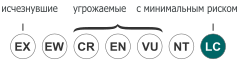
Least ConcernedIUCN 3.1 Least Concern : 136854 |
|
Content
Previously considered a synonym for the Gabon galago galago gabonensis , it was later isolated in a separate form. [one]
Mid-sized galago with a slight sexual dimorphism: males are slightly larger than females. The muzzle is long with a light gray strip on the nose, expanding to the forehead. The lower part of the body is light gray. Around the big eyes are spots of dark fur, connecting on the bridge of the nose. The ears are bare, black. The upper body is grayish brown. Feet and palms are black and gray. The tail is long, fluffy, dark gray, sometimes has a white tip. Weight from 220 to 355 grams. [2]
It occurs in West Africa from the Niger River , including southeast Nigeria to central Cameroon . [2] They prefer primary rainforests, both lowland and mountainous, reaching a height of 2000 meters above sea level. [2]
Nocturnal forest animal seeking food on earth. In the diet, fallen fruits and invertebrates. They jump well between trees, sometimes they rise to a height of 15 meters. [2] Territorial animals, each galago has an area of up to 3 hectares. [3]
They lead a solitary lifestyle, but sometimes they stray into small groups of 2-3 individuals. Territories of 2-7 females can intersect with each other or with the territory of one male. Some females can use sleeping places for other females and spend time together looking for food. In the litter there is usually one cub remaining with the mother until reaching the age of 45 days. Mating occurs throughout the year. [2]
The International Union for Conservation of Nature has assigned this species a Least Concern status . No serious threats to the population have been identified. [one]