Litronax [1] ( Latin: Lythronax ) is a genus of theropod dinosaurs of the tyrannosauridae family, whose fossil remains are found in the layers of the Campanian tier in Utah ( USA ). The genus includes the type and only species Lythronax argestes [2] . The generic name consists of two Greek words: lythron - "bloody" and anax - "king". It was a large, moderately folded bipedal predator that could grow up to 7.4 meters in length and reach a mass of 2.5 tons.
| † Litronax | |||||||||||||||||||||||||||||||||||||||||||||||
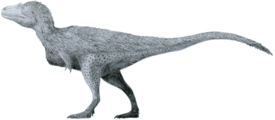 Reconstruction | |||||||||||||||||||||||||||||||||||||||||||||||
| Scientific classification | |||||||||||||||||||||||||||||||||||||||||||||||
|---|---|---|---|---|---|---|---|---|---|---|---|---|---|---|---|---|---|---|---|---|---|---|---|---|---|---|---|---|---|---|---|---|---|---|---|---|---|---|---|---|---|---|---|---|---|---|---|
| |||||||||||||||||||||||||||||||||||||||||||||||
| International scientific name | |||||||||||||||||||||||||||||||||||||||||||||||
Lythronax Loewen et al. , 2013 | |||||||||||||||||||||||||||||||||||||||||||||||
| Single view | |||||||||||||||||||||||||||||||||||||||||||||||
† Lythronax argestes Loewen et al. , 2013 | |||||||||||||||||||||||||||||||||||||||||||||||
| Geochronology 80.75–79.6 Ma
◄ Nowadays◄ Cretaceous-Paleogene extinction◄ Triassic extinction◄ Mass Permian Extinction◄ Devonian extinction◄ Ordovician-Silurian extinction◄ Cambrian explosion | |||||||||||||||||||||||||||||||||||||||||||||||
Litronax is the oldest known tyrannosaurid. He is known for his almost complete skeleton , including the skull and lower jaw . The eyes of the dinosaur were turned forward, which gave him the possibility of stereoscopic vision .
Content
Finding History and Title
Litronax is known for the most complete of the known specimens of tyrannosaurids from southern Laramidia . Thorough excavations of fossils took almost a year [3] . Now this copy is on display at in Salt Lake City (USA). A sample of the UMNH VP 20200 holotype was found at the UMNH VP 1501 site of the Formation, located on the in Cain County, Utah. Fossil remains in 2009 were discovered by Scott Richardson. The fossils were extracted from the lower part of the middle horizon, which dates from 80.75-79.6 million years ago, that is, the age of the animal itself is approximately 80 million years. Based on the stratigraphic arrangement of the fossils, it was concluded that lithronax is the oldest known tyrannosaurid [4] .
The authors of the description named a new taxon by analogy with a tyrannosaurus. They wanted to add symbolism, since the anatomy of the skeleton of the dinosaur found repeats a number of features of later tyrannosaurids. Scientists decided to leave the word "king" in the name without using the word rex and named the animal Lythronax - "blood king". For the species name, the word argestes was chosen, meaning the southwest wind in Homer's poetry, with a reference to the place of find - the southwest of Utah [3] [4] .
Litronax is known for its incomplete skeleton, and its diagnostic features include a reduced number of tooth holes in the upper jaw, a concave lateral edge of the tooth bone, high neural arches of the cervical vertebrae and a wide lower part of the skull. The holotype sample consists of the right branch of the lower jaw , both nasal bones, the right frontal bone , the left zygomatic bone , the left square bone , the right laterosphenoid, the right palatine bone , the left tooth bone, the left plate bone, the left arched bone, the left pre-articular bone, one rib , tail chevron , pubic bones, left tibia and fibula , as well as II and IV left metatarsal bones. All fossilized bones are recognized as belonging to one adult [4] .
Description
It was estimated that the length of the lithronax was 7.4 meters, and the mass was 2.5 tons [3] [5] .The rostrum of the skull is relatively short - its length is less than two-thirds of the total length of the skull. The skull as a whole is morphologically similar to the skulls of a tyrannosaurus and tarbosaurus . A strong upper jaw has a heterodontic arrangement of teeth - the first 5 teeth are much larger than the remaining 6. Like other tyrannosaurids, the pubic bone of lithronax contained a large, distally enlarged thickening (the so-called “shoe”), accounting for approximately 65% of the total length of the pubic bone. Postcranial morphology is similar to the morphology of other tyrannosaurids [4] .
Vision
The skull is well preserved. He retained unique characteristics: a short, narrow rostrum, an expanding posterior occiput, and eye sockets turned forward. It was previously believed that these characteristics appeared at the end of the Cretaceous, however, the discovery of lithronax pushed the appearance of these skeleton elements back. In particular, the eyes turned forward gave the dinosaur the possibility of stereoscopic vision, which is considered a sign of a predatory animal. The authors of the original description noted that anterolaterally expanded eye sockets among other tyrannosaurids are found only in tyrannosaurus and tarbosaurus [4] .
Ration
The shape and location of the lithronax skull helps to understand how tyrannosaurins could bite, which, in turn, helps to understand how they hunted and fed. Observations show that the type of bite of this tyrannosaurin was different from the bite of other representatives of the subfamily. Researchers came to this conclusion, since the position of the skulls of other tyrannosaurins was sometimes significantly different. The discovery of lithronax suggests a completely different picture of the evolution of the skull of the group than previously thought [6] .
The teeth of lithronax are also well preserved. The shape of the teeth resembled bananas, only slightly smaller in size. They were equipped with a serrated notch, and were not flattened, but rounded. Perhaps the teeth served their master not only to bite off the meat, but also to crush the bone [7] .
Systematics
Lythronax argestes belongs to the family of tyrannosaurids - large coelurosaurs , most of whose genera are known from Asia and North America . A detailed phylogenetic analysis , based on a data matrix of 303 cranial and 198 postcranial traits, places this dinosaur together with teratophone in the tyrannosaurus subfamily. Litronax is a sister taxon of a clade containing the Maastrichtian genera Tarbosaurus and Tyrannosaurus and the late Campanian Zhuchentirannus [4] . Litronax probably was not a direct ancestor of the tyrannosaurus, but these two genera had one common ancestor, which was even older than the lithronax [3] .
Early research suggested that there was a land bridge between Asia and North America along which various forms of tyrannosaurids moved between continents. New research has cast doubt on this hypothesis. Recently, it has been suggested that almost all Asian tyrannosaurids are part of the same evolutionary line. Currently, it is believed that in North America there were separate evolutionary radiations of the northern and southern tyrannosaurids, with lithronax located in part of the southern group [4] . The study of the UMNH VP 16690 sample supports this hypothesis [8] .
In a study of dinosaurs in southern Utah, conducted by Alan Titus and Mark Lowen in 2013, the separation of teratophone taxa, bistachiaevers, and lithronax was proposed (sample UMNH VP 20200). This means that within the Western Inland Basin there were three or more species of tyrannosaurids. Analysis showed that the three southern tyrannosaurids form a clade with the exception of all other tyrannosaurids from the northern campanian formations [8] .
The cladogram below reflects the results of an analysis conducted by Lowen et al. In 2013 [4] .
| Tyrannosauridae |
| ||||||||||||||||||||||||||||||||||||||||||||||||||||||||||||
Paleoecology
The formation dates from 81–76 million years ago [9] . During the period when lithronax lived, the Western Inland Sea spilled as much as possible in its entire history, almost completely separating southern Laramidia from the rest of North America. Researchers have suggested that it was the isolation of Laramidia that helped tyrannosaurids acquire powerful jaws. Perhaps Laramidia was the original site of the appearance of tyrannosaurid theropods. And lithronax was probably the largest predator of its ecosystem [3] . The area where the dinosaurs lived included lakes, floodplains, and rivers flowing east of the river. The Wauip Formation is part of the Grand Staircase region, an extensive sequence of sedimentary rock layers that extend south from Bryce Canyon National Park through Zion National Park and overlook the Grand Canyon . The presence of rapid sedimentation and other signs indicate a humid seasonal climate prevailing here [10] .
Litronax shared its habitat with dinosaurs such as the zavrolofin Acristavus gagslarsoni and the lamboseosaur Adelolophus hutchisoni , the ceratops Diabloceratops eatoni [11] , and unnamed ankylosaurs and pachycephalosaurs [12] . Vertebrates that lived at the same time as this tyrannosaurine included freshwater fish, silt fish , many stingrays and sharks , turtles , such as Compsemys , crocodile [13] and bipedal [14] . This region was inhabited by quite a few mammals: many- tuberous , cladotherium , marsupial and placental insectivores [15] . Local mammals were more primitive than those that lived on the site of the modern formation. Numerous petrified traces left by crocodilomorphs , poultase and theropods were found in the Wauip formation [16] .
In 2010, unique fossil traces were found here, reflecting the relationship between predatory dinosaurs and their mammalian prey. Fossil traces include at least two different burrow complexes, as well as associated grooves left by the maniraptor dinosaur. Their proximity indicates a case of active predation between an animal that has left claw marks and a resident of a hole [17] .
Notes
- ↑ Hawn D. Tyrannosaurus Chronicles: Biology and Evolution of the World’s Most Famous Predator = The Tyrannosaur Chronicles: The Biology of the Tyrant Dinosaurs: orig. ed. 2016: [per. from English ] / scientific. ed. A. Averyanov . - M .: Alpina non-fiction , 2017 .-- S. 69 .-- 358 p. : ill. - ISBN 978-5-91671-744-0 .
- ↑ Lythronax information on the Paleobiology Database website. (Retrieved March 12, 2018)
- ↑ 1 2 3 4 5 Vergano D. Newfound "King of Gore" Dinosaur Ruled Before T. Rex . National Geographic (November 7, 2013). Date of appeal September 11, 2018.
- ↑ 1 2 3 4 5 6 7 8 Loewen MA, Irmis RB, Sertich JJW, Currie PJ, Sampson SD Tyrant Dinosaur Evolution Tracks the Rise and Fall of Late Cretaceous Oceans (English) // PLoS ONE / Evans, David C. .. - 2013 .-- Vol. 8 , no. 11 . - P. e79420 . - DOI : 10.1371 / journal.pone.0079420 . - PMID 24223179 .
- ↑ Gore King of the Southwest: Lythronax argestes . Natural History Museum of Utah. Date of appeal September 14, 2018.
- ↑ Dave Hone. Lythronax argestes : a new tyrant and the spread of the tyrannosaurs . The Guardian (Nov 6, 2013). Date of appeal September 14, 2018.
- ↑ Geoffrey Mohan. King of gore dinosaur was the 'bad grandpa' of tyrannosaurs . Los Angeles Times (November 6, 2013). Date of appeal September 14, 2018.
- ↑ 1 2 Titus A., Loewen M. At the Top of the Grand Staircase: The Late Cretaceous of Southern Utah. - Indiana University Press, 2013 .-- P. 508. - 656 p. - ISBN 978-0-253-00883-1 .
- ↑ Getty MA, Loewen MA, Roberts EM, Titus AL, Sampson SD New Perspectives on Horned Dinosaurs: The Royal Tyrrell Museum Ceratopsian Symposium / MJ Ryan, BJ Chinnery-Allgeier, DA Eberth. - Bloomington: Indiana University Press, 2010 .-- P. 478-494. - ISBN 978-0-253-35358-0 .
- ↑ Jinnah ZA Sequence Stratigraphic Control from Alluvial Architecture of Upper Cretaceous Fluvial System - Wahweap Formation, Southern Utah, USA // Search and Discovery, Article # 30088. - 2009. - P. 1-38 .
- ↑ Gates TA, Horner JR, Hanna RR, Nelson CR New unadorned hadrosaurine hadrosaurid (Dinosauria, Ornithopoda) from the Campanian of North America (Eng.) // Journal of Vertebrate Paleontology. - 2011. - Vol. 31 , no. 4 . - P. 798 . - DOI : 10.1080 / 02724634.2011.577854 .
- ↑ Kirkland JI , DeBlieux DD New Horned Dinosaurs from the Wahweap Formation (Eng.) // Utah Geology. - 2007 .-- September. - P. 4-5 .
- ↑ Thompson CR A preliminary report on biostratigraphy of Cretaceous freshwater rays, Wahweap Formation and John Henry Member of the Straight Cliffs Formation, southern Utah // Geological Society of America Abstracts with Programs. - 2004. - Vol. 36 , no. 5 . - P. 43 .
- ↑ Orsulak M., Simpson EL, Wolf HI, Simpson WS, Tindall SS, Bernard J., Jenesky T. A lungfish burrow in late Cretaceous upper capping sandstone member of the Wahweap Formation Cockscomb ara, Grand Staircase-Escalanta National Monument, Utah ( English) // Geological Society of America Abstracts with Programs. - 2007. - Vol. 39 , no. 5 . - P. 43 .
- ↑ Eaton J. G, Cifelli RL Review of Cretaceous mammalian paleontology; Grand Staircase-Escalante National Monument, Utah (Eng.) // Geological Society of America Abstracts with Programs. - 2005. - Vol. 37 , no. 7 . - P. 115 .
- ↑ Tester E., Simpson EL, Wolf HI, Simpson WS, Tindall SS, Bernard J., Jenesky T. Isolated vertebrate tracks from the Upper Cretaceous capping sandstone member of the Wahweap Formation; Grand Staircase-Escalante National Monument, Utah (Eng.) // Geological Society of America Abstracts with Programs. - 2007. - Vol. 39 , no. 5 . - P. 42 .
- ↑ Simpson EL, Hilbert-Wolf HL, Wizevich MC, Tindall SE, Fasinski BR, Storm LP, Needle MD Predatory digging behavior by dinosaurs (Eng.) // Geology. - 2010 .-- Vol. 38 , no. 8 . - P. 699 . - DOI : 10.1130 / G31019.1 .