Type 1 Ho-Ki (一 式 装甲兵 車 ホ ホ キ Isshiki Sōkōheishahoki Ho-Ki) is a Japanese tracked armored personnel carrier used by the Imperial Army of Japan during the Second World War .
| Type 1 Ho Chi | |
|---|---|
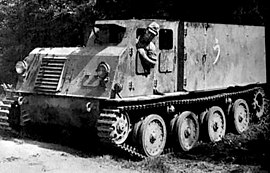 Type 1 Ho Chi. 1944 year | |
| A country | Japan empire |
| Production history | |
| Designed by | 1941 year |
| Years of production | 1942 - 1945 |
| Total released | 501 |
| Specifications | |
| Weight kg | 5.5 [1] |
| Booking mm | 6 mm [4] |
| Type and model of engine | Air cooled diesel |
| Speed km / h | 42 km / h |
| Engine power hp | 134 h.p. at 2000 rpm |
| Cruising range, km | 300 |
| Suspension | Lever |
| Length mm | 4.78 m [2] |
| Width mm | 2.19 m [2] |
| Height mm | 2.58 m [2] |
| Crew (calculation), people | 3 + 12 paratroopers [3] [2] |
Content
History
Type 1 Ho Chi was developed at the request of the army on a heavy armored artillery tractor, which could also serve as an armored personnel carrier. The development of both tracked and semi-tracked armored personnel carriers began in 1941. Both versions were designated as “Type 1” (see Type 1 Ho-Ha ). [five]
The fully-tracked Type 1 Ho-Ki was manufactured at the Hino Motors factory, but in small quantities. Although the Japanese army has been using mechanized infantry units in China since the mid-1930s, the general opinion of army commanders was that armored personnel carriers were too slow compared to conventional trucks and thus could not match the speed required for modern infantry tactics. [5] In addition, with the priorities of Japanese military production focused on combat aircraft, warships and other offensive weapons, most of the experimental armored vehicles remained in the form of prototypes. By the time Type 1 Ho-ki entered mass production in 1944, there was very little raw material, and most of the Japanese industrial infrastructure was destroyed by American bombing. [6] [7] The total number of machines produced is 501 [8] .
Design
The hull of the armored personnel carrier was technologically divided into two sections. In the front part, with a shift to the left, the driver’s cabin was located, which monitored the road through large inspection hatches, protected by armored covers. To his right was the engine-transmission compartment. The conveyor was equipped with a 6-cylinder diesel engine with a capacity of 90 liters. with. and air cooling system. Nearby were two fuel tanks of 189 and 227 liters. For air intake in the frontal part of the hull and in the starboard side, armored blinds were installed. The exhaust pipe was also displayed on the starboard side. On the front inclined armor plate, two high-beam headlights were mounted. A hull model with double-sided sides was also developed, but it did not take root in mass production. [9]
The Ho Chi chassis consisted of 8 rubberised road wheels and 2 support wheels (4 and 2 on each side, respectively), front steering wheels, rear-wheel drive wheels and a small track with metal tracks. Track rollers were equipped with a spring suspension and were borrowed from a light tank Type 95 "Ha-go". [9]
Application
The first batch of Ho-Ki Type 1 armored personnel carriers was dispatched to troops operating in China . Type 1 Ho Chi was later used in Burma and the Philippines in 1944 . [10] Units of the 2nd Panzer Division were transferred to the 14th Army and sent to the Philippines, where they were deployed on the main island of Luzon . The 2nd Panzer Division was short of armored personnel carriers, so at least four types of Ho Chi were used to transport troops in Luzon during the battle in the Philippines. [11] [12]
After the surrender of Japan, all military equipment was seized by American troops, but after some time the Ho Chi began to be transferred to the self-defense forces . As part of the renewed Japanese army, these machines continued to be used until the early 1960s. [9]
Notes
- ↑ Tomczyk, 2003 , p. 64.
- ↑ 1 2 3 4 Taki's Imperial Japanese Army: Type 1 APC "Ho-Ki"
- ↑ p. 541. Sayama Jiro "Armored Vehicles". 2002 year
- ↑ Tomczyk, 2003 , p. 65.
- ↑ 1 2 Japanese Armored Vehicles of the Second World War archived from the original
- ↑ Foss, The Encyclopedia of Tanks and Armored Fighting Vehicles
- ↑ Zaloga, 2007 , pp. 3, 15, 17.
- ↑ The situation of the production of large arms. Japan Center for Asian Historical Documents "Fundamentals of Weapons Production at 20 Showa 8 month 31 day. Army Ammunition Administration Headquarters "reference C14011026600
- ↑ 1 2 3 Type 1 Hawk armored personnel carrier
- ↑ Tomczyk 2003, p. 63.
- ↑ Rottman & Takizawa 2008, pp. 12, 54.
- ↑ Zaloga 2012, p. 35.
Literature
- Foss, Christopher F. The Encyclopedia of Tanks and Armored Fighting Vehicles: The Comprehensive Guide to over 900 Armored Fighting Vehicles from 1915 to the Present Day. - Thunder Bay Press, 2002. - ISBN 1-57145-806-9 .
- Tomczyk, Andrzej. Japanese Armor Vol. 3. - AJ Press, 2003 .-- ISBN 978-8372371287 .
- Zaloga, Steven J. Japanese Tanks 1939–45. - Osprey, 2007 .-- ISBN 978-1-8460-3091-8 .
- Zaloga, Steven J. M4 Sherman vs Type 97 Chi-Ha: The Pacific 1945 .-- Osprey Publishing, 2012 .-- ISBN 978-1849086387 .