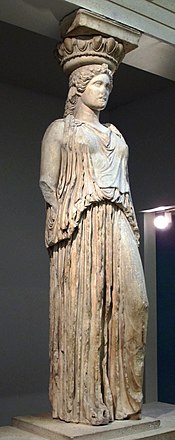
Caryatid ( Greek καρυάτιδα ) - a statue of a dressed woman, introduced into use by ancient Greek architecture to support entablature , replacing a column or pilaster .
First mentioned by Vitruvius in his treatise on Octavian Augustus:
“So, for example, if someone in his construction instead of columns puts marble statues of women in long robes, called caryatids, and places mutules and cornices on them, he will give the curious to such an explanation: the Peloponnesian city of Kariy made an alliance with Greece, the Persians, against Greece ; subsequently, the Greeks, with glory having won freedom for themselves by the victorious end of the war, with general consent declared war on the Carians. And so, having taken their city, having killed the men and devastated their state, they took their wives into slavery, while not allowing them to take off their long clothes or other clothes of married women, not only to conduct them once in a triumphal procession but that they, serving as a hard example of slavery, covered with eternal shame, clearly paid for the crime of their fellow citizens. For the sake of this, the then architects used the sculptures of these women for public buildings, placing them to bear the burden, so that the offspring remembered the punishment of the Carians. ”
- Vitruvius. 10 books on architecture. I. 1, 5

If such a statue depicts a woman with a basket of fruits or flowers on her head, then she is also called canefora . The name given to this architectural motif is believed to have come from the girls of the city of Kariya in Laconia , who at the celebrations in honor of the goddess Artemis performed religious dances with baskets on their heads.
The most famous caryatids of ancient times are in the portico of Erechtheion on the Athenian Acropolis, also known as the portico of caryatids or Pandrosion, named after the nymph Pandrosa, and in the treasury of the Sifnos in Delphi.
In the Middle Ages, caryatids were almost never used and again often began to appear in architecture, starting from the Renaissance . In modern art, not only female figures, dressed or semi-naked, supporting beams, or any protrusions of the building, are called caryatids, but similar male figures, although the more correct name of the latter is Atlantes .
See also
- Bark (statue)
Literature
- Somov A.I. Caryatid // Brockhaus and Efron Encyclopedic Dictionary : in 86 volumes (82 volumes and 4 additional). - SPb. , 1890-1907.
Links
- Two caryatids guard the riddle of the largest tomb in Greece . Polit.ru (September 11, 2014). Date of treatment August 7, 2017.