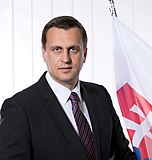


Prime Minister of Slovakia - Robert Fico
President of Slovakia - Andrei Kiska
The political structure of Slovakia means a combination of political institutions and political decision-making processes .
The political system of Slovakia is based on the principles of parliamentary democracy . The main role is played by intensely competing political parties , which is why the political system of Slovakia is often called party democracy .
Content
Legal framework
Slovakia is a parliamentary republic , the head of state is the president . The state system is a unitary state . According to the Constitution of Slovakia, power is divided into legislative , executive and judicial [1] .
Constitution
The main law of Slovakia was adopted on September 1, 1992 by the Slovak National Council (as part of the Czech and Slovak Federal Republic ) [2] . Signed on September 3, 1992 by the President of Slovakia in the Room of the Knights of Bratislava Castle . Entered into force on October 11, 1992 (some provisions from January 1, 1993) [2] . The Constitution was amended three times: in 1998, 1999 and 2001.
The following is declared in the Constitution:
| The Slovak Republic is a sovereign, democratic and legal state. It is independent of any ideology and religion. [one] |
The text of the Constitution consists of a preamble and 9 chapters, divided into 156 articles, which in turn are grouped into separate sections [1] .
Legislature
Legislative power in the state belongs to a unicameral parliament - the National Council of Slovakia , consisting of 150 deputies elected in general direct elections for a term of 4 years by a proportional system .
Citizens of the state solve some important issues by referendum . Citizens who have reached the age of 18 are eligible to vote, and those who have reached the age of 21 are eligible to be elected.
The constitution establishes the principle of incompatibility of the deputy mandate and the position of member of the government, thus the mandate of the deputy is not valid for the period of membership in the government.
The National Council adopts laws, the state budget, forms the composition and structure of the government, initiates popular referendums, approves agreements on joining interstate unions.
The adopted laws are signed by the president.
Parties
Following the parliamentary elections of March 6, 2016, the following political parties represent the interests of the people in parliament [3] :
| Abbreviation | Title | % | Mandates | Mandates in the past convocation |
|---|---|---|---|---|
| Smer-SD | Course - Social Democracy | 28.28 | 49 | 83 |
| SAS | Freedom and Solidarity | 12.1 | 21 | eleven |
| OĽaNO / NOVA | Ordinary people and independent individuals / NOVA | 11.02 | nineteen | sixteen |
| SNS | Slovak National Party | 8.64 | 15 | - |
| ĽSNS | People's Party - Our Slovakia | 8.04 | 14 | - |
| Sme rodina | We are Family | 6.62 | eleven | - |
| MOST-HÍD | Bridge | 6.5 | eleven | 13 |
| Sit ' | Network | 5.6 | ten | - |
| Kdh | Christian Democratic Movement | 4.94 | - | sixteen |
| SDKÚ-DS | Slovak Democratic and Christian Union - Democratic Party | 0.28 | - | eleven |
Executive Power
The highest executive body is the Government of Slovakia , which is formed by a coalition of parties. The head of the government is the Prime Minister of Slovakia , who is often elected from the leaders of the largest parliamentary party. The government consists of 13 ministers and several deputy prime ministers; their number depends on the needs of a particular government.
The government presents its program to parliament with the goal of gaining confidence ( investor procedure). If, within 6 months after the formation of the government, its program is not approved, the president is authorized to dissolve the National Council.
The government bears collective and individual political responsibility before parliament.
Government
| Government of Slovakia since 2016 [4] | |||
|---|---|---|---|
| Position | Name | The consignment | In position with |
| Prime Minister | Robert Fico | Course - Social Democracy | March 23, 2016 |
| First Deputy Prime Minister / Minister of the Interior | Robert Kalinyak | Course - Social Democracy | March 23, 2016 |
| Vice Prime Minister / Minister of Finance | Peter Casimir | Course - Social Democracy | March 23, 2016 |
| Vice Prime Minister / Minister of Foreign Affairs | Miroslav Lajchak | Independent | March 23, 2016 |
| Minister of Economics | Peter Ziga | Course - Social Democracy | March 23, 2016 |
| Minister of Transport, Construction and Regional Development | Arpad Ersek | Bridge | August 31, 2016 |
| Minister of Agriculture and Rural Development | Gabriella Matechnaya | independent | March 23, 2016 |
| Minister of Defense | Peter Hajjods | independent | March 23, 2016 |
| Minister of Justice | Luisia Tsitnanskaya | Bridge | March 23, 2016 |
| Minister of Labor, Social Affairs and Family | Jan Richter | Course - Social Democracy | March 23, 2016 |
| Minister of the Environment | Laszlo Solimos | Bridge | March 23, 2016 |
| Minister of Education, Science, Sports | Peter Plavkan | independent | March 23, 2016 |
| Minister of Culture | Marek Madyarich | Course - Social Democracy | March 23, 2016 |
| Minister of Health | Tomas Drucker | independent | March 23, 2016 |
Judicial branch
The judicial power is exercised by the state judicial system, represented by the courts of general jurisdiction and other courts. The highest court of general jurisdiction is the Supreme Court . The Supreme Court is chaired by the President, who is also the President of the Council of Justice of the Slovak Republic.
Courts of general jurisdiction at lower levels are organized on the basis of administrative-territorial division and the principle of efficiency (not all district centers have district courts). The president is appointed by the president for an indefinite term on the proposal of the special agency, the Judicial Council [1] .
The Supreme Court as the highest court in the Slovak Republic never acts as a court of first instance. He considers appeals against decisions of the regional, district courts and the Specialized Criminal Court.
The decision of the Supreme Court of Slovakia is final and not subject to appeal.
The system of courts of general jurisdiction does not include the Constitutional Court and the Specialized Criminal Court.
The special court is the Constitutional Court - the highest body considering national affairs on the conformity of certain actions and forms of interaction between branches of government.
The Constitutional Court consists of 13 judges, who are appointed by the president on the proposal of the National Council for a period of 12 years.
Until 2009, military courts operated in Slovakia. After their abolition, competence passed to the courts of general jurisdiction.
President
The head of state and the commander in chief of the Armed Forces of the country is the President.
Under current law, the President of Slovakia is mainly vested with ceremonial functions, but in some cases he has special powers, including: the appointment and dismissal of the Prime Minister from his post (as well as other members of the government), the announcement of a referendum, the right to dissolve the parliament (if certain conditions) and others.
The president is elected by direct expression of the will of the people in the elections every 5 years. Early termination of the powers of the president can only be done by the National Council either by declaring a popular referendum, or on the basis of treason, or on the basis of a violation of the current constitution (by decision of the Constitutional Court).
Since 2014, non-partisan Andrei Kiska has been taking over the presidency.
See also
- The political system of the Czech Republic
Notes
- ↑ 1 2 3 4 Constitution of Slovakia (words.)
- ↑ 1 2 of the Slovak Constitution for 26 years . RTVS (09/03/2018). Date of appeal September 9, 2018.
- ↑ Smer wins, but will need coalition partners
- ↑ New government meets for first time, appoints state secretaries (March 31, 2016). Date of treatment September 9, 2018. (words.)
Links
Literature
- National Parliaments of the World: Encyclical. ref. / Grew. Acad. Sciences, Institute of State and Law. - M., 2005. - S. 196
- Slovakia // Great Russian Encyclopedia : [in 35 vols.] / Ch. ed. Yu.S. Osipov . - M .: Great Russian Encyclopedia, 2004—2017.
- Bibilo, V.N. Judicial systems of foreign states: textbook.-method. allowance for students jurid. specialist. BSU / V.N.Bibilo. - Minsk: BSU, 2012 .-- 93 p.