Adikesava Perumal temple is a Hindu temple dedicated to one of the Vishnu images called Adi Keshava, located in the small town of Teruvattaru between Trivandrum and Kanyakumari [1] . The complex was erected in the traditional architectural style of South India. The temple is one of the 108 divyades that are required for pilgrimage in the tradition of Sri Vaishnavism . The temple of Adi Keshava in 1510 visited Chaitanya during a trip to South India [1] . The place is also known as Adi Anantam ( Adi Anantam ) and Dakshina Vaikuntha (Dakshina Vaikuntham) [2] .
| Sight | |
| Adi Keshava Temple in Teruvattara | |
|---|---|
| Sri Adikesavaperumal Temple | |
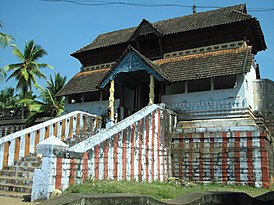 The main entrance to the Temple of Adi Keshava | |
| A country |  India India |
| Teruvattaru | Kanyakumari (Borough) , Tamil Nadu |
| Denomination | Vaishnavism , Shaivism |
| Type of building | hindu temple |
| Architectural style | dravida |
| condition | active temple |
| Site | sriadikesava.org |
Myths and Legends

The Padma Purana says that the temple was built in the Treta Yuga , that is, several thousand years ago, long before the Padmanabhaswami Temple. Indologists believe that its construction took place between the 5th and 7th centuries. The first wall inscription in the temple dates from the reign of the Dravidian Tamil dynasty of Chera , which reigned in South India from the 1st century. The inscriptions indicate the patronage of the ruler in 510-519. The temple is sung in verses of Nammalwar (880–930), in the poetry of other alvars, it is not mentioned. In the verses, Nammalwar is determined to dispense with people who indulge in worldly things only. He wants to worship the deity in Teruvattara and sing prayers to him in order to shorten the path of endless births and remove the burden of the bad consequences of the futile deeds of the past (Tiruvaymoli, texts 10.6.1-10.6.11) [3] .
The origin of the holy place is described by the local Purana (legend), connecting it with Brahma and Shiva . The mythology of the temple has developed from several interwoven legends. Brahma wanted to receive darshan (vision) of Vishnu . For his sake, he performed yajna (fire sacrifice). However, the sacrifice was made with errors, as a result of which a demon named Kesha appeared along with the sister Kesha. Brahma hastened to get rid of them, blessing them with a long life and sending them further across the universe. The demons went to outrage across the three worlds, and neither the demigods nor the sages could deal with them. The sages began to pray to Vishnu to save them from the incarnations of evil. Hearing the prayers of the sages, Vishnu descended to Earth and defeated Kesha. Adi Shesha crushed him with his body, as a result of which Vishnu is depicted lying on a snake. Vishnu himself received the epithet "Keshava" as reclining on the demon Keshe. The demonic power is under the control of Vishnu, which reflects his lying image [2] .
Keshi's sister vowed to avenge her brother. It turned into the Tamiraparani River and began to flood the land. In response, Vishnu sent Bhu-devi , his wife and the goddess of the Earth, to save the situation. Bhu-devi raised the level of the earth, as a result of which the river could not flood it. Recognizing defeat, Tamiraparani became a water "garland" that goes around a holy place. The modern Tamiraparani river is formed as a result of the confluence of Payasvini, flowing past the temple, and the Kodaya river [2] .
It is believed that Shiva observed the battle between Vishnu and the demon Kesha, being in 12 forms ( lingams ). In another version, Vishnu installed lingams around the demon to neutralize it. The temples of Shiva are located around Teruvattaru, forming a peculiar circle. The pilgrimage to the places of Shiva is considered completed only after visiting the temple in Teruvattara. This tradition continues to be preserved, as a result of which the pilgrimage to the Temple of Adi Keshava is mixed, Vaishnava and Shaivist in character [2] .
Another modern legend is associated with the Temple of Adi Keshava, set forth by M. Rajagopalan. In 1674, the Muslim army was approaching Teruvattar - the city and the temple were waiting for looting. The ruler (at that time Rani Umai Ammai Nachair reigned ) appealed for support to Varma of Kottayam , who ruled in the neighboring principality of Kottayam . Varma went to the Temple of Adi Keshava, where in prayer he pronounced 14 verses with a request for the success of the confrontation with the invaders. The poems became known as the “Bhakta Sankirtana” ( Bhakta Sangeerthanam ), which are still reproduced in the temple. Varma had a vision that a warrior in green armor left the Vishnu shrine. An approaching army of Muslims was attacked by swarms of wasps . The soldiers were demoralized and the attack failed. [4]
Another legend describes the struggle against European colonization. In 1741, the ruler of Travacor Martanda Varma ( Marthanda Varma, 1705–1758) opposed the Dutch forces near Kolashel in Kanyakumari. Before the battle, he put his sword at the feet of Adi Keshava and asked for his blessing. The Dutch were defeated, and their commander, captain De Lanoi ( Eustache Benoît de Lannoy, 1715–1777) was captured and later transferred to the service of Martanda Varma [4] .
In the XIX century, South India was again subjected to Muslim attack. Nawab Arkota invaded Travacor territory. This time the Hindu army was defeated. Soldiers from Arkot desecrated the temple and damaged its skillful decorations. Due to the heavy weight of the murti, Adi Keshava could not be pulled away, but the portable murti (the so-called "utsawa-murti") was removed from the temple along with other jewelry. Murti Adi Keshava was kept in the treasury of Arkot for some time. According to legend, every day the murti appeared on top of a pile of treasures, wherever he was hidden. According to the decision of the Nawab, he was chained with two chains to immobilize the murtis. At that time, the Begum (wife) of the Nawab was suffering from pains that the doctors could not cope with. The deity appeared to the guard of the temple and ordered him to arrange a festive service. The guard convinced the Nawab that the disease would go away as soon as the deity was returned back to the temple. When the murti returned, there was no trace of the disease. Nawab repented and, in gratitude, presented the deity with a golden headboard, a crown and a golden plate. A special puja was held for Adi Keshava, in which the crown was in the form of a Muslim headdress. It continues to be used in a service called Thiru Allah Puja twice a year during the holidays. [2]
Temple Architecture
The architecture of the Adi Keshava Temple, like the architecture of other temples in Kanyakumari, follows the traditions of Kerala . It is based on a combination of wood and stone with characteristic sloping wooden roofs instead of tall gopurams . Adi Keshava Temple is located on a stone platform, covering an area of one and a half acres (6 sq. M.). It is surrounded by a massive stone wall 30 feet (9 meters) high. From three sides, the temple is washed by the Tamiraparani River and its tributaries. On the western side of the complex is a ghat (a promenade in the form of a stepped stone descent to the water), ablution near which is believed to exempt from sins [2] .
They enter the temple through the eastern gate, to which they climb 25 high stone steps. The gates are located in a stone tower with a wooden roof, built in the classical style of Kerala architecture. After entering the temple, the road leads south to the shrine of Sri Bhutanatha ( Sri Butanatha , i.e. Shiva). Further in the southwest is the sanctuary of Adikeshava ( Vishnu ), Devi ( Durga ) and Venkatachalapati ( Venkatesvara ) [1] .
On the way to the main temple there is a copper flagpole, dwajasthamba. It was installed in 1895 by Maharaja Mulam Tirunal Rama Varma ( Mulam Tirunal , who ruled the Travankor from 1885 to 1924). The main temple is surrounded by a giant rectangular open gallery with columns. It is called “Nalambalam” and consists of four adjoining galleries with 224 granite columns. All columns are decorated with stone images of Deepa-Lakshmi ( Lakshmi in the image of the goddess of fortune), who are holding oil lamps in their hands. Each column has its own Lakshmi figure, which is distinguished by a hairstyle, clothes or posture. Thus, the gallery does not have identical images [1] .
In front of the main sanctuary is the Mukha-mandapa or hall, entirely carved from a single piece of black granite. The ornaments of the Mukha-mandapa reflect the high craftsmanship possessed by stone carvers during the years the temple was built. Nearby is the Balipita-mandapa, where the columns represent life-size images of Vishnu, Lakshmana , Indra , Venugopal ( Krishna ), Nataraja and Parvati , Brahma playing the wine , as well as a number of other deities. The temple complex has a separate small temple dedicated to Tiruvambadi Krishna [2] .
East entrance to the temple
Gate tower
Images of Deepa-Lakshmi in the gallery with columns
Transition of one gallery to another
Darshan
When visiting the temple, pilgrims observe ancient rules and traditions. Male visitors are dressed in traditional clothing, dhoti . Entrance to the temple in shorts or trousers is not allowed. The main sanctuary is facing the west, although the main entrance to the temple is located in the east. Vishnu resides in the main sanctuary in the form of Adi Keshava Perumal. The long stone murti Adi Keshava, reaching 18 feet (5.5 meters), reclines on the Shesh snake. The deity faces west and it is believed that Vishnu is looking at the temple of Sri Padmanabhaswami in Trivandrum , where his younger "brother" is located [2] .
To obtain a complete darshan, pilgrims bypass Adi Keshava in parts and see him three times through separate doorways. Darshan begins with seeing the legs and ends with the head. The sanctuary is designed in such a way that the rays of the setting sun illuminate the face of Adi Keshava. Adi Keshava’s left hand is down, Vishnu’s attributes are on his right hand. Adi Sheshi's serpentine hoods rise above his head. Unlike most temple murti, the local murti is not made of granite. It consists of a special cement mixture known as Katusharkara yogis ( Katusarkara уogam ). For the manufacture of the material used 16 thousand salahram-shil with the image of Sudarshan- chakra. Because of the special material, the deity is not washed by water. However, during the holidays, Adi Keshava is wiped and dressed in new clothes. On both sides of Adi Keshava are Lakshmi and Bhu-devi [2] .
Location
Teruvattaru is located 50 km south of Trivandrum and 60 km north of Kanyakumari . The temple is located near the Payaswini River, also known as Chandragiri, the largest river in Kasaragod County. Thanks to the temple, the small town of Teruvattaru became a place of pilgrimage, where Vaishnavas and tourists come to visit the holy place. Teruvattaru is reached by taxi from Kanyakumari or Trivandrum. A bus can be delivered to him from Trivandrum or Kanyakumari with a transfer to Marthandam and then by bus to Teruvattaru. The temple is a ten minute walk from the bus stop. The closest train station is Kulitturai ( Kulitturai , ), from which a taxi takes half an hour to Teruvattara [2] .
Close to the image of Adi Keshava are Ranganatha from Srirangam and Padmanabhaswami from Trivandrum . The temple is not as large as the famous Padmanabhaswami Temple in Trivandrum, but it is believed that the latter was built in its image [5] . Similar temples are located in Sriperumpudur ( Adikesava Perumal temple , ) and Mailapore ( Adikesava Perumal temple , ).
Notes
- ↑ 1 2 3 4 Tourist Guide to South India, 2003 , p. 128.
- ↑ 1 2 3 4 5 6 7 8 9 10 Knapp, 2017 , Chapter 19.
- ↑ Subramanian S. tiruvaTTARu divya dEsam . The Realm of Religion (05/03/2016).
- ↑ 1 2 Rajagopalan, 1993 , pp. 168-169.
- ↑ Khatri, 2012 .
Literature
- Bayi GL Thulasi garland. - Mumbai: Bharatiya Vidya Bhavan, 1998.
- Khatri V. World Famous Treasures Lost and Found . - Delhi: Pustak mahal, 2012.
- Knapp S. Krishna Deities and Their Miracles . - New Delhi: Ocean Books Pvt. Ltd., 2017.
- Rajagopalan M. 15 vaishnava temples of Tamilnadu . - Madras: Mico Colony Besant Nagar, 1993 .-- S. 164–172.
- Tourist Guide to South India . - India: Sura Books, 2003.