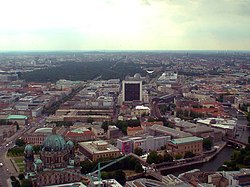
Museum Island ( German: Museumsinsel ) - the name given to the northern tip of the Spreeinsel island on the Spree River in Berlin , where a whole constellation of famous Berlin museums is located . Museum Island is a center of attraction for tourists and art lovers from around the world. Since 1999, a unique architectural and cultural ensemble has been included in the UNESCO World Heritage Site .
 | UNESCO World Heritage Site , Object No. 896 Russian • English • fr. |

Content
- 1 History
- 2 Museum Island now
- 3 Museums
- 4 See also
- 5 Links
History
In the Middle Ages, the northern part of the island of Spreinsel was a swampy flood meadows. In the southern, higher part of the island as early as the 13th century. the city of Cologne arose, and its northern part later became a garden at the Berlin City Palace . In the 17th century, the Spree's left sleeve was equipped with a canal system. The current Kupfergraben canal arose, thanks to which the northern part of the island was drained. Between Spree and Kupfergraben, Cologne Island ( German Cöllnische Werder ) arose, where Lustgarten was built in the second half of the 17th century. By 1748, the Pomeranzenhof greenhouse ( German Pomeranzenhof ) with tropical fruits, palm trees and exotic plants, the last reminder of Lustgarten, was converted into a warehouse due to the increase in trading activities on waterways. Later, additional warehouses were built on the island, including for flour and salt.
In 1797, King Frederick William II supported the proposal of the archaeologist and art history professor Alois Hirth to create a museum to house works of art of antiquity and modern times . In 1810, by his highest decree, King Frederick William III ordered the laying of "a public collection of carefully selected works of art . " By this decree, he went to meet the increasingly loud calls of educated burghers to create public collections of works of art.
In 1822, Karl Friedrich Schinkel presented a project for a new building, according to which an extensive reconstruction of the northern part of Spreinsel was planned. In addition to the museum building, the island’s development project included the construction of several bridges and the alignment of the Kupfergraben Canal. The commission for the construction of the museum was entrusted to Wilhelm von Humboldt .
The first museum on the Museum Island and at the same time the first public museum of Prussia was the Old Museum built in 1830 . In 1859, the Prussian Royal Museum (now the New Museum ) was opened. In 1876, the opening of the National Gallery (the modern name of the Old National Gallery ) followed. In 1904, the Kaiser Friedrich Museum (now the Bode Museum , renamed in 1960 in honor of the German art historian Wilhelm von Bode ) was opened on the very "nose" of the island. In 1930, the “Museum Island” appeared the building of the Pergamon Museum . Thanks to the “Museum Island”, which became the center of science and art in Berlin, the city earned the flattering nickname “ Athens on the Spree ”.
In the 1870s, the name “Museum Island” was universally assigned to this part of the island and reflected Prussia’s claims for a worthy place as the cultural capital of Europe along with Paris and London . In 1880, at a conference of museum directors it was decided to place exclusively on the Museum Island works of "high art", which at that time was considered the art of Europe and the Middle East .
Further development projects aimed at creating additional exhibition space for constantly growing art collections. Alfred Messel also planned to add an additional southern building to his brainchild - the building of the Pergamon Museum and place the Egyptian collection in it. These plans were not destined to come true due to the huge number of technical and financial difficulties that arose.
Under the National Socialists , the “Museum Island” was also included in the plans for the reconstruction of Berlin, developed by Albert Speer , where it was planned to erect four more monumental museum buildings designed by architect Wilhelm Kreis . According to this project, on the northern shore of the Spree, opposite the Bode Museum , the German Museum , the Museum of the 19th century and the Museum of Egyptian and Near Asian Art were to grow (which, after the revision of the project, became simply the Egyptian Museum and, having in the project an exhibition area of 75,000 m², the largest of three buildings). The development of the territory between the streets of Friedrichstrasse , Oranieburgerstrasse and the square of Monbijuplac would require the transfer of the Montbijou palace itself. For military-historical collections of the Berlin Zeichhaus along Kupfergraben, Kreis planned to build the building of the World War Museum . Hanns Dustmann , the imperial architect of the Hitler Youth , proposed, in addition to the new museums in the northern part of the island, to create a new Ethnographic Museum in the southern part between the city railway line and Friedrichstrasse. All these large-scale projects were hindered by the war.
During the Second World War, the island's museums were destroyed by more than 70%. Starting from 1950, the plan for their gradual restoration did not cover the most affected of all the New Museum. The ruins of the New Museum, called the “shameful spot,” were supposed to be demolished, which, however, was delayed due to the lack of space. Expensive rehabilitation work began only in 1987 . It was supposed to bring Museum Island in full order by 1989 , however, due to lack of funds, these works were never started.
After the reunification of Germany in the late 90s, large-scale work on the restoration and rehabilitation of Museum Island began. In 1999, the Council of the Prussian Cultural Heritage Foundation approved the master plan of Museum Island. It provides for the rehabilitation of existing buildings, their architectural integration into a museum ensemble and the reorganization of collections that were divided until 1989 .
Museum Island now
The northern tip of the “Museum Island” is crossed by the Montbijou bridge connecting the island with both banks of the Spree. Both bridges are closed to public transport and form the entrance to the Bode Museum, a Neo - Baroque triangular building whose huge dome rises above the northern part of Spreinsel.
On the south side of the Bode Museum, the island crosses the line of the Berlin city train , which separates the building of the Bode Museum from the adjoining Pergamon Museum. This latest museum building in the Museum Island complex is Berlin's most visited museum, world famous for its monumental antique artifacts such as the Pergamon Altar , which gave the museum its name. The entrance to the museum is an area bounded on three sides by the buildings of the museum building, which can be reached from Am-Kupfergraben street via a pedestrian bridge.
The New Museum adjoins the Pergamon Museum from the south-west, which has been in ruins for a long time after the Second World War, and is being restored from the south-east from the Pergamon Museum. The Old National Gallery is an antique temple with a tall staircase in style the entrance. Above the entrance to the gallery stands an equestrian statue of Frederick William IV , whose hand belongs to the first sketches of the building. At the entrance to the National Gallery there is a lawn decorated with sculptures from the museum fund. From the south and east at Spree, the lawn is bordered by Doric-style colonnades . In the summer, film screenings and open-air concerts are held here.
On the south side of the New Museum and the National Gallery, the island is crossed by Bodeshtrasse Street, open for vehicles to travel through the western Spree. The adjacent Friedrichsbrücke bridge over the east Spree sleeve is closed to motor vehicles. Further south of this street in the western part of the island is the Old Museum and Lustgarten, and in the eastern part - the Berlin Cathedral . The narrow lane Am Lustgarten between them connects Bodenstrasse with the major transport route Unter den Linden - Palace Square - Karl-Liebknecht-Strasse, which limits the relatively quiet Museum Island from the south.
North of Berlin Cathedral opposite the Old National Gallery on summer evenings, ornithology enthusiasts can watch an amazing sight - tens of thousands of starlings heading for the night in the chestnut forest.
Museums
The five museums on Museum Island are part of the Museum Association of the State Museums of Berlin , which in turn is an institution of the Prussian Cultural Heritage Foundation . The Museum Island, along with the Cultural Forum in Berlin Tiergarten , the Charlottenburg Palace complex and museums in Berlin-Dahl, forms one of Berlin's most famous museum centers.
The buildings on Museum Island are predominantly housed in archaeological collections and 19th-century art. After the reunification of Germany , the reunification of the assemblies previously divided between West and East began. In accordance with the master plan of Museum Island, it is planned to reorganize and jointly exhibit the collections of all museums. The new entrance building , which is scheduled to open in 2008, will become the main entrance to the Museum Island as a whole. At the same time, it will house an information center, cafes, shops, restaurants and halls for special events and exhibitions.
In the Old Museum on the main floor, a part of the Antique collection is exhibited: sculptures, weapons, gold jewelry and silver treasures from the collection of ancient Greek art , from the Cycladic era to the ancient Roman era. Since August 2005 , the Berlin Egyptian Museum , which moved there from Charlottenburg, is temporarily located on the top floor of the museum. In 2009, he will take his place in the rebuilt New Museum.
The restored New Museum after opening in 2009 accepted the exposition of the Egyptian Museum and the collection of papyri , which in particular includes the famous bust of the ancient Egyptian Queen Nefertiti and other works of art from the Akhenaten era. The New Museum also partially exhibits the exposition of the Museum of the prehistoric period and early history , relating to the Stone Age and other ancient eras.
The three buildings of the Pergamon Museum contain architectural objects, ancient Greek and Roman sculptures from the Antique Collection, the Museum of Asia Minor , whose exhibits cover six thousand years of history, art and culture of Asia Minor , and the Museum of Islamic Art , which stores works of art by Islamic peoples VIII — XIX centuries The Pergamon Museum gained worldwide fame thanks to the impressive reconstruction of the archaeological ensemble of the Pergamon Altar , the gates of the Miletus Market , the Ishtar Gate with a fragment of the Babylonian Procession Road and the frieze from Mshatta . After the opening of the fourth, still under construction building of the Pergamon Museum, it will be possible to see such monumental works from the collection of the Egyptian Museum as the gate from the temple complex of Kalabsha and the columned hall of Tsar Sahura , as well as the facade from Tell Khalaf from the Near Asian Museum, which since the war languish in the museum vaults of the State Museums of Berlin.
The collection of the Old National Gallery presents works of sculpture and painting of the 19th century, ranging from Caspar David Friedrich and the French Impressionists to frescoes that created Nazarenes in Rome .
The Bode Museum, which opened after October 17, 2006, displays exhibits from the Museum of Byzantine Art from the 3rd to 19th centuries, Italian and German sculptures from the early Middle Ages to the 18th centuries. from the sculptural collection . A series of coins are stored in the Coin Office , which cover the period from the 7th century BC. e., when the first coins were minted in Asia Minor , and ending with coins and medals of the XX century, as well as selected exhibits of old masters from the Berlin art gallery .
In 2005, one in three open to public access museums on Museum Island was visited by one in seven visitors to Berlin museums.
See also
- Prussian Cultural Heritage Foundation
- Berlin State Museums
- Antique collection of Berlin
- List of museums in Berlin