
Tazzi Aldobrandini - a set of 12 silver with gilding flat bowls ( tazzi ) made in the 16th century. The place of manufacture and the name of the author are not known for certain. Each cup is dedicated to one of the Roman emperors (counting Julius Caesar ) described by Suetonius in the book “The Life of the Twelve Caesars ”. The bowls belonged to the noble Italian family Aldobrandini until the end of the XVIII century, due to which they got their name.
Description
Tazzi are richly decorated flat bowls with high legs. Vessels of this form (probably borrowed from ancient Greek kiliks ) were known in Italy from the 15th century and were intended for wine or - later and outside of Italy - for fruits or sweets [1] . Each of the bowls of Aldobrandini is decorated with a full-height human figure rising in the center, depicting one of the ancient Roman rulers. The inner surface of each tazza is decorated with four relief scenes from the life of the corresponding emperor.
The craftsmanship with which the figures and the decoration of the bowls were made is outstanding for its time and is described by experts as “the most impressive separate sample of Italian and, possibly, pan-European jewelry work of the 16th century” [2] and “one of the most impressive preserved silver objects of the 16th century” [3] . Such luxuriously executed vessels were probably intended to decorate the table in especially solemn occasions.
Each bowl has a height of 41 cm (16 inches) and consists of prefabricated elements (base, mount, directly bowl-plate, pedestal and figurine of the emperor). Some of the bowls are decorated with the coat of arms of the genus Aldobrandini, while the location of the coat of arms in the lower part of the product indicates that the Tats were not originally ordered by representatives of this family, but were purchased by them later.
- Details of the decor of Tazza Vitellius:

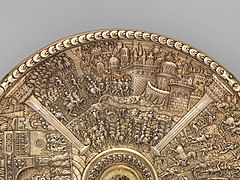

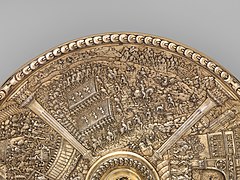


History
The time and place of making the bowls is not known for certain. Initially, it was assumed that they could be made by the outstanding Italian sculptor and jeweler Benvenuto Cellini , however, at present, such attribution has been refused. Further suggestions were made that Tatsans could be made by a craftsman from the Netherlands or, possibly, from German Augsburg or Nuremberg , during his work in Italy. Later studies are inclined to the version that the bowls were made in the southern Netherlands for a noble patron of the Habsburg family (possibly for Albrecht VII of Austria ) at the end of the 16th century and were acquired by a representative of the Aldobrandini family no later than 1603 [4] . The individual characteristics of the bowls indicate that a team of silver craftsmen was involved in the manufacture.
The Tazzians were in the possession of the Aldobrandini family until 1769, after which they transferred to the Borghese family. The bowls probably remained in Italy until Napoleon conquered Italy in 1797. However, in the first quarter of the 19th century, they ended up in London at the store of the Kensington Lewis silver merchant [5] . In 1834, the Tatsans, attributed to Benvenuto Cellini, were sold to the collection of Charlie Skarisbrick (1801-1860) for 1000 guineas . A year after his death, the bowls were purchased for 1200 guineas by Richard Attenborough, at that time all twelve bowls were in a single set and the original form.
In the 1860s, originally silver bowls were gilded. A little later, in the second half of the XIX century, the bowls were dismantled, in six of them the bases were replaced with more magnificent ones, also made in the XVI century, but probably in Spain. The kit was divided, individual bowls fell into the hands of different owners in different countries. Due to the prefabricated design of the bowls, by the end of the 19th century, the emperor’s figures and the original bowls were mixed up, which is why six of the twelve bowls are currently crowned with “not their own” figure, and the figure and the base were completely lost at Titus’s bowl. Only one of the twelve bowls - the Tazza Claudius - was preserved in its original form (not counting the gilding), with the original base and the correct figure. Bowls are kept in various museums around the world.
List
| The emperor | Bowl | Figurine |
|---|---|---|
| Julius Caesar | A bowl with a replaced, decorated base is kept at the Lazaro Galdiano Museum , Madrid. Also exhibited in New York and Lisbon. | A figurine with a bowl [6] [7] . |
| Octavian Augustus | A bowl with an original base and an erroneously attached figurine of Nero was sold at Christie's auction in 2000 for £ 1 million. It is in the collection of British entrepreneur Selim Zikhi [8] [9] . | The Octavian figurine is attached to the cup of Domitian and belongs to the Minneapolis Institute of Arts [10] . |
| Tiberius | The bowl with the original base, connected to the Domitian figurine, is kept in the Victoria and Albert Museum in London, where it has been located since 1937 [11] . | The figurine of Tiberius, attached to the cup of Nero, is in a private collection, but is available for exhibition at the Metropolitan Museum of Art in New York [12] . |
| Caligula | The bowl with the original base, connected to the Galba figurine, is in the Museum of Antonio Mederiush i Almeida in Lisbon [13] [14] . | The Caligula figurine is connected to the Galba bowl and is in the collection of the British billionaire banker Bruno Schroeder. |
| Claudius | Claudia’s bowl is in a private collection and is provided for exhibition at the Metropolitan Museum of Art in New York [15] . | Figurine with a bowl. |
| Nero | A bowl with an original base, connected to a figurine of Tiberius. It is in a private collection, provided for the exhibition at the Metropolitan Museum of Art in New York [16] . | The figurine of Nero, connected with the cup of Octavian, is in the collection of the British businessman Selim Zikhi. |
| Galba | The bowl with the original base and Caligula figure is in the collection of the British billionaire banker Bruno Schroder [17] . | The statuette of Galba, connected to the Caligula bowl, is in the Museum of Antonio Mederiush i Almeida in Lisbon. |
| Oton | A bowl with a replaced decorated base and an original figurine has been kept at the Royal Ontario Museum since 1976 [18] . | Figurine with a bowl. Until 1956, the bowl of Oton was crowned with a figurine of Domitian [19] . |
| Aulus Vitellius | A bowl with a replaced decorated base and original figurine is kept at the Metropolitan Museum of Art , New York [20] . | Figurine with a bowl. Until 1956, the Vitellius bowl was connected to the figure of Oton. |
| Vespasian | A bowl with a replaced decorated base and an original figurine was exhibited in Burlington House in 1901, then acquired by American entrepreneur John Pirpont Morgan . Sold at Christie's auction in 1982, then sold again at Sotheby 's in 2013. He is currently in the private collection of the Al Thani Dynasty in London [21] [22] . | Figurine with a bowl. |
| Tit | The original base and figure are lost; in 1914, the bowl was described as a saucer for rose water. Currently stored at the National Museum of Ancient Art in Lisbon. | The original figure is lost. There is a replica of the 19th-century Titus bowl, but its crowning figure is a copy of the Julius Caesar figure. The replica is kept in a private collection [23] [24] . |
| Domitian | A bowl with a replica of the original base and an Octavian figurine is kept at the Minneapolis Institute of Arts [10] [25] . | The figurine of Domitian is connected to the cup of Tiberius (in the 1950s, the cup of Tiberius was mistaken for the cup of Domitian) and is stored in the Victoria and Albert Museum . |
Notes
- ↑ The art of living. The interior of the burgher house in Holland, the heyday . Museums of the Moscow Kremlin. Date of treatment January 22, 2017.
- ↑ "The Aldobrandini Tazzas", John Hayward, The Burlington Magazine, Vol. 112, No. 811 (Oct., 1970), pp. 669-676, Published by: The Burlington Magazine Publications Ltd., Article Stable URL: https://www.jstor.org/stable/876472
- ↑ Aldobrandini Tazza , Victoria and Albert Museum
- ↑ The Silver Caesars: A Renaissance Mystery (Neopr.) // HISTORIANS OF NETHERLANDISH ART.
- ↑ Silver in England , Philippa Glanville, p. 121
- ↑ Julius Caesar figurine and bowl , Museo Lázaro Galdiano, Madrid
- ↑ Julius Caesar tazza , Metropolitan Museum of Art
- ↑ Review of Rennaissance and Baroque: Silver, Mounted Porcelain, and Ruby Glass from the Zilkha Collection by Paul Schroder
- ↑ Augustus tazza , Metropolitan Museum of Art
- ↑ 1 2 Augustus figurine and Caligula (sic) bowl , The Minneapolis Institute of Arts
- ↑ Tiberius tazza , Metropolitan Museum of Art
- ↑ Tazza with Emperor Tiberius figure and dish with scenes from the life of Nero , Metropolitan Museum of Art
- ↑ Highlights of the Museu Medeiros e Almeida , LisbonLux
- ↑ Caligula tazza , Metropolitan Museum of Art
- ↑ Claudius tazza , Metropolitan Museum of Art
- ↑ Nero tazza , Metropolitan Museum of Art
- ↑ Galba tazza , Metropolitan Museum of Art
- ↑ The Aldobrandini Tazza with Emperor Otho , Toronto (exhibited at Winnipeg Art Gallery)
- ↑ “The Aldobrandini Tazza” with a figure of the Roman Emperor Otho , Google Arts & Culture
- ↑ Vitellius tazza , Metropolitan Museum of Art
- ↑ Auction of Morgan Aldobrandini Tazza, identified as Vespasian at Sotheby's, New York, February 1, 2013, lot 10
- ↑ Vespasian tazza , Metropolitan Museum of Art
- ↑ Titus dish , Metropolitan Museum of Art
- ↑ Titus tazza (replica) , Metropolitan Museum of Art
- ↑ Domitian tazza , Metropolitan Museum of Art
Literature
- The Silver Caesars: A Renaissance Mystery , The Metropolitan Museum of Art / Yale University Press, ISBN 9781588396396
- The Silver Caesars: A Renaissance Mystery , Metropolitan Museum of Art, 2017, ISBN 1588396398 , ISBN 9781588396396