“Torpedo Cruiser” “Oi” ( Japanese大 井) is a Japanese light cruiser of the Kuma type . In 1941, it was rebuilt into a “torpedo cruiser” with ten 610-mm four- tube torpedo tubes and had the most powerful torpedo armament of all the ships of the world until August 1942, along with the second Japanese “torpedo cruiser” Kitaki . He participated in the Second World War .
| Cruiser Oi | |
|---|---|
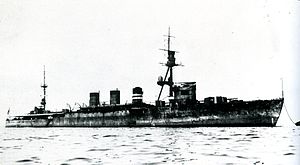 The cruiser "Oi." Hiroshima . 1923 year | |
| Service | |
 Japan Japan | |
| Named after | |
| Class and type of vessel | Light cruiser |
| Manufacturer | Kawasaki shipyard in Kura |
| Construction started | November 24, 1919 |
| Launched | July 15, 1920 |
| Commissioned | in October 1921 |
| Withdrawn from the fleet | died July 19, 1944 |
| Main characteristics | |
| Displacement | 5019-7800 t |
| Length | 162.1; 158.5 m ( waterline ) |
| Width | 14.25 m; 17.5 m after 1941 |
| Draft | 4.8-5.6 m |
| Reservation | 32 - 64 mm |
| Engines | 4 steam tubes |
| Power | 90 000 liters with. (67 mW ) |
| Mover | 4 propellers |
| Speed | 36-23,4 knots |
| Sailing range | 9,000 miles at 10 knots, 6,000 miles at 14 knots |
| Crew | 439-468 officers and sailors |
| Armament | |
| Artillery | 7 140 mm ; since 1941 4 140 mm |
| Flak | 2 13.2 mm ; since 1941 2 × 2 25 mm ; (then 28-36 25 mm) |
| Mine torpedo armament | 4 × 2,533 mm TA , 80 min ; since 1941 - 10 × 4 610 mm TA; from September 1942 - 6 × 4 610 mm TA |
| Aviation group | 1 aircraft, 1 launch catapult until 1941 |
Content
History
“Torpedo cruiser” “Oi”, originally a cruiser of the Kuma type — was the development of light cruisers of the “Tenryu” type and they were to be built according to the large shipbuilding program “8 by 4” of 1917. It was planned to build six 3500-ton “leaders” based on the Tatsuta cruiser project (with an increase in the number of 140-mm guns from four to five) and three 7200-ton class “A” reconnaissance cruisers (subsequently turned into heavy cruisers of the “A” type Aoba " ). But in 1918, after the news of the start of construction of the 8,000-ton Omaha light cruisers in the US began, they decided to abandon the leaders, and instead develop an averaged project of the scout cruiser with a displacement of 5500 tons, capable of fulfilling the duties of the destroyer leader, conducting reconnaissance and opposing the American “Omaha” [1] .
The first B-class reconnaissance cruisers were five Kuma-class light cruisers. They were laid in the years 1918-1919 according to the budgets of the financial years 1917-1918 and 1918-1919. The project was developed by the 1st-rank captain Hirag based on the Tatsuta cruiser, but he left it farther than originally intended. The number of 140-mm guns increased from four to seven, the cruising range - from 6000 to 9000 miles , and the power of the tubes - from 51,000 to 90,000 liters. with. Japanese sailors abandoned the elevated location of artillery, placing all 140 mm shield installations on the same level of the deck of the tank floor. Because of this, only three guns could shoot in the bow and stern, and six on each side. But the American Omaha’s guns were also not better placed and out of twelve guns six could be shot in the bow and stern , and eight guns on board. ...
The 5500-ton cruiser was based on Tenryu blueprints . The increase in displacement went to increase capacity from 51,000 to 90,000 liters. sec., due to which the speed is increased to 36 knots. Such power forced to move from three shafts to four. The number of boilers increased to 12, as in Tenryu, two with mixed heating from oil and coal [1] .
The main artillery was supplemented by two 76-mm anti-aircraft guns and four twin 533-mm torpedo tubes , which stood side-by-side. In addition, cruisers could take mines [1] .
Of the eight cruisers planned for construction under the 8–4 program , five were built according to the initial design (Kuma type), and three more advanced Nagara type [1] .
At first cruisers of the Kuma type with 533 mm torpedo tubes, but when 610 mm torpedoes appeared, 610 mm torpedo tubes were installed on the cruisers. In the 1930s, air catapults were put on cruisers (removed from the war) and anti-aircraft armament. The length of the Kuma cruisers is 162 meters (m), the midship width is 14 m, the draft is 4.8 m. The standard displacement is 5,603 tons (t), the total displacement is 7094 tons. On the Kuma ships there are 12 boilers Canpon with mixed coal-oil heating and 4 steam turbines , each driving four propellers. The total capacity of the tubes is 90,000 liters. with. Speed 36 knots. Estimated range of 15-nodal 5000 miles. The crew of 450 people [2] .
| External Images | |
|---|---|
| Drawing "Oi" on the right and above until 1941 | |
| External Images | |
|---|---|
| Kuma Cruiser Booking Scheme | |
| External Images | |
|---|---|
| 533 mm torpedo tube cruiser "Oi" | |
In 1935-1938, on all Kuma cruisers, mixed heating boilers were converted to oil and to improve stability they reduced the "upper" weight, in addition, 103-200 tons of solid ballast were placed in the hull (and 202-289 tons of liquid ballast were taken into the space between double bottom). The total displacement of the ship was close to 8000 tons, and the speed dropped to 32 knots [1] .
| External Images | |
|---|---|
| Schemes of Ooi on the right and top with 10 × 4 TA. 1941 | |
| External Images | |
|---|---|
| Color drawings on the right and top with 10 × 4 TA | |
| External Images | |
|---|---|
| Middle of the model from the top right with 10 × 4 TA | |
The biggest refinement on Kuma cruisers in the prewar years was the restructuring of the Kitakami and Oi cruisers into torpedo cruisers. In 1936, the Fleet General Staff developed a plan whereby a numerically superior US fleet could be neutralized by a night attack with the widespread use of new long-range and powerful type 93 torpedoes, and large artillery ships would engage in battle with a weakened American fleet during the day. The first torpedo strike, according to this plan, was to inflict heavy cruisers of the "A" class, which could pierce the gaps of the American Navy. Through the breaches, light cruisers and destroyers were to enter the attack on the large ships of the Americans. According to this plan, it was proposed to arm two light cruisers with at least ten four-pipe torpedo tubes. Two cruisers, having fired 40 torpedoes, could make, according to the officers of the Fleet General Staff, large gaps in the combat order of the US Navy. The tactics of night battle did not materialize for one reason - the Americans avoided fighting in the dark before appearing on radar ships. The radar turned plans for massive torpedo strikes at night into impossible. "Torpedo cruisers" the Japanese did not come in handy. During World War II, anti-aircraft weapons were strengthened and standardized on all cruisers of the Kuma type, and they were also equipped with radar No. 21 <ref name = "Kuma type" </ref>.
In 1941, the Kitaki and Oi were rebuilt (Kitaki in Sasebo , Oi in Maizura ) and turned into torpedo cruisers. Re-equipment to replace weapons with 4 × 2 127-mm gun mounts, 4 × 2 25-mm anti-aircraft guns and 11 (five on each side and one in the diametrical plane) quadruple 610-mm TA for firing the famous "long spears" - oxygen torpedoes of type 93 [1] .
Initially it was supposed to turn into three “torpedo cruisers” three ships - “Kitakami”, “Oi” and “Kiso”. The lack of 127-mm twin gun mounts and 610-mm vehicles was the reason for refusing to re-equip the Kiso, and the workload on the other two cruisers was reduced - they left the bow four of 140-mm guns, and the number of installed vehicles was reduced from 11 to 10 (abandoned the device in the diametrical plane) [1] .
For onboard deployment of heavy torpedo tubes at a length of approximately 60 m (from the forecastle to the aft bulkhead of the engine room), the deck was expanded with sponsons to 17.5 m. The armament was supplemented by 2 twin 25 mm anti-aircraft installations [1] .
The “torpedo cruisers” “Oi” and “Kitakami” did not participate in the attack on Pearl Harbor at the beginning of World War II , and in May 1942, due to the planned invasion of the Midway Atoll, they joined the cover unit of Vice Admiral Takasu - the Hyuuga battleships (flagship), “Ise” , “Fuso” and “Yamashiro” , light cruisers “Kitakami” and “Oi” and 12 destroyers, which was sent to the Aleutian Islands [2] .
His task was to cover airborne formations aimed at the islands of Kyska and Atta . This operation was essentially a diversion , which was supposed to facilitate actions in the direction of the main strike, diverting part of the US Navy to the Aleutian Islands. On June 6-7, the Japanese occupied the islands of Kyska and Attu, not meeting resistance. But after the failure of the Midway operation, this no longer made much strategic sense, and the retention of the occupied territories was only a useless waste of material and human resources [2] .
After the Battle of Midway, on June 4, 1942, the Japanese fleet was reorganized and the 9th cruising squadron (Kitakami, Oi) was assigned to the 1st fleet. Both cruisers operated in the southwestern Pacific Ocean, transporting troops and escorting convoys . After participating in the landing in the Philippines, both decided to convert it into high-speed transports for use in the waters of New Guinea and near Singapore [2] .
In August - September 1942, it was refitted - the number of torpedo tubes was reduced to six (6 × 4), and the free space was used to accommodate two landing boats of the Daikhatsu type . At the same time, the number of 25 mm assault rifles was increased (2 × 3 and 2 × 2 became), a bomb-thrower and 18 depth charges were installed in the stern. Later, the number of 25 mm automatic anti-aircraft guns was increased to 28 (subsequently to 36) [1] .
"Oi" July 19, 1944 sunk south of Hong Kong by the American submarine " Flashar [1] .
Features
Standard displacement : 5780 tons, total displacement : 7800 tons [1] ;
Length: 162.1 meters (m) (the longest), 158.5 m (along the waterline), 152.4 m (between perpendiculars) [1] ;
Width: 14.25 m; 17.5 m greatest after 1941 [1] ;
Draft: 4.8 m (average) until 1941; 5.4-5.6 m after 1941 [1] ;
Power plant : 4 Gihon turbines , 12 Kampon boilers , 4 shafts [1] ;
Power: 90,000 liters. with. [1] ;
Speed - 36-23.4 knots [1] ;
Fuel reserve: 350 tons of coal + 700 tons (maximum 1150 tons) of oil [2] (1600 tons [1] );
Cruising range: 9000 miles at 10 knots, 6000 miles at 14 knots [2] ;
Armor protection : armor deck - 32 mm, armor belt - 64 mm, conning tower - 51 mm [2] ;
Artillery weapons: 7 140-mm guns , 2 , 2 13.2-mm anti-aircraft machine guns ; since 1941 - 4 140 mm, 2 × 2 25 mm ; from September 1942 - 2 × 2 127 mm universal installations , 2 × 3 and 2 × 2 25 mm (subsequently 28–36 25 mm) [1] ;
Mine - torpedo armament : 4 2-pipe 533 mm TA , 80 min ; since 1941 - 10 × 4 610 mm TA; from September 1942 - 6 × 4 610 mm TA [2] ;
Aviation weapons: 1 aircraft and 1 aircraft catapult until 1941 [2] ;
Crew: 439 officers and sailors [2] .
Notes
- ↑ 1 2 3 4 5 6 7 8 9 10 11 12 13 14 15 16 17 18 19 Light cruisers of the Kuma type. Cruisers. V. Dashyan. Ships of the Second World War. Japanese Navy. Part 1
- ↑ 1 2 3 4 5 6 7 8 9 10 Type “Kuma”. A.A. Mikhailov. Light cruisers of Japan (1917-1945)
Literature
in Russian
- A. Dashyan . Ships of the Second World War. Japanese Navy. Part 1. The cruiser. Kuma Light Cruisers
- Mikhailov A.A. Light cruisers of Japan. 1917-1945 - St. Petersburg, 2005 .-- 120 p. . Historical and cultural center ANO "ISTFLOT" Samara. Publisher R.R. Munirov. (Warships of the world). ISBN 5-98830-013-1
- S.V. Ivanov . Light cruisers of Japan (War at Sea-25)
in English
- Eric Lacroix, Linton Wells II. Japanese cruisers of the Pacific war. - Annapolis, MD: Naval Institute Press, 1997 .-- 882 p. - ISBN 1-86176-058-2 .