Clever Geek Handbook
📜 ⬆️ ⬇️

Non-armored

Shellless [1] ( lat. Lissamphibia ) - a subclass of amphibian vertebrates . This subclass includes all living amphibians.

Non-armored
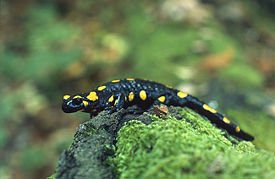
Salamandra salamandra (Marek Szczepanek) .jpg
Fire salamander
Scientific classification
Domain:Eukaryotes
Kingdom:Animals
Kingdom :Eumetazoi
No rank :Bilateral symmetrical
No rank :Secondary
Type of:Chordate
Subtype :Vertebrates
Infratype :Maxillary
Overclass :Tetrapods
Grade:Amphibians
Subclass :Non-armored
International scientific name

Lissamphibia Haeckel , 1866

Classification

Currently represented by three units :

  • Tailed amphibians ( salamanders , newts , etc.)
  • Tailless amphibians ( frogs , toads , tree frogs , etc.)
  • Legless amphibians (several types of worms ).

Evolution and Systematics

There are several hypotheses regarding the origin and evolutionary relationship of the non-armored [2] :

  • All non-shellless descended from dark-toned amphibians .
  • All non-shellless descended from thin-vertebral amphibians .
  • Armor-less are not a monophyletic treasure. Tailless and tailed amphibians evolved from dark spondyls, and legless amphibians evolved from fine vertebrates.
  • Armor-less are not a monophyletic treasure. Tailless and tailed descended from dissorphoid dark-spondyls, and legless amphibians descended from stereospond dark-spondyls.

The findings of a 2011 study combining data from a morphological analysis of modern and fossil amphibians and molecular clocks tend to the second of the above hypotheses [3] .

Reconstruction of the appearance of Gerobatrachus hottoni

In 2008, a fossil of Gerobatrachus hottoni , 290 million years old, was found in the Lower Permian sediments of Texas . This animal was assigned to dark- spondylous amphibians, however, it possessed a mixture of characteristics inherent in tailless and tailed amphibians. This finding, according to researchers who described it, filled a gap between the Mesozoic tailless and tailed amphibians and their Paleozoic ancestors. She also pointed out that tailed and tailless amphibians are closer to each other than to legless amphibians [4] [5] .
Notes

  1. ↑ Bannikov A.G. , Denisova M.N., Darevsky I.S. Class Amphibians, or Amphibia (Amphibia) // Animal Life. Volume 5. Amphibians. Reptiles / ed. A. G. Bannikova , Ch. ed. V. E. Sokolov . - 2nd ed. - M .: Education, 1985. - S. 26. - 399 p.
  2. ↑ Marjanović D., Laurin M. Fossils, Molecules, Divergence Times, and the Origin of Lissamphibians (English) // Syst Biol: journal. - 2007. - Vol. 56 (3. - P. 369-388 . - DOI : 10.1080 / 10635150701397635 .
  3. ↑ Alexander Pyron, R. Divergence Time Estimation Using Fossils as Terminal Taxa and the Origins of Lissamphibia (English) // Syst Biol: journal. - 2011. - Vol. 60 (4) . - P. 466-481 . - DOI : 10.1093 / sysbio / syr047 .
  4. ↑ Casselman, Anne . "Frog-amander" fossil may be amphibian missing link (May 21, 2008). Date of treatment July 5, 2012.
  5. ↑ Anderson, Jason S .; Reisz, Robert R .; Scott, Diane; Fröbisch, Nadia B .; Sumida, Stuart S. A stem batrachian from the Early Permian of Texas and the origin of frogs and salamanders // English : journal. - 2008. - Vol. 453 . - P. 515-518 . - DOI : 10.1038 / nature06865 .
Source - https://ru.wikipedia.org/w/index.php?title= Unguided&oldid = 100963820


More articles:

  • Explorer II
  • Separate high-explosive flamethrower company
  • New Amsterdam (Guyana)
  • Guy Licinius Nerve (Praetor)
  • Strongin, Lev Izrailevich
  • Dick, Walter von
  • Skiing at the Winter Universiade 2019
  • Shehre Kord
  • Strand, Petter
  • Yegan

All articles

Clever Geek | 2019