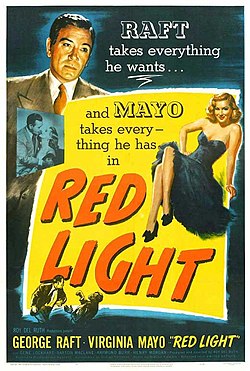
"Red Light" ( English Red Light ) - film noir directed by Roy Del Ruta , which was released in 1949 .
| Red light | |
|---|---|
| Red light | |
 | |
| Genre | Film noir |
| Producer | Roy del ruth |
| Producer | Roy del ruth Joseph kaufman |
| Author script | George Callahan Charles grayson |
| In the main cast | George Raft Virginia mayo Raymond Burr |
| Operator | Bert glennon |
| Composer | Dmitry Temkin |
| Film company | Roy Del Ruth Productions ( Pioneer Pictures Corp. ) United Artists (distribution) |
| Duration | 83 min |
| A country |  USA USA |
| Tongue | English |
| Year | 1949 |
| IMDb | ID 0041790 |
The film is based on the story of Don “Red” Barry “This guy Gideon”. The film tells about the owner of the transport company Johnny Torno ( George Raft ), who is obsessed with revenge for the murder of his brother-priest. He intends to find and punish the criminal, who turns out to be his former accountant, Czerny ( Raymond Burr ), whom Johnny had once been jailed for embezzlement. However, when Johnny found his brother's killers, he suddenly realized his brother’s last thought about the inadmissibility of revenge and released Czerny, who eventually died in an accident during a chase.
The film received mixed reviews from critics who noted the play of Raymond Burr and Harry Morgan as killers, as well as a spectacular production of a number of scenes in the noir style. At the same time, the critic’s weakness of the film considered its religious component, which is too moral and implausible, as well as the uninteresting game of Raft in the lead role.
Story
In the cinema hall of the San Quentin prison, filmmakers prisoners Nick Czerny ( Raymond Burr ) and Rocky ( Harry Morgan ) watch a newsreel, one of the stories of which is dedicated to army chaplain Jesse Torno ( Arthur Franz ), who returns home to San Francisco after five years of heroic service in the Pacific. The magazine shows how Jesse is greeted by his brother Johnny ( George Raft ), the head of the transport company "Torno", where Cherni once worked as an accountant. Four years ago, Cherni, with the filing of Johnny, was arrested and convicted of embezzlement. Now, the former accountant decides to take revenge on Johnny, hiring Rocky for this purpose, who will be released in a week. Meanwhile, Johnny, who loves Jess very much, having learned that he was appointed abbot of one of the churches in the north of the state, offers to take him to a new duty station. While Jess is packing his belongings, the lights in the hotel room suddenly go out and Rocky appears in the doorway, who shoots Jess and leaves. Soon Johnny appears, who, having broken open the door to the room, sees the dying Jesse on the floor. Raising him in his arms, Johnny asks to say who shot him, however, all that Jess has time to say before dying is the words: “The Bible. Written in the Bible. Johnny picks up Jesse's Bible from the table, and scrolls through her page by page at home, hoping to see the name of the brother's killer, but does not find anything. At this point, Johnny is visited by two homicide detectives — Streker ( Barton MacLane ) and Ryan — who warn him against trying to find and punish his brother’s killer on his own.
When at work, Johnny’s deputy named Warnie Hazard ( Gene Lockhart ) tells him that Cherni was released, Johnny concludes that it was he who killed his brother. However, as Streker managed to find out, Cherni was still in prison at the time of Jess's death. During a walk from Warnie down the street, Johnny notices the office of the International Gideon Society , which places the Bibles in hotel rooms, realizing that there must be another copy of the Bible in Jess's number. When Johnny re-searches the hotel room, the bellhop informs him that the Bible from Gideonov, who was in Jess's room, was stolen by someone. Through a familiar hotel employee, Johnny receives a list of people who lived in Jess's room after his murder. The first on the list is the name of Carla North ( Virginia Mayo ), who left the Ken Murray Show in Hollywood as the contact address. John goes to Hollywood, where in the theater he speaks with producer Ken Murray ( Ken Murray ), who reports that the program in which Carla worked was closed, but gives the name of the hotel where the girl was going to move.
In the absence of Carla, Johnny penetrates her room and searches her belongings. He does not find the Bible, but he finds a photograph of Jess surrounded by a group of American pilots. Suddenly, Carla enters the room, surprised to find Johnny there. She denies taking the Bible, and when asked about a photo, she says that her brother is shown there, who, shortly after the picture was taken, died in battle. Realizing that she is not involved in the murder of Jess, Johnny offers Carla to work for him and transports her to San Francisco, placing him in his chic apartment. Johnny instructs her to search for the remaining visitors of the hotel on the list, without explaining the purpose of the search. Some time later, Cherni arrives at the office of the company “Torno” with a request to reinstate him at work, but he is refused. While in the reception room, Cherni intercepts the private conversation of Johnny and Warnie in the office, where Johnny explains that he is searching for the hotel Bible, in the pages of which his brother managed to write down the name of his killer.
Carl and Johnny follow the list of people in the room to Reno to talk to chef Wallace Stoner, but it turns out that he also did not take the Bible. During the conversation, Johnny notices that someone is watching them (it was Rocky). Putting a cookbook in the bag, Johnny uses it as bait. When Rocky grabs the book that Johnny allegedly left at the counter of a street kiosk and tries to hide, Johnny grabs him and pushes him into the waiting car. There he takes away the revolver from Rocky, and also finds in him the key to the hotel room where he stopped. Cherni, who is in the room, when he heard someone stranger open the door, immediately escapes through another exit. While Johnny fiddles with the doors, Rocky also manages to escape. On the way back to San Francisco, on the observation deck of the Rocky train, Czerny claims that he is getting out of business, in response, he reminds Rocky that he is the murderer and that his name is written in the Bible. In turn, Rocky declares Cherni that before the shot Jess reported that he had come from Nick, so it is possible that the Bible contains the name Cherni. Without hesitation, Nick hits Rocky in the jaw, as a result of which he flies over the rail of the speeding train and falls on the railway tracks. Arriving in San Francisco, Czerny heads to the Torno office to deal with Warnie. When Warnie gets out of the office late in the evening and tries to start his car, he sees that someone deliberately disabled the ignition system. After that, at the service parking lot, the lights go out and approaching footsteps are heard. In fear, Worny tries to run, but stumbles and falls, after which he hides under one of the containers, which stands on jacks. Worny sees only the feet of an approaching man who knocks one of the jacks down, after which the container falls and crushes Worny to death. Having committed this murder, Cherni calmly and contentedly lights a cigarette.
Continuing his search, Johnny is going along with Carla to go to Monterey to meet with another visitor to the hotel. However, after the dangerous events in Reno, Carla refuses to go until Johnny explains the purpose of his actions. When Johnny tells her what's the matter, Carla strongly opposes his methods, demanding to follow the law and trust the police. Angry, Johnny slaps her face, after which Karl, accusing him of blind hatred, takes her things and leaves, giving up her salary. The next day, Streker and Ryan meet Johnny near the office, reporting that his wallet was found at the Reno shooting site, and therefore from now on he will be under surveillance around the clock. However, having asked one of his drivers to cover him with a trailer, Johnny by car immediately escapes detectives. In Monterey, Johnny finds Pablo Cabrillo (Phillip Pine), who turns out to be a blind veteran of the war. Some time ago, not wanting to be a burden to others, Pablo arrived at a hotel in San Francisco with the intention of committing suicide there. However, while Pablo in his room asked God to forgive him for the sin of suicide, a cool wind blew out and a window washer suddenly appeared from the window, who took away Pablo’s weapon and comforted him. At that moment the pages of the Bible lying on the table began to rustle, after which the washer took it and read Pablo a few lines, again instilling in the blind soldier the desire to live. After his story, Pablo leads Johnny to his home to give the Bible, which he took from the hotel. However, Pablo's mother states that about an hour ago the Bible was taken away by a young woman who, as Johnny describes, was Karla. Johnny comes to church, where he enters into a discussion with the abbot about the faith, stating that she did not save his brother from death, after which, in a rage, he grabs a candlestick, breaking their stained glass window.
Upon returning to his office in San Francisco, Johnny writes a check to the church with a large donation of 20 thousand dollars, and then proceeds to search for Carla, calling the hotel. At this moment, Cherni, who intends to be the first to take possession of the Bible, enters the office. Since Johnny is not aware of the role of Cherni in the murder of his brother, he instructs him to ring all city hotels in search of Carla. Soon, however, Carla herself appears in the office of Johnny with the required Bible, and after her, Strecker and Ryan, who are following her, appear. Carla opens the Bible, showing a fragment of the text “To the Romans”, chapter 12, verse 19: “Do not avenge yourself, beloved, but give place to the wrath of God. For it is written: Vengeance is mine; I will repay, says the Lord. ” In the margin of the page, Jess attributed: "Johnny - you do not kill." Streker tells Johnny that the police found a revolver in his desk that Johnny took from Rocky, and it was from this weapon that Jess was killed. Johnny wants to immediately go in search of Rocky, while Karl is trying to stop him by saying that Jess had just asked his brother to refuse revenge. After this, Johnny rereads the verse again and agrees with her. Soothing Cherni leaves, but on the stairs he stumbles upon a wounded Rocky, who, as it turns out, survived after falling from the train. Cherni shoots him, telling the others that he was the first to fire on him. Already dying, Rocky points to Cherni as the organizer of the assassination of Jess. Threatening with all weapons, Cherni confesses that he paid Rocky to kill Jess, after which he gets out onto the roof of the building and in torrential rain tries to escape. Johnny rushes after him. When, after the shooting, Cherni’s cartridges run out, Johnny, under the influence of his brother’s words, is not able to shoot a man out of revenge. Cherni is trying to run away, but in the dark he steps in a puddle on a power cable that feeds a huge non-new sign of the company “Torno”, and kills him with electric current on the spot. Streker tells ranked Carla that Johnny has nothing to do with the murder of Cherni, and that "someone else" did.
Cast
- George Raft - Johnny Torno
- Virginia Mayo - Carla North
- Gene Lockhart - Warnie Hazard
- Raymond Burr - Nick Czerny
- Harry Morgan - Rocky
- Barton Maclaine - Detective Streker
- Arthur Franz - father (chaplain) Jess Torno
- Arthur Shields - Redmond's father
Director and main roles in the film
As the film historian Stone Wallace notes, "during his long Hollywood career, Roy Del Ruth was able to create a noticeable number of worthy pictures." He began his film career in silent film times [1] , where, according to film historian David Kalat, he acted "as a director of crude farcical comedies for the famous producer Mac Sennet " [2] . With the advent of sound, Del Ruth has established himself as the director of sharp energetic thrillers Warner Bros , among them Maltese Falcon (1931), Mad Blonde (1931), Little Giant (1933) and The Missing Persons Bureau (1933 ) in which such actors as James Cagney , Edward G. Robinson and Bette Davis [2] [1] played. According to film historian Bruce Eder, “there was a time when Del Ruth was able to make harsh crime scenes,” one of examples of which were the first screen version of the Maltese Falcon (1931). But by the mid-1940s, when he began to are parallel with directing and producing their films, the work of Del Ruth made a very sharp turn in the direction of sentimentalism. And if in such films as the quirky comedy " It happened on Fifth Avenue " (1947), it only intensified the picture ", the genre of film noir this style was not quite acceptable [3] . According to Kalat, “Del Ruth shot low-budget films, because he was really good at it, not because he was forced to do it” [2] .
As Wallace points out, Del Ruth “already had experience with George Raft , having filmed the then novice actor in a brief dance episode in the movie Taxi! “(1932), and later worked with Raft, who had already made a name for himself, in the picture“ It was going to happen ”(1936)” [1] . According to Kalat, “in the late 1940s, Del Ruth became for Raft something of a ray of light. He knew what Raft was capable of, but he wanted to move him further forward, and not just to exploit his name ” [2] . And, as Wallace points out, “their cooperation has been fruitful for Raft during the downturn in his career” [1] .
According to Kalat, by the 1940s “the brightest days of Raft were already behind. He continued to sell his well-established image of the screen tough guy, but his films have steadily lost in the level of ambition and quality. ” Raft was strongly influenced by the murder in 1947 of his friend, the famous gangster Bugsy Siegel , after which, according to Kalat, “Raft began to develop paranoid fear that there was a threat to his safety. In particular, he began to ban strangers from appearing on the set. ” As the critic writes, “Raft’s obsession was combined with a career downturn in the post-war period, which put him in a difficult situation, when he was forced to accept any role, no matter where proposals came from,” including “poorly defined roles in low-budget films of category B ” [2] . According to Wallace, at the end of the 1940s, Raft made several pictures with director Edwin L. Marin , but they "lacked the spark of Raft's early work, and in principle they were stereotyped." With the exception of “ Johnny Angel ” (1945) and to a lesser extent “ Nocturne ” (1946), the collaboration between Raft and Marina yielded no meritorious results that did not receive any commercial success or approval of criticism. Among these paintings are Mr. Ace (1946), Christmas Eve (1947), Intrigue (1947) and Street Race (1948) [1] . According to Wallace, “each of these pictures was hampered by a modest budget, a routine history and the banal game of Raft in a role of the same type, which quickly became boring and uninteresting for cinema visitors” [1] .
As for Virginia Mayo , then, according to Kalat, she “got a start to the cinema when producer Samuel Goldwyn “ discovered ”her as a dancer of a variety show. Soon, she began to play major roles in musical comedies as the love interest of such popular comedians as Danny Kay and Bob Hope . ” However, in the late 1940s, she “attempted to break with her traditional role and show herself as a serious actress. Her role in “Red Light” was a demonstration of her aspiration, and she got an even more fascinating role a year later in another film Noir “ White heat ” (1950) ” [2] . A decade later, Mayo will again play with Raft in the movie “ Airplane over the Atlantic ” (1959), which “will be one of the last roles of Raft, after which he will be relegated to episodic roles and a cameo” [1] .
As Wallace writes, at the time of filming the picture, later famous Raymond Burr was still a relative newcomer. Thanks to his impressive physique and even ominous voice, he almost inevitably received the bad guy’s role in numerous crime dramas and westerns, but then gained wide fame as the famous lawyer Perry Mason in the eponymous judicial television series (1957–1966). Later Raft will say about working with Burr: “I felt a great talent in him” [1] .
Burr's on-screen accomplice was Harry Morgan , known, according to Wallace, as "a multifaceted strong and reliable supporting actor who had previously played with Raft in the Street Race noir (1948)." Later, Morgan recalled Raft as a gentleman and one hundred percent professional at work. Morgan was so impressed with him that he said: “I would play ten more pictures with George, if it were possible” [1] . Wallace notes another "experienced actor Barton MacLane , known for his long series of roles of tough guys in the gangster films of the Warner Brothers studio." Previously, he had worked with Raft on the films “ You and I ” (1938) and “ Male Strength ” (1941). In this picture, according to Wallace, “MacLane received long-awaited relief, instead of the standard role of a gangster, playing the policeman investigating the case” [1] . And finally, “ Arthur Frantz , an actor whose career ranged from supporting roles in category A films ”, such as “ Sands of Iwo Jima ” (1948) and “ Revolt on Kane” (1954) to the main roles in categories B , such as Monster on Campus (1958) and Atomic Submarine (1959), “give a brief but powerful game as brother-priest Jess” [1] .
Film making history
The author of the story behind the film was Don “Red” Barry , a former American football player who became a film actor. He got his nickname “Red” after he starred in a Western role in 1940 based on a comic about the popular hero Red Ryder . As Kalat writes, “although the franchise of this film continued further without Barry, the nickname“ Red ”was fixed to him”. As the film expert writes further, “Barry played all his life in westerns, but from time to time he wrote something, and quite often his written works turned into films” [2] . In particular, he wrote a story titled “This Guy Gideon,” in which a person conducted a persistent search for Gideon's Bible, and, based on the name, many thought that the hero of the story was Gideon, and he was looking for his Bible [2] . Del Ruth bought the rights to film the story, but he did not like the title so much that he also paid for the story of Weldon Reader “Red Light” “just to become the owner of this title for his film” [2] . The American Film Institute, citing the Hollywood Reporter , confirms that in 1941 producer Del Ruth bought the rights to the title of Weldon Reader's Red Light, which was published in This Week magazine . However, as stated in the credits, the story of the film is not based on Reader’s book, but on Donald Barry’s short story This Guyon Guy [4] .
According to Kalat, when Del Ruth offered Raft the main role, the actor gave him one condition. He really wanted his character as a fad to be interested in styling his own hair, to which Del Ruth replied that no audience would believe that such a guy would do it. As Kalat writes, “the irony was that Raft was given this idea by his dead friend, gangster Bugsy Siegel , who actually spent his free time between murders and various forms of racketeering for styling and preening his hair.” However, as Kalat notes, “what was really not important, because truth is sometimes more strange than fiction. Del Ruth, on the other hand, had no intention of making the work strange to such an extent as to raise doubts about its plausibility. ” In the end, Del Ruth persuaded Raft, and he abandoned the idea of a haircut [2] .
The press of that time doubted whether Raft was able to cope with the role. As Kalat noted, “by this time it was already quite clear that Raft could convincingly play a tough guy, but Red Light demanded psychological skills and metaphysical insights from an actor, that is, such depths that no one usually demanded from him” [2 ] .
The working title of this film is “Mr. Gideon” [4] .
According to the American Film Institute, Alice Faye , Shelley Winters and Carmen Miranda were considered for a female role in the film, but in the end the filmmakers rented Virginia Mayo from Warner Bros [4] .
Filming took place in San Francisco , Sacramento , San Quentin Prison , Carmel and Monterey , California , as well as in Reno , Nevada [4] .
The Hollywood Reporter also reported that it would be the first feature film with magnetic sound recording instead of optical [4] .
Movie evaluation by criticism
Overall film score
After the release of the film screens did not enjoy much success. As Kalat writes, “incomes at the box office were weak, and this independent picture has faded into obscurity over the years” [2] . The contemporary film historian Sandra Brennan also considered that this “criminal melodrama impregnated with religious themes is considered to be an insignificant example of the film noir” [5] . However, according to Kalat, “the next generation remembers the“ Red Light ”with great enthusiasm due to its special noir moments, and not because of its religious themes.” According to Kalat, “the fact that (these two aspects) were mixed at all means that the Red Light was an unusual, inventive and ambitious undertaking” [2] . Film historian Blake Lucas also noted that “Red Light” “is a rather strange film, since the conventions of the noir genre, as a rule, are reluctant to coexist with a religious message.” This film, however, contains “one classic noir scene on the night truck stop, where Warnie, in a state of extreme fright, discovers that the wires of the distributor in his car are torn off. Even more frightened, he runs in fear, stumbles and then climbs under the truck. Further, the viewer sees only a pair of legs of the pursuer, who comes up to the truck and casually knocks one of the jacks under Worny's screams. Then the camera rises to show the sinister Raymond Burr in the role of Czerny, who smokes and smiles ” [6] .
Spencer Selby called the picture “an unusual thriller about revenge with a strongly pronounced religious theme” [7] , and David Hogan “a small but perky thriller in which rage is the main emotion and motivator” of the main character's behavior [8] . According to Michael Keene, “despite his religious notes and propensity for preaching,” the film tells “a fast-moving story of murder and revenge,” which highlights “as always Burr’s amazing play” [9] . According to Wallace, “this is one of the most unusual and intriguing films of George Raft, combining themes of religion and revenge. Presented sharply, in a truly noiry style, these conflicting components of the picture raise it above the level of ordinary drama. Another reason why this film achieves more than most of Raft’s films after he left Warner Bros is in the strength of director Roy Del Ruta ” [1] .
On the other hand, Kalat writes: “There is no doubt that this is potentially interesting material on which to build an exciting film around the negation of the usual formulas of revenge. The problem is that this film is trying not only to make a cake, but also to eat it. Moral moralizing against revenge comes into conflict with the rich visualization of this very revenge. ” According to the critic, “the scenes with the killings (performed by) Burr and / or Morgana demonstrate the vital energy of the painting. The rest of the film - all the scenes with Raft and Mayo - seem to be aimed at reproaching the public for its enjoyment of hard killings ” [2] .
On the other hand, Dennis Schwartz believes that “Del Roy sets up a noir routine film, imbued with themes of revenge and religion, which is more likely to lean towards the usual criminal drama. The exception is some bright moments in the camera work, which reveal the gloomy halftones of the film. ” And besides, “the film is interesting mainly because Raft got an ideal role for him, which he played well” [10] . Leonard Moltin called the film “a pompous drama in which the innocent Raft wants revenge on the killer released from prison who killed his brother”, [11] and Bruce Eder expressed the opinion that this is “quite a good little story that could work if it were to reduce "Light intensity" and add a little subtlety. " From this story, “Del Ruth could have created something as complex and disturbing as, for example, Mark Robson’s “ Land of Death ”(1950), but he did not succeed in doing so” [3] .
Some images in the film
The film is built on the confrontation of the characters Johnny Torno performed by Raft and Nick Cherni performed by Burr . As Kalat writes, the film introduces Johnny “as a respected businessman, but the suspicious familiarity with which the police communicate with him, the gangsters he hires, and the gun in his desktop drawer make it clear that his respectability is only a semblance the same type of gangster that Raft has played all his life. Nevertheless, he is also bound by the world of decent people, in particular, through his brother Jess, a war hero and a dedicated priest ” [2] .
For his part, Nick Czerny, played by Raymond Burr, "breathes with righteous wrath of the erroneously accused." Although the accusation was fair and he really stole money from his boss, Johnny, Nick revenge on his former employer nonetheless. “Nick's revenge plan is to hire Harry Morgan to kill Brother Johnny. There is no logic in it, but it is a sign of Nick’s painful mentality. A person who thinks rationally will not do the wild, but spectacular actions that Nick performs throughout the picture. ” As Calat further notes, in the final of the painting “Burr's transcendental mania is revealed in full force when Nick and Johnny converge face to face. Something should stop Nick, but the film refuses the idea that he will just be arrested, as if not dramatically enough. ” Instead, the idea that “man assumes and God disposes” comes into play, leading to an absurdly literal outcome with the intervention of God, who seems to be impressed by the current of poor Nick on the spot ” [2] .
David Hogan, in turn, notes that the priest “Jess, as screenwriter George Callahan and director Roy Del Ruth conceived him, provides an unearthly, divine presence — he is closer to the symbol of beauty than anything resembling a human being. It is fake and annoying, and I want it to be good, it is painful to pinch ” [8] .
Memorable scenes in the picture
As Kalat believes, “if someone else remembers this strange picture, it is only because of her sinister and cruel murder scenes. Throughout the film, the various murders that Burr and the gangster Harry Morgan hired by him are extremely stylish - directed by Del Ruth gave vent to his most cruel imagination. But, although these scenes were admired by noir fans, the fact is that they constitute only a small fraction of the total length of the film. ” [2] According to Kalat, “the main among these cruel scenes is too often discussed by noir fans ... and too many noir researchers retold this scene with love. As a result, she swelled beyond measure and acquired mythological significance. The scene is as follows: Raymond Burr pursues the assistant Raft, played by Gene Lockhart . In a desperate attempt to escape, Lockhart takes refuge under a trailer trailer that is jacked up. He holds his breath and watches in horror as Burr's feet move closer and closer. Then one leg disappears, and in the blink of an eye, Lockhart realizes why - then it happens. Burr is going to knock out the jack! Lockhart starts screaming in mortal horror — but his scream abruptly stops when the mass of a trailer hits the ground. Burr looks down with imperturbable pleasure and lights a cigarette. ” [2]
Wallace also believes that “the spectacular staging of violence is the pinnacle of this film. The previous independent criminal dramas of Raft were compared to this one much more modest, without any hint of gunfights or screen violence. Of course, the main culprit behind the violence scenes is Burr's character. He is the one who confronts his "partner" Rocky from a moving train, and later knocks a jack out from under the trailer, which crushes to death the frightened Gene Lockhart " [1] . Schwartz also draws attention to the “classic noar scene in which the criminal Burr smokes and smiles, looking at how his intimidated victim hiding under a truck presses to death after he knocks out the retaining car jack” [10] .
David Hogan drew attention to several episodes related to the topic of religion, in particular, to the scene in the church, during which “Johnny states to the priest that“ it would be better for God to give him round-the-clock services ”, adding that pure faith is“ nonsense for Sunday suckers! “With these words, he throws a candelabrum into the church stained glass window. For 1949 it was strong, even for the American public, which was mostly Protestant . The words of Johnny and his cruel deed point to his blasphemy and at the same time possess the force that attracts additional interest to the film ” [8] . As Hogan writes further, in yet another “of the many clumsy references to religion, Nick is surprised to see Rocky in front of him, whom Nick considered dead after having pushed him from the observation deck of a moving train. Rocky is like the resurrected Lazarus , battered and enraged, who looks askance at Nick from below the dark staircase with metaphorical blood in his eyes ” [12] . On the other hand, according to Hogan, “God's faith and love are strongly shown in the scene when Johnny meets a man who tells how he was going to commit suicide by throwing himself out of the window, but the window cleaner saved him, who seemed to come from nowhere.” . The authors of the film seem to build an associative array - “window cleaner, sky, angel” [12] .
Evaluation of the work of the director and creative team
According to Eder, “the sentimental directorial style of Del Ruta destroys the predominantly gloomy and noir atmosphere created by Bert Glennon’s beautiful camera work, which at the right moments is filled with a sense of threat.” Apparently, Del Ruth saw his main task "in demonstrating the struggle of the character George Raft for the immortality of his own soul." This is confirmed in its own way by “the music of Dmitri Temkin - magnificent, intense and complex, which becomes evidently excessive in the last minutes of the film” [3] .
Actor Assessment
Criticism ambiguously assessed the play of George Raft in the title role, although it positively responded to the play of the other actors, especially Raymond Burr and Harry Morgan . After the release of the picture, Variety magazine, in particular, wrote that “The raft is strong and gloomy in the image of a man of revenge and a lone wolf prowling”, but his game becomes “clumsy and detached when the script requires him to read a fragment from the New Testament or portray repentance and conversion. This lack of acting skills deprives the picture of her last hope for redemption ” [2] .
According to Hogan, in this picture “Raft plays all the same screen itself - flat, but with great charisma. He pushes the film like a bulldozer, constantly in a state of irritated arousal. In one exciting moment, when Johnny was crying over his murdered brother, Rafta was discouragingly inadequate, but he was a movie star in the true sense - you can't take your eyes off him ” [12] .
Wallace believes that “under the able guidance of Del Ruta Raft was able to escape from the one-dimensionality of his previous roles. His trademark impenetrable appearance in the course of history revealed several times, showing a myriad of emotions (sometimes better, sometimes worse), ranging from painful grief over the brutal murder of his brother to cold rage when he purposefully pursues the murderer for the sole purpose. " According to the critic, the image of Johnny "turns out to be one of the most difficult roles of Raft, which requires a genuine acting game, and Raft for the most part copes with it delightfully." Particularly strongly, he shows himself by demonstrating "an unexpectedly violent emotional explosion in the church, when the priest pleads with him to refuse revenge." As Wallace notes, “unfortunately, despite its many merits and the more nuanced image that Raft creates compared to its other films, the film remains one of the most forgotten films in the actor’s filmography.” According to Wallace, this is partly due to the fact that “by this time, viewers were already watching with enthusiasm the post-war noir thrillers, which brought such fresh and fascinating actors like Burt Lancaster , Robert Mitchum and Richard Widmark on the screens. Although they played almost the same characters as Raft (they were the same gangsters, detectives and decisive heroes), however, when presenting images, these actors seemed to be from another planet compared to the inexpressive and by this time seemingly caricature game of Raft ” [ 1] .
Calat believes that “for such a short film, also built around the solo journey Raft, Del Ruth assembled a stunning cast”, where such recognized stars as Raft, Mayo , Jean Lockhart and Burton MacLaine share the screen with at that time young, huge and frightening Raymond Burr , as well as young, but not at all young-looking Harry Morgan ... Rarely would there be so many recognizable faces in a picture of such a modest scale ” [2] . Eder notes "on the positive side of McLane, who plays a positive character for a change, as well as Morgan, who dominates many of his scenes as an evil thug." According to the critic, "he and Burr do not allow the film to go into a complete impasse" [3] .
According to Wallace, “the beautiful Virginia Mayo copes well with her role as an agitated girl - and, which is probably more important, brings a much-needed decorative moment into the dark picture.” [1] For her part, Kalat notes: “If you are interested in how Virginia Mayo has anything to do with what is happening, then it is possible that she herself asked the same question. Her role is secondary, except for the scene in which she calls Raft to realize that his Christian brother almost certainly did not instruct him to avenge his death. Otherwise, her role is marginal. She perfectly copes with what she gets, although the film would have been stronger if she accompanied Raft throughout his hunt ” [2] .
Notes
- ↑ 1 2 3 4 5 6 7 8 9 10 11 12 13 14 15 Stone Wallace. Red Light. Review (eng.) . Noir of the Week (June 14, 2008). The appeal date is August 21, 2018.
- ↑ 1 2 3 4 5 6 7 8 9 10 11 12 13 14 15 16 17 18 19 20 21 David Kalat. Red Light (1949). Article (eng.) . Turner Classic Movies. The appeal date is July 20, 2018.
- ↑ 1 2 3 4 Bruce Eder. Red Light (1949). Review (eng.) . AllMovie. The appeal date is August 21, 2018.
- ↑ 1 2 3 4 5 Red Light (1949). History (English) . American Film Institute. The appeal date is August 21, 2018.
- ↑ Sandra Brennan. Red Light (1949). Synopsis (English) . AllMovie. The appeal date is August 21, 2018.
- ↑ Silver, 1992 , p. 241.
- ↑ Selby, 1997 , p. 173.
- ↑ 1 2 3 Hogan, 2013 , p. 281.
- ↑ Keaney, 2003 , p. 355.
- ↑ 1 2 Dennis Schwartz. Roy Del Ruth directs ainfused with themes of revenge and religion (eng.) . Ozus' World Movie Reviews (21 March 2004). The appeal date is August 21, 2018.
- ↑ Leonard Maltin. Red Light (1949). Overview Turner Classic Movies. The appeal date is August 21, 2018.
- ↑ 1 2 3 Hogan, 2013 , p. 282.
Literature
- Alain Silver (Editor), Elizabeth Ward (Editor). Film Noir: An American Style, Third Edition . - Woodstock, New York: The Overlook Press, 1992. - ISBN 978-0-87951-479-2 .
- Spencer Selby. Dark City: The Film Noir . - Jeffeson, NC: McFarland & Co Inc, 1997. - ISBN 978-0-7864-0478-0 .
- Michael F. Keaney. Film Noir Guide: 745 Films of the Classic Era, 1940–1959 . - Jefferson, North Carolina, and London: McFarland & Company, Inc., Publishers, 2003. - ISBN 978-0-7864-1547-2 .
- David J. Hogan. Film Noir FAQ: Hollywood's Golden Age of Dames, Detectives, and Danger . - Milwaukee, WI: Hal Leonard Corporation, 2013. - ISBN 978-1-4803-4305-4 .
- Geoff Mayer and Brian McDonnell. Encyclopedia of Film Noir . - Westport, Connecticut: Greenwood Press, 2007. - ISBN 978-0-3133-3306-4 .