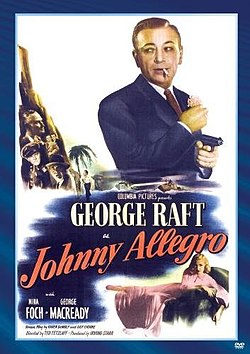
Johnny Allegro is a film noir directed by Ted Tetslaff , which was released in 1949 .
| Johnny Allegro | |
|---|---|
| Johnny allegro | |
 | |
| Genre | Film noir |
| Producer | Ted Tetslaff |
| Producer | Irving Starr |
| Author script | Guy Endor , Karen De Wolf James Edward Grant (story) |
| In the main cast | George Raft Nina Foch George Macredie |
| Operator | Joseph F. Byroc |
| Composer | George Dunning |
| Film company | Columbia pictures |
| Duration | 80 min |
| A country |  USA USA |
| Tongue | English |
| Year | 1949 |
| IMDb | ID 0041527 |
The film tells about a former gangster ( George Raft ), whom the US Treasury agents are forcing to infiltrate the leader of a gang of criminals ( George Macredi ), who, on behalf of a foreign state, is preparing to flood the American economy with fake dollars in order to destabilize it in its own political interests.
Critics restrainedly appreciated the picture, in particular, due to the inexpressive role of Raft in the lead role, but at the same time, the acting works of Nina Foch and George Macredi, who had previously successfully played together with the successful Gothic noir “ My Name is Julia Ross ” (1945), received positive feedback.
Story
Johnny Allegro ( George Raft ) is the owner of a small flower shop, which is located in one of the most expensive hotels in Los Angeles . The moment he was about to deliver a bouquet to one of the clients, he was loudly greeted by an attractive blonde ( Nina Foch ) in the hotel lobby who then whispers in his ear so that he pretends that they are well acquainted. Puzzled, Johnny decides to play along, kisses her, and then invites her to the hotel bar. She introduces herself as Glenda Chapman, after which she tells an incredible story that her father is a secret nuclear scientist, and therefore foreign agents monitor her. Although Johnny immediately realizes that American cops are watching her, he nevertheless agrees to help Glenda leave the hotel, unnoticed by a police detective on duty in the lobby. After several days of conversation, Johnny and Glenda are visited by an agent from the Treasury Department, Schulzi ( Will Gere ), reminding Johnny of his gangster past and his escape from the Sing Sing prison . Since during the Second World War, Johnny established himself as a hero who risked his life more than once, Schulzi offers him the opportunity to avoid punishment for past crimes by collecting information on Glenda. That evening, during a meeting, Glenda tells Johnny that she must leave urgently, but cannot tell him where she is leaving and why. Johnny agrees to help quietly get her out of the hotel, but when they go down to the garage located on the basement, a policeman is waiting for them. Johnny shoots him, then, together with Glenda, gets into the car and hides. Understanding that Johnny is facing severe punishment for killing a policeman, Glenda agrees to take him with him. She does not know that the murder was staged, and Johnny shot blank cartridges.
In a private jet, Glenda and Johnny fly to Florida , then transfer to a boat, arriving on an unknown small island. On the island, Johnny learns that Glenda is married to Morgan Wallin ( George Macredie), a mysterious character who lives in luxury, loves classical music and believes that bow and arrow are more effective than firearms. Despite the fact that Johnny helped Glenda escape by shooting a policeman, Wallin is suspicious of him and forcing him to surrender his weapon. Understanding that if Wallin checks his gun and sees that he is loaded with blank cartridges, he will immediately guess everything, and therefore Johnny makes several attempts to get the gun back, but he fails. The next morning, while walking through the territory, Johnny notices that two people arrived on the island, whom Wallin represents as Pelham Vetcha ( Ivan Traiso ) and Groote ( Walter Road ). In the afternoon, Wallin takes Glenda and Johnny with him to the mainland, supposedly in order to watch the races . At the hippodrome, Wallin instructs Johnny to take a large box of wrapping paper to one of the offices. Taking this opportunity, Johnny calls from Shulzi’s office, making an appointment for him at the Veterans Hospital this evening. Immediately after returning, Johnny Wallin announces that he is leaving for a business meeting, sending Johnny and Glenda to a restaurant. During dinner, Johnny simulates an attack of malaria , and he is urgently sent to the hospital. There, Johnny secretly meets with Shulzi, who says that during the war, Japan printed a lot of fake dollars to flood the west coast of the United States in order to create chaos in the economy. After the war, printed cliches were confiscated, but 500 million fake dollars were already hidden in Korea , which they are now trying to introduce into the US economy through Wallin. Johnny says that he now realized that the box he handed over at the hippodrome contained fake dollars that Wallin launders through the hippodrome. Schultzi instructs Johnny to find out where Wallin keeps the money.
Late in the evening, after returning to the island, Johnny enters Wallin's office to retrieve his gun from his desk, but in the office he is waiting for Glenda, who is clearly looking for proximity with Johnny. At this point, Wallin enters the office. Having escorted his wife and left alone with Johnny, Wallin, with a threat in his voice, tells him that he can’t lose either in business or with women. Later that evening, Johnny gets on a boat, and reports to Shulzi the approximate coordinates of their island, after which the Coast Guard ship is sent to the indicated region. Meanwhile, a conflict arises between Wallin and two of his guests on the open veranda, during which they accuse him of having searched their belongings and also introduced the unverified Johnny into the case. In addition, in their opinion, Wallin is only interested in making a profit, while he must work with them in the interests of their state. Vetch and Groot accuse Wallin of treason, taking out weapons, and Wallin, in turn, picks up the bow. Johnny overhears part of the conversation, figuring out that fake money is stored somewhere on the island. Then, having crept closer behind, he grabs Vetch's arm, as a result of which he shoots past, and at that moment Wallin manages to fire an arrow at Groote, and then shoot from the bow and fleeing Vetch. While Wallin is packing his things, about to escape from the island, Johnny again contacts Schulzi so that he can detect the transmitter and determine the coordinates of the island, also reporting that Wallin is hiding money on the island.
Glenda finds Johnny, telling him that he wants to part with Wallin and start a new life with Johnny. When he states that Wallina will not go anywhere without money, she reports where the vault of money is located on the island. Meanwhile, Wallin discovers that the cartridges in Johnny’s pistol are idle, and then quickly goes to the store, where Johnny has already entered into a fight with Wallin’s assistant who was watching him. Armed with a bow and arrow, Wallin begins a hunt for Johnny, chasing him across the island. When Wallin drives Johnny to the pier and is about to kill him with the last remaining arrow, Glenda pushes him by the arm, and as a result, Wallin misses. Johnny runs towards Wallin, and a fight begins between them, as a result of which Johnny pushes his opponent from a cliff, and he crashes to death. Johnny puts Glenda on a boat to hide from the authorities and avoid punishment, but Glenda refuses to leave without him. Soon the Coast Guard ship arrives, which takes them aboard. On the way to the continent, Shulzi pats Johnny on the shoulder, saying that he and Glenda did a good job.
Cast
- George Raft - Johnny Allegro
- Nina Foch - Glenda Chapman
- George Macredie - Morgan Wallin
- Will Gere - Shulzi
- Gloria Henry - Eddie
- Ivan Traiso - Pelham Wetch
- Harry Entrim - Paji
- William "Bill" Philips - Roy
Criticism of the film
Overall rating of the film
After the film was released, criticism took it quite restrained, in many respects, due to the low rating of the game of George Raft in the title role. As Bosley Krauser , a film reviewer, wrote in the New York Times , “there is nothing special in the film except for the scene where one of the characters is killed by their bows,” it is “a short story ... Nothing remotely resembles Mr. Raft’s live acting, which today has become one of the most slurred and comatose actors ” [1] . Calling the picture “a typical George Raft melodrama”, the reviewer of Variety magazine further noted that “the plot comes to life on a couple of turns to embellish the melodrama about the former gangster who has embarked on a path of correction, who takes on the dangerous task of the government in order to demonstrate his good intentions” [ 2] . Edwin Schallert of the Los Angeles Times noted that “this is a smoothly made and original melodrama,” but in essence it’s still a Category B movie . Moreover, “Raft is quite good in its usual way, although there is no special spark in its game” [3] .
Modern movie historian Mark Demig wrote that this “adventure thriller talks about a recovered gangster who faces a new and completely different threat” when government agents instruct him to expose a “glossy counterfeiter who is involved in preparing a right-wing coup by pouring huge parties of counterfeit money ” [4] . According to Bruce Eder, this "thriller is very far from another exciting film noir directed by Ted Tetslaff " Window ", which was released in the same year." According to Eder, "the plot is not bad, telling about the post-war attempt of agents provocateurs to use almost perfect counterfeit money to destroy the US economy." In addition, the film touches on the topic of hunting for people on the island, which had previously been raised in the adventure film " The Most Dangerous Game " (1932). Eder also notes that the political signal the film is trying to send is “a bit ridiculous, but similar moments can be found in films such as Big Jim MacLane (1952) and My Son John (1952), although in this case the engine history becomes a right-wing conspiracy against the country, not communist conspirators ” [5] . Miller writes that "this stylish film noir talks about a gangster on the run who is recruited to catch even larger fish." The theme of loss of fidelity, the image of the villain, as if taken from the movie “The Most Dangerous Game” (1932), as well as “allusions to the Red Threat (the forces behind the main criminal are foreign agents, possibly communists) are interwoven into the main storyline of the picture. " [6] .
Actor rating
According to Krauser, “Raft, for whose harsh character is more characteristic of images of criminals, this time helps government secret agents to destroy a gigantic gang of counterfeiters” [1] . Variety notes that Raft plays in his usual manner, but " Nina Foch delights in the role of a girl who is not so bad and who needs Raft to take the right path." The reviewer also notes George Macredie as “her husband and a villain working for foreign powers who want to flood the country with fake money and thereby destroy the national economy” [2] .
According to Miller, “when George Raft came to Columbia to shoot in this film, he was already approaching the end of the period when he played the main characters. Raft can still quickly pour in chopped cues, which made him a star of gangster paintings, but his film partners deserve praise here. ” First, according to Miller, this is “ George Macredie , who, in the role of the asexual Morgan Wallin, brings in all the decadence and arrogance that allowed him to play with Glenn Ford and Rita Hayworth unforgettably in Guild (1946). To add a bit of audacity to his character, he prefers to hunt his enemies with a bow and arrow. ” The critic also notes that “Nina Foch is becoming a revelation in the role of his wife, who is possibly on the side of Raft, but maybe not. The combination of an ice blonde in her appearance with a guttural and passionate manner of speech makes her look like the heroines of Alfred Hitchcock ” [6] .
Bruce Eder refers to the advantages of the picture "a peculiar game of Will Gear in a key supporting role, and the pleasant work of Nina Foch, who played better than usual, a good bad girl." He also highlights George Macredie, who "creates the image of a polite villain, in a manner of speech and expression of cold restraint that frightening sadistic features are felt." In addition, "in the context of the time when the film was made, it is clear that it is" not one of us ", as it is fixated on good food, elegant decor and classical music." In contrast, Raft says that he “has no time to listen to music,” and he uses it only to “cover up his attempt to slip on a boat, to communicate with the authorities on the radio” [5] .
Notes
- ↑ 1 2 Bosley Crowther. The Screen . The New York Times (May 31, 1949). Date accessed August 20, 2018.
- ↑ 1 2 Variety Staff. Johnny Allegro (1949) Variety (December 31, 1948). Date accessed August 20, 2018.
- ↑ Edwin Schallert. Slickness all but masks weak spots in 'allegro' . Los Angeles Times (14 June 1949). Date accessed August 20, 2018.
- ↑ Mark Deming. Johnny Allegro (1949). Synopsis AllMovie. Date accessed August 20, 2018.
- ↑ 1 2 Bruce Eder. Johnny Allegro (1949). Review AllMovie. Date accessed August 20, 2018.
- ↑ 1 2 Frank Miller. Johnny Allegro (1949). Article . Turner Classic Movies. Date accessed August 20, 2018.
Links
- Johnny Allegro at IMDb
- Johnny Allegro on AllMovie
- Johnny Allegro at the American Film Institute website
- Johnny Allegro at Turner Classic Movies