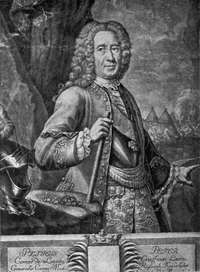
Count Peter Petrovich Lassi ( Lessi , Lessia ) [1] ( eng. Pierce Edmond de Lacy , Peadar de Lása ; October 30, 1678 - April 19, 1751 ) - one of the most successful Russian commanders of the 18th century . Irish by birth, in 1700 he entered the Russian service and by 1736 he rose to the rank of Field Marshal . Father of the Austrian field marshal Franz Moritz Lassi .
| Peter Petrovich Lassi | ||||
|---|---|---|---|---|
 | ||||
| Date of Birth | October 30, 1678 | |||
| Place of Birth | Killidy , Kingdom of Ireland | |||
| Date of death | April 19, 1751 (72 years old) | |||
| Place of death | Riga , Livonia Province , Russian Empire | |||
| Affiliation | Kingdom of Ireland ( 1678 - 1691 )  Russian Empire ( 1700 - 1751 ) Russian Empire ( 1700 - 1751 ) | |||
| Years of service | 1691 - 1751 | |||
| Rank | Field Marshal | |||
| Commanded | Livonia Governor General | |||
| Battles / wars |
| |||
| Awards and prizes |
| |||


Content
Origin and youth
It came from the ancient Norman clan Lassi (Lacy, Lassy), which had long since settled in Ireland [2] . At the age of 13, Peter sided with the Jacobites and took part, in the rank of lieutenant, in the defense of Limerick from the Williams .
At the end of the war of the two kings , Count Lucan emigrated with his supporters to France, where the so-called Irish squad , in which Peter Lassie was recorded as a private. For in France, the British officer dignity was not recognized for the young man. The brothers of the future field marshal died in the wars of Louis XIV , and he, having earned his first officer rank in the Savoy campaign in 1697 , switched over to the Austrians .
Under the command of the Duke de Croix, he participated in a campaign against the Turks and joined him in Russian service in 1700.
Northern War
Under the command of the Duke de Croix, Peter participated in the Battle of Narva .
In 1701, after marching to Kokenguzen and Riga, Field Marshal B.P. Sheremetev promoted Lassi to captain and appointed commander of the grenadier company. In 1702, he participated with her in a case near Gummelsgof ; in 1703 he was appointed commander of the "noble company", was with her in the Livonian campaigns of this year, and in 1704 - during the siege and assault of Derpt .
In 1705, he was transferred by major to the regiment of Count Sheremetev and participated in the Grodno operation . In 1706, he was appointed by the personal decree of Peter I the lieutenant colonel in the newly recruited regiment of Kulikov (then the 1st infantry Nevsky ), whom Lassi would become "the eternal boss."
For the capture of Bykhov in 1707 he was promoted to colonel . With the opening of a new campaign against the Swedes (1708), he commanded the Siberian Infantry Regiment and was dangerously wounded in the head when crossing the Desna , but remained in service. After the occupation of Romain , the king appointed Lassi “commandant with regiments and Cossacks, and the Romans [Lassi] strengthened them with battles and palisades and, in other matters, controlled everything according to instructions given from His Imperial Majesty; for which the service was granted to the Grenadier Regiment. "
Commanding the latter, Lassi took part in a campaign near Reshetilovka and in the Battle of Poltava , where he was seriously injured a second time.
In 1710, he took a close part in the siege of Riga , and after taking Riga was appointed commandant of the city .
In 1711, participating in the Prut campaign , promoted to brigadier .
In 1713, under the direct command of Peter I , he was in a battle near Friedrichstadt . He also took an active part in the siege of Stettin (Szczecin).
In July 1719, Lassi took part in an expedition to the shores of Sweden . Having landed with a detachment near Stockholm , Lassi terribly devastated the surroundings. The loot taken out by the Russians from this expedition was estimated at one million thalers, and the devastation at 12 million. The Russian attack on indigenous Sweden broke the last resistance; since that time, peace talks have been ongoing continuously, the Swedes have made almost all the concessions required of them. Lassi was promoted to lieutenant general in 1720.
From 1723 to 1725 he was a member of the Military College [3] .
In 1727, Lassi was sent with the corps of troops to the borders of Courland to prevent Moritz of Saxony , claiming a vacant throne, to establish himself in the duchy, and at the same time to prevent the Poles from exerting too much influence there. Lassi acted energetically and rather deftly and carried out the assignment entrusted to him. After that, Lassi was left as governor in Livonia .
War of the Polish Succession
Lassi's full military talent manifested itself with the beginning of the war for the Polish inheritance . In 1733, he was sent by the head of a detachment of 16,000 people sent to the Polish-Lithuanian Commonwealth to support Augustus III against Stanislav Leshchinsky .
The ousting of Leschinsky from Poland illuminated Lassi as a subtle diplomat who especially skillfully prepared such military enterprises that were associated with the difficulties of moving and food the army in wild, sparsely populated places.
The campaign of 1733-1734 was just that. Lassi handed over his affairs in managing the province to the father of the future general-general, Völkersam, and leaving his family to live permanently in the Riga governor's house, he left for the troops. He was ordered on August 6 to enter the borders of Poland. He spent the month of July on the final arrangement of the food supply, collecting horses, ammunition, etc. Lassi had to get out of a great difficulty: to go through the country without arming civilians against Russia, without looting and without robbing. In addition, the Russian government increased this difficulty by instructing Lassi to pay with Russian money for everything; when the Poles refused to accept them, ordered them to take everything by force, paying with Russian coins.
In early August, Lassi crossed the border, occupied Kovno on August 19, and Grodno on August 27. As the army of Lassi approached, the pans left their estates and fled to Warsaw. The peasantry remained, and the commander-in-chief was able to maintain order in the army so much that the population did not suffer from it. Soon after the start of the campaign, Polish nobles, supporters of Russia, began to come to him for support and patronage. This was by the way, as the army was in a difficult position. Her movement was slow and heavy. The army was tied up by a mud, and the spilled rivers and forests were hardly passable. Lassi overcame them and, having relations with pro-Russian tycoons, faithfully, although slowly, sparing the soldier, he moved to Grodno [4] .
Lassi approached Warsaw on September 14, September 20, he took the outskirts of Warsaw, Prague , and September 22 in the tract Grokhov was assembled under the protection of Russian bayonets seym, who chose Frederick Augustus , Elector of Saxony as king of Poland. 93 cannon shots from Russian guns ushered in this election to Warsaw, which was in the hands of supporters of Leshchinsky. Having ferried troops from Sokhotin, Lassi forced the enemy to retreat to Krakow and on October 5 occupied the capital and its environs with his troops. However, discipline in the army was frustrated due to the fact that all Lassi orders and enterprises were delayed and spoiled by the intervention of Leuvenwolde , the Russian ambassador in Warsaw. In addition, the government sent an order of October 30 to hasten with the end of the Polish campaign, more often to inform and act on everything, according to the descriptions sent by Lowenwold.
The Siege of Danzig
By the end of 1733, new confederations had formed in northern Poland, and on November 5, Lassi was sent with a 12,000-strong army against the Confederates and Leschinsky. On November 22, he stood at the village of Lovichi, waiting for money and ammunition. On January 30, 1734, he was 6 miles from Danzig , and on February 21 he reported to Petersburg about the blockade of the city and the location of troops
According to Lassi, Danzig, equipped with good artillery, 30 thousandth army, defended by French engineers and a garrison, could not be stormed with such insignificant artillery and army as that which was at his disposal. Slowness and caution did not like him in Petersburg, where, moreover, they wanted to fuse Minich ; the latter was instructed to expedite the capture of Danzig. At the council of war, Lassi was opposed to an immediate attack, but Minich's opinion of the assault triumphed. Even before him, however, Lassi managed one important venture: he defeated the governor Jan Tarlo , a supporter of Leshchinsky, who was going to help Danzig, and prevented the French frigate from entering the mouth of the Vistula .
During the assault on Danzig, Lassie's enormous influence on the soldiers was revealed. In the assault column, all the officers were killed, and she stopped under the deadly fire of the enemy. Minich ordered to retreat, but no one obeyed him. Only Lassie's personal appearance and his persuasion worked, and the soldiers retreated in order, of course, with enormous damage. From the contribution taken from Danzig, Lassi got quite a lot. From the money for the "bell ringing" he received 5,000 rubles, 2,083 chervonets, 2 thalers and 20 pennies.
On the Rhine
Polish affairs had not yet been brought to an end when a new commission fell upon Lassi. In 1734, the French attacked Emperor I of the Reich Charles VI , and, according to the agreement , he requested allied assistance from Russia: which was expressed in the sending of a 13,000-strong army under the command of Lassi. Again, he had to lead troops through sparsely populated or poor areas, protecting the soldiers from exhaustion, and the population from looting and violence.
on the march of the Russian corps [5]
Oh Gauls! Did you know the hussar blades
And in fear they thought: devils serve the Germans!
Tremble w - Moscow sends us faithful regiments.
Hardly any of you will escape a terrible death!
Particularly difficult was the march through Bavaria . The reigning Elector Karl Albrecht did not participate in the war, but held pro-French views. Bavarian representatives said in Vienna that the elector would not allow the passage of the Russian corps, even through the use of force and exit from neutrality. To pressure the elector, the imperial authorities even had to make a military demonstration by removing troops from the Rhine and Inna. In the end, the elector lost. Due to the lack of provisions, the march through Ober-Palatinate and Sulzbach was done without a day in 4 days. In Pomol Sprung, the Bavarian authorities provided the corps with fodder and supplies.
General Lassi reported to St. Petersburg that when passing through Bavaria “no one was shown any prohibition and insanity from anyone or my team, no one was embittered, but that Major General Baron Mirowicki, standing in Obor-Falsky land close to our route, was one and a half thousand soldiers , having come to me, I named him, the elector of Bavaria, in name, for the good Her Imperial Majesty, when he passed the earth, he thanked his condition and actions ” [6] . On August 15-16 (26-27) the corps arrived in Ladenburg and rose from Ladenburg to Heidelberg. On August 18 (29), Prince Yevgeny of Savoy accepted the parade of the Russian corps and was satisfied with “this well-managed and well-trained infantry” [7] , but the corps did not have to take part in hostilities: the appearance of Russians in Germany made Austria’s enemies bow to peace.
In March 1736, Lassi was in Vienna . The emperor honored him with an excellent reception, caressed and bestowed: decorated with a portrait showered with diamonds and handed over 5000 pieces of gold in a red velvet bag. In Russia, Lassi showed signs of pleasure and approval even earlier. On February 17, 1736, the Cabinet notified the Senate of the Highest Decree appointing Lassi Field Marshal .
French Minister d'Arganson quite definitely wrote that Russia's actions in Poland, their powerful movement towards the Rhine, give an idea of the impressive power that this power has. Cardinal De Fleury thus admonished the Marquise Jacques de Shetardi , who was sent by the ambassador to Russia: “Russia has reached too high a degree of power in relation to equilibrium in the North, and her union with the Austrian house is extremely dangerous. We saw on business in Poland how the Vienna court abused this union. If he could recently bring to the Rhine a corps of Moscow troops of 10 thousand, then when he needs to subjugate the whole Empire to his arbitrariness, he will be able to destroy all of Germany with crowds of barbarians ” [8] .
War with the Turks
Azov Campaign
At this time, a war broke out against the Turks . On April 17, 1736, Lassi arrived already from the Rhine campaign to Tsaritsynka , where his commanding comrade, also Field Marshal, Minih , was staying, and consulted with him about future actions against the enemy. Lassi moved to Azov - Minih to the Crimea . In the steppe he was attacked by the Tatars; his things were robbed and he himself barely escaped.
The siege of Azov was quick: on June 17 (28), Lassi launched an assault on the Azov palisade, and on 19 (30) the city surrendered. Such quick success was partly due to a skillful and energetic military search, and partly to the fact that Lassi got several Armenian spies who pointed out to him the weakest places of the fortress. Upon taking it, she was brought into a form capable of defense, and siege artillery was sent to the city of Izum . Lassi himself began to prepare the army for advancement to the Crimea, but he met an unexpected obstacle in the form of displeasure from the side of Minich [9] .
Crimean campaign
Upon returning from Azov, the government laid on Lassi a gathering for the campaign of the Don Cossacks , Little Russian and Sloboda Cossack regiments, as well as the Bashkirs . Such an assignment was contrary to Lassi's personal intentions. Four years have passed since he left his family, did not see children, and even because of constant movements almost did not receive letters. According to him, his children were "without science and charity." Wanting to see his own, Lassi asked for the whole winter on vacation in Riga. Instead, he received an order to discuss, together with Minikh, the plan for the future campaign and, in the form of consolation, he was awarded the Order of St. Andrew the First-Called . On April 1, 1737, 37 commanders of land were granted in Livonia, the Commander-in-Chief in the promotion of faithful service.
On May 3, Lassi made his way from Azov to the Crimea from the side of the Rotten Sea , from where they didn’t wait for him and, crossing him, invaded the peninsula, devastating everything on the way and moving to Karasubazar . At this town, he defeated the Khan's army in two battles on June 12 and 14, but could not remain in the country due to a lack of provisions, and especially horse feed. Lassi would have stayed even longer in the Crimea and would have achieved greater success if help from Little Russia from Prince I.F. Baryatinsky had arrived in time for him. Seeing no timely support, Lassi retreated to Milky Waters .
Lassi Corps 1738-1739
Having traveled to St. Petersburg to consult and coordinate the actions of the Russian and Austrian armies (November 1737), Lassi returned to the south and began to prepare for a new spring campaign. His regular army was strengthened by Cossack and Kalmyk regiments, and again complaints were received from Lassi about the lack of money, recruits, horses, ammunition, the lack of carts, dissolution, horsemen, horse harness, artillery supplies, etc. Having settled the disagreements among the commanders of the Don army and as far as possible having finished, Lassi moved to Perekop . June 26, 1738 he crossed the dry Sivash , leaving the wagon train under the protection of a decent team. The 40,000th Turkish-Tatar army retreated behind the rampart, at the end of which was the Chivash-Kale fortress. Lassie besieged her. Heavy rain prevented the start of decisive action.
Lack of supplies and drought forced him to retreat to the Donets; the failure had so much effect on Lassie that he sent the Empress a letter of resignation, but in Petersburg they were pleased with him. The Empress thanked him for the service and wished for its continuation. Such the highest approbation moved him unspeakably and in a response letter of thanks he promised to serve with zeal for the rest of his life.
The following year, the Dnieper flotilla and Zaporozhye Cossacks were subordinate to him. In April 1739, the start of a new campaign was supposed. Lassie was extremely dissatisfied with her preparation. The conclusion of the Belgrade peace made this campaign redundant. Regular troops under the command of Lassi were moved to Moscow because of the possibility of war with the Swedes.
War with the Swedes
Lassi was one of those chivalrous natures that were still encountered in the first half of the 18th century. He needed to sell his sword as needed, but faithfully and honestly served the one who paid. A warrior by nature and inclinations, he loved and knew his job and distinguished himself from other Russian generals from foreigners in that he always and everywhere pursued the interests of Russia, and not his own. He never showed an inclination to become famous for the vain shedding of Russian blood, alien to him, and never dared to do such desperate things as Minich thundered.
In the Swedish war of 1741-1743, Lassi was the commander in chief of the Russian army. On February 19, 1740, he himself was appointed Governor-General of Livonia and Riga, and in November he was granted with offspring to the counts of the Holy Roman Empire . This time was the heyday of his influence. On August 8, 1741, Lassi was appointed to attend the Military College.
The Swedish war owes much of its success to energy, orderliness and care for the troops of Peter Lassi. Leading her, he showed himself to be a loyal and intelligent student of Peter the Great, and in his operations in Finland he used both his experience and his personal past. With discipline in the army and the ability to get along with the population, he acquired many well-wishers and supporters of Russia in Finland .
The war with Sweden ended the hostilities of Lassi, but he continued to be a prominent military figure, and they turned to him for advice in complicating foreign affairs. On July 27, he was appointed commander of forces in Livonia.
Peter Lassi died in 1751, leaving behind a good memory, especially among soldiers.
Reviews of Contemporaries
In his notes, the Spanish ambassador to the Russian court, the Duke de Liria, reports of him :
General Lassi, a general from infantry, originally an Irishman, knew his job perfectly; he was loved, and he was an honest man, unable to do anything wrong, and everywhere he would have enjoyed the glory of a good general.
[eleven]
Family
- Son-in-law - Riga Governor General Yu. Yu. Brown
- Son - Franz Moritz Lassi (1725-1800), a famous military leader.
- A relative [12] is Boris (Moritz) Petrovich Lassi (Lesi) (1737-1820), a general from infantry.
Notes
- ↑ Peterlesius signed in Russian .
- ↑ Lassi, Russian military leaders // Brockhaus and Efron Encyclopedic Dictionary : in 86 volumes (82 volumes and 4 additional). - SPb. , 1890-1907.
- ↑ Lassi // Small Encyclopedic Dictionary of Brockhaus and Efron : in 4 volumes - St. Petersburg. 1907-1909.
- ↑ He tried to keep the government up to date with his affairs, but because of the impossible means of communication, he did not always succeed, and on September 13 the ministers demanded, "where Lassius is found and what happens to him." On September 11, he reported to Petersburg about the election of Stanislav Leshchinsky as the Polish king and about his orders in accordance with this: to capture the supporters of Stanislav and the Tatar lancers supporting him. The cabinet responded to this with a rescript addressed to K. G. Lowenwolde , the Russian ambassador in Warsaw, ordering Lassi to report to him “in part” about the campaign and condition of the troops. In fact, the commander in chief was dependent on the ambassador.
- ↑ Nelipovich S.G. Union of double-headed eagles. The Russian-Austrian military alliance of the second quarter of the XVIII century .. - P. 173.
- ↑ Nelipovich S.G. Union of double-headed eagles. The Russian-Austrian military alliance of the second quarter of the XVIII century .. - M .: Joint Editorial Office of the Ministry of Internal Affairs of Russia, Quadriga, 2010. - P. 160. - ISBN 987-5-91791-045-1.
- ↑ Nelipovich S.G. Union of double-headed eagles. Russian-Austrian military alliance of the second quarter of the XVIII century .. - S. 161.
- ↑ Nelipovich S.G. Union of double-headed eagles. Russian-Austrian military alliance of the second quarter of the XVIII century .. - S. 166.
- ↑ Lassi was older in his ranks and ranks, but always obeyed the orders of Minich.
- ↑ Lassi, Petr Petrovich // Russian Biographical Dictionary : in 25 volumes. - SPb. - M. , 1896-1918.
- ↑ Duke of Lyria. Notes on the stay at the Imperial Russian court in the rank of ambassador of the King of Spain // Russia of the XVIII century. through the eyes of foreigners. - L., 1989 .-- S. 253.
- ↑ Lassi // Military Encyclopedia : [in 18 vol.] / Ed. V.F. Novitsky [et al.]. - SPb. ; [ M. ]: Type. t-va I. D. Sytin , 1911-1915.
Literature
- Bantysh-Kamensky, D.N. 12th Field Marshal Count Lassi // Biographies of Russian Generalissimo and Field Marshal. In 4 parts. Reprint reproduction of the 1840 edition. Part 1-2 . - M .: Culture , 1991 .-- 620 p. - ISBN 5-7158-0002-1 .
- Lassi, Petr Petrovich // Russian Biographical Dictionary : in 25 volumes. - SPb. - M. , 1896-1918.
- Surzhik, D.V. Lassi Petr Petrovich . Project RVIO and VGTRK "100 great commanders . " Date of treatment June 16, 2013. Archived June 16, 2013.
- Bellingari, Edward de. The roll of the house of Lacy: pedigrees, military memoirs and synoptical history of the ancient and illustrious family of De Lacy, from the earliest times, in all its branches, to the present day. Full notices on allied families and a memoir of the Brownes (Camas) . Waverly Press, Baltimore (MD) 1928.