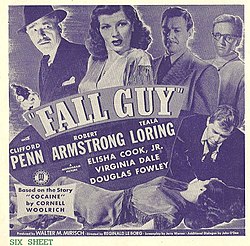
“Scapegoat” ( born Fall Guy ) is a film noir directed by Reginald Le Borg , which was released in 1947 .
| Scapegoat | |
|---|---|
| Fall guy | |
 | |
| Genre | Film noir |
| Producer | Reginald Le Borg |
| Producer | Walter Mirish |
| Author script | Jerry Warner John O'Dee Cornell Woolrich (short story) |
| In the main cast | Leo Penn Robert Armstrong Tila Loring |
| Operator | Mack Stangler |
| Composer | Edward J. Kay |
| Film company | Monogram pictures |
| Duration | 64 min |
| A country |  USA USA |
| Tongue | English |
| Year | 1947 |
| IMDb | ID 0039368 |
The film is based on the story of the popular criminal author Cornell Woolrich “Cocaine”. The film is about a young man, Tom Cochrane ( Leo Penn ), who, due to drug intoxication, cannot remember the events of the previous night, when he allegedly killed a young woman. With the help of his brother-in-law ( Robert Armstrong ) and the bride ( Tila Loring ), he gradually restores the picture of what happened, eventually exposing the cunning plan of the guardian of his bride, who decided to kill the blackmailer who was blackmailing him, substituting in this crime Tony, whom his pupil was jealous of.
Criticism generally restrained the film, paying attention to its low budget, a rather template plot and not enough vivid play of the leading actors. At the same time, according to some critics, the film turned out to be quite lively and energetic.
Story
In New York, late at night, a young man falls out of a telephone booth and falls unconscious on the sidewalk. Soon he is noticed by a policeman passing by, urgently sending him to the hospital. Since the man’s shirt is stained with blood and a bloodied knife is found with him, police suspect that he may be involved in the murder. After finding out that the person’s name is Tom Cochrane ( Leo Penn ), detectives Shannon ( Douglas Fowley ) and Taylor ( Harry Strang ) are trying to interrogate him, but Tom is not able to answer questions. The doctor explains that Tom is heavily affected by cocaine and it will take some time before he wakes up. However, when the police leave the room to study the evidence, Tom escapes through the side door. In the middle of the night, Tom’s bride named Lois Walters ( Tila Loring ) is woken up by his son-in-law, Mack MacLane ( Robert Armstrong ), informing him that Tom is with him, but is in an almost insane state. Lois is about to go straight to Mack, but she is met in the living room by her guardian, “uncle” Jim Grossett ( Charles Arnt ), who does not approve of Lois’s relationship with Tom, calling him a loafer and a drunkard. Ignoring Jim's words, Lois arrives at Mack, where Tom, who has come to his senses a bit, has uneasily reported that he killed a woman last night. Mack, who serves in the police, asks his brother to tell in detail what happened to him. With some difficulty, Tom begins to recall the events of the last night:
At first he had a drink at a bar, from where, along with a casual acquaintance, he went to a party in a private apartment, where he met an attractive singer ( Virginia Dale ). Inviting him to the table with drinks, she insisted that he drink a couple of cocktails, after which he "began a crazy glow." He doesn’t remember anything further, and some time later he woke up in a seemingly same apartment, but all alone. Tom tried to go outside, but instead of the front door, he opened the door to the dressing room, from where the corpse of a slaughtered young woman fell, as it seemed to Tom, the very singer he met at the party. Then Tom locked the door to the dressing room, picked up a bloody knife from the floor, mechanically put the key and knife in his pocket, and went outside to call his brother. However, in a telephone booth, he lost consciousness and fell on the sidewalk.
After listening to his story, Mack insists that he immediately go to the police, but Lois persuades Mack to conduct his own investigation with Tom, while he is still at large. Soon, his immediate superior, Inspector Shannon, drives up to Mack's house. Noticing his car through the window, Tom and Lois quietly hide through the back door and hide in the next round-the-clock movie theater. Shannon suspects that Mack knows where Tom is, but does not try to put pressure on him, believing that Mack will soon lead the police to Tom. However, with the help of Lois Mack manages to get away from police surveillance, and with Tom he comes to the same bar where Tom met a friendly stranger yesterday. Sitting in the bar, Tom suddenly recalls that the stranger was called Joe, and at that moment he notices the same singer leaving the bar and runs away after her. Having lost sight of her in the crowd, Tom returns to the restaurant, where he recalls that Joe said that he was working as a lifter. Tom and Mack go around the neighborhood in search of the elevator Joe ( Elisha Cook ), and, after an intense search, they find him in one of the houses. However, Joe categorically denies that he has ever seen Tom, and only turning his hands around the guy and using force, Mack and Tom find out the address where the party was held yesterday. Mack and Tom arrive at the indicated address, where they meet the Shindell couple ( John Harmon and Iris Adrian ), who actually held a party yesterday, but they do not recognize Tom, saying that they had a lot of unfamiliar guests yesterday. Finishing the interrogation, Mack looks out the window, noticing that Joe is watching them from the other side of the street. Mack and Tom quickly go outside, but they only see how someone pushes Joe and he dies under the wheels of a passing car. Paying attention to the position of the neon sign on the house opposite, Tom suddenly realizes that he came to himself not in this apartment, but in exactly the same, only a floor above. Mack and Tom come to that apartment, where there is still no one. They open the door to the dressing room, where a corpse falls out on them. Having examined it more closely, Tom realizes that this is not the singer he met, but just a girl who looks like her. The moment Mack and Tom are about to leave, Shannon appears with the intention of arresting both. However, Tom pushes Mack at Shannon and manages to hide in Lois's car waiting below. However, police arrest Mack by putting him in a pretrial detention cell. Tom is hiding again in a round-the-clock movie theater, and Lois goes to the police station to meet with Mack, after which the police establish her surveillance. Meanwhile, in search of a singer, Tom again goes to the same bar, however, without waiting for her, leaves. The bartender, who promised to inform him if she reappears, suddenly sees her entering the bar with her young man named Mike ( Jack Overman ). Having ordered drinks, the singer, whose name is Marie, tells Mike that yesterday, by the order of one gentleman, she poured drugs on the guy in a cocktail and gave him a drink. After that, the gentleman ordered her to pay off Joe and leave the city immediately, and now she fears for her life, especially after her friend Patty, whom the gentleman supplied with cocaine, disappeared yesterday. So without waiting for the bartender to run after Tom, Marie and Tom leave the bar and go to Marie’s home. On the way, Mike notices surveillance and, sending Marie to the apartment, decides to find out who is watching them in front of the house. This person turns out to be Tom who went to talk with Marie, but Mike, not listening to him, hits Tom several times, as a result of which he loses consciousness. Meanwhile, in her apartment, Marie preens by the mirror, hearing the door open. Believing that this is Mike, she blithely continues to comb her hair, but then she sees in the mirror that this is the gentleman who turns out to be Jim Grosset. Jim, who from Lois’s stories knew all about Tom’s actions, strangles Marie. Mike, who hears Marie's screams, tries to break the front door, but Jim manages to escape through the window through the fire escape to the roof of the building. Having knocked out the door, Mike finds Marie’s body in the room, after which Tom comes to himself, who immediately rushes to chase the killer. Tom jumps out onto the roof, and despite Jim shooting, continues to chase him. In the end, when Jim knocks Tom down and is about to kill him, Mike sneaking up behind him with a few strokes of a metal pole smashes Jim's head, killing him.
After it all ends, at the police station, Tom tells Lois that, as it turned out, Patty blackmailed Jim, threatening to tell him about his drug affairs. In addition, Jim was jealous of Lois for Tom and wanted to break their relationship. And therefore, having killed Patty and substituting Tom, Jim, according to Tom, tried to "kill two birds with one stone." Commissioner Shannon releases Mack, drops all charges against him and Tom, and wishes Tom and Lois a happy wedding.
Cast
- Leo Penn - Tom Cochrane (credited as Clifford Penn)
- Robert Armstrong - Mack MacLane
- Tila Loring - Lois Walter
- Elisha Cook - Joe
- Douglas Foley - Inspector Shannon
- Charles Arnt - “Uncle” Jim Grossett
- Virginia Dale - Marie
- Iris Adrian - Mrs. Shindell
Filmmakers and Leaders
According to film historian Glenn Erickson, at the beginning of his career, Walter Mirish produced Category B films for a decade, mainly for the Monogram studio and its prestigious Allied Artists division. In particular, after this film, which was his first, Mirish produced another noir on Monogram - “ I would not want to be in your shoes ” (1948), which was also staged according to the book by Cornell Woolrich [1] . After these pictures, Mirish produced on Monogram a series of films of the children's adventure movie series "The Bomb, the guy from the jungle " (1949). Mirish later performed the production duties (without credits) of such classic years as “ The Invasion of Body Thieves ” (1956) and “ Friendly Exhortation ” (1956), and in 1957, together with his brothers, created his own independent production company The Mirisch Company , which produced such Oscar-winning tapes as “ Apartment ” (1960) and “ West Side Story ” (1961), as well as films such as “ Only Girls in Jazz ” (1959), “The Magnificent Seven ” (1960) and “ Pink Panther” "(1963). However, most of all, according to Erickson, Mirish is known as the creator of "one of the best paintings of the 1960s, the crime drama" Midnight Heat "(1967), which earned him an Oscar for the best film" [1] .
Erickson also notes that "the picture also boasts its literary lineage - the author of the story underlying the script is the recognized detective author Cornell Woolrich." By that time, such successful noir films as “ Street of Fortune ” (1942), “ Lady Ghost ” (1944), “ Deadline at Dawn ” (1946), “ Black Angel ” (1946) and The Chase (1946). The mention of Woolrich in the movie posters of the time testified that his name was selling well at the time [1] . The film historian Arthur Lyons, for his part, noted that at that time the Monogram studio “seems to have fallen in love with Woolrich’s work, so a significant number of her noir films were based on his novels with a memory loss from alcohol and drugs” [2] .
Director Reginald Le Borg began in 1936 with short films, only in 1943 he moved to the level of full-length cinema, where he initially specialized in the production of low-profile films from the boxer Joe Palucu and the Bower guys . However, Le Borg was most remembered for staging horror films such as “ Call to Doctor Death ” (1943), “ The Phantom of the Mummy ” (1944), “The Strange Woman ” (1944), “ Eyes of the Dead ” (1944), and a little later - “ Black Dream "(1956) and" Diary of a Madman "(1963) [1] .
According to Erickson, the lead actor, which is listed in the credits as “Clifford Penn,” this is actually Leo Penn , the father of the famous movie star Sean Penn in the future. They say that after speaking in support of trade unions, Leo Penn got into the Hollywood black lists , and since 1949 he could not get a job in the cinema. He switched to television, where for more than 30 years he worked first as an actor, and then in parallel and as a director [1] .
As Erickson writes further, “the young Tila Loring played in a couple of dozens of small films in the 1940s, but in the end did not achieve a major breakthrough,” and Robert Armstrong , who is best known for the movie “ King Kong ” (1933), being, according to Erickson, “already in a deep middle age, he still received many mid-level roles. A year earlier, he played a key role in the slightly more significant Monogram film Noir “ Trap ” (1946) ” [1] .
Movie Story
The story by Cornell Woolrich , originally titled Cocaine High ( C-Jag ), was reissued in Black Mask magazine under the name Cocaine in January 1947 [3] .
In this film, his first major role was played by Leo Penn , who before that was shot only in episodes. In screen captions, as well as in subsequent reviews, his name was indicated as Clifford Penn, under that name he appeared only in this film [3] .
Criticism of the film
Overall rating of the film
The film received a moderate assessment of criticism. In particular, film historian Bob Porfirio called it "a small-budget Monogram studio film with an uneven and eclectic visual style." According to Porfirio, the picture can be attributed to the noir genre primarily due to the plot typical of Woolrich’s works, where he develops his “strange ideas about how drugs affect the human will”. Under the influence of alcohol or drug intoxication, Woolrich’s characters are involved in crimes, suffering from loss of memory, incessant nightmares or find themselves in a seemingly hopeless situation. Similar plot moves can be seen in films such as Fear at Night (1947), Deadline at Dawn (1946), Chase (1946) and Nightmare (1956) [4] .
According to Spencer Selby, the film tells about a man who “without remembering anything about last night and having at his disposal only a few clues, is trying to prove that he did not kill an attractive woman” [5] . Michael Keeney called the picture “a pretty standard thing”, although, in his opinion, “veteran noir Cook is always a pleasure” [6] . Glenn Erickson wrote that this "Category B mini-budget film was designed to compete with the then-popular detective thrillers, which many years later were called noir films." The critic believes that “the film is not at all bad for Walter Mirish’s first production project”, however, “this picture is not the brightest representative of the noir style” [1] .
According to Denis Schwartz, this “low-budget film noir of the Monogram studio has a pleasant gloomy visual style and the usual dark noir theme of an innocent person who is captured by circumstances beyond his control. A small category B film, but it has energy and liveliness ” [7] .
Martin Teller noted that “Woolrich is known for the intricacies of his stories, but in this case it’s not so difficult to follow the plot, although there are some interesting twists and turns,” “a significant part of the story is revealed in a clumsy denouement towards the end of the film” [8] . According to Teller, “the story bears some resemblance to two other films based on Woolrich’s stories” - “ Black Angel ” (1946) and “ Fear in the Night ” (1947) - however, “this is probably the weakest of these films due to unconvincing acting and insufficiently meaningful stories. The film can be watched, but there is nothing special in it, everything is pretty boilerplate ” [8] .
Assessment of the production qualities of the painting
Analyzing the picture, the film expert Glenn Erickson drew attention to its “modest but worthy” production. He writes that in 1947, even for Monogram, filmmaking was not cheap, because “the cameras were heavy and the creative teams were big. The only way to cut costs was to shorten the filming period. ” According to the film expert, “this explains why everything in Jerry Warner’s script is simplified, New York is represented with the help of various previously used decorations, and, in addition, many archival frames are used, sometimes made twenty years ago” [1] .
Erickson, in particular, writes that "the installation of glasses of champagne, signs of nightclubs and happy revelers is also taken directly from the film archive, and it does not accurately convey the desperate nature of Tom's search for a mysterious woman." The critic further notes that when “someone sprinkles cocaine on Tom, we really don’t see how this happens. The film can not afford beautiful pictures to convey a narcotic state, and therefore the voiceover takes on a heavy load. Poor Tom is trying to convey his feelings, involuntarily showing how poorly the creators imagined at that time the state of a person in drug intoxication. ” In general, “the characters talk more about their actions than they do something. With the help of questions and answers, the viewer is made aware that Mack and Tom ran all over New York during the day, but all that the viewer sees is a close-up of their feet on the sidewalk ” [1] .
Erickson notes that “ Le Borg does a lot to fit into Mirish’s budget, minimizing the number of scenes and camera movement”, however, gives “one tense view when Marie, who can be called the fateful woman of the film, watches in the mirror the way the killer approaches her, intending to strangle her. " In addition, “Mirish found a place in the budget to include a song performed by Virginia Dale at the party, there are also a couple of good fights and a fight on the roof that cause some excitement” [1] . However, according to Erickson, “there was no good solution for scenes with the body of the murdered woman in the closet. Tom finds the corpse standing, and he almost falls on it like an ironing board. Tom puts him back, locks the door and leaves, hoping that no one will know anything. A day later, the cabinet is opened again, and the body falls exactly as it happens in Benny Hill's sketches ” [1] .
Actor rating
The acting as a whole did not impress critics. Although, in Erickson’s view, “ Leo Penn shows great potential as an attractive protagonist” [1] , Martin Teller believes that “Penn and Loring are pretty artless, their characters clearly lack personality” [8] , and Erickson adds that “Loring doesn’t have much work in this picture” [1] .
Michael Keeney notes that “in this picture, the famous actor Robert Armstrong , who was already 57 years old (and he looked at his age), is described as a 36-year-old police officer” [6] . According to Erickson, “ Elisha Cook and Douglas Fowley close the list of well-known faces on the screen,” who “came straight from large studios” [1] , and, as Teller believes, “both Armstrong and Cook are good” [8] .
Erickson also notes Virginia Dale as the singing mysterious woman Marie, who at least gives a little fun by grimacing to her boyfriend and ending up being more a victim than a hunter. "Marie’s guy is the eternal bandit Jack Overman , who’s here suddenly gets the role of the good guy " [1] . Erickson especially emphasizes Iris Adrian as loquacious hostess parties, which he describes as" loud fun-loving woman. "Adrian played the same type for forty years, ending a career in comedy roles Dis Her . According to the critic, "Adrian animates each scene, which involves" [1] . Well, according to Erickson, "the film, which takes place in New York in the 1940s, would not be complete without a tiny Lou Lubin , who plays a nervous bartender. ”A few years earlier,“ he unforgettably played the role of a detective in the movie Val Luton's “The Seventh Victim ” (1943) ” [1] .
Notes
- ↑ 1 2 3 4 5 6 7 8 9 10 11 12 13 14 15 16 17 Glenn Erickson. Fall Guy. Review DVD talk. Date accessed August 19, 2018.
- ↑ Lyons, 2000 , p. 47.
- ↑ 1 2 Fall Guy (1947). History . American Film Institute. Date accessed August 19, 2018.
- ↑ Silver, 1992 , p. 100.
- ↑ Selby, 1997 , p. 144.
- ↑ 1 2 Keaney, 2003 , p. 88.
- ↑ Dennis Schwartz. A minor B-film, but it had some zip . Ozus' World Movie Reviews (May 5, 2002). Date accessed August 19, 2018.
- ↑ 1 2 3 4 Martin Teller. Fall Guy Martin Teller's Movie Reviews (November 4, 2012). Date accessed August 19, 2018.
Literature
- Alain Silver (Editor), Elizabeth Ward (Editor). Film Noir: An Encyclopedic Reference to the American Style, Third Edition . - Woodstock, New York: The Overlook Press, 1992 .-- ISBN 978-0-87951-479-2 .
- Spencer Selby. Dark City: The Film Noir . - Jeffeson, NC: McFarland & Co Inc, 1997 .-- ISBN 978-0-7864-0478-0 .
- Michael F. Keaney. Film Noir Guide: 745 Films of the Classic Era, 1940–1959 . - Jefferson, North Carolina, and London: McFarland & Company, Inc., Publishers, 2003. - ISBN 978-0-7864-1547-2 .
- Arthur Lyons. Death on the Cheap: The Lost B Movies of Film Noir . - Boston, MA: Da Capo Press, 2000 .-- ISBN 978-0-3068-0996-5 .