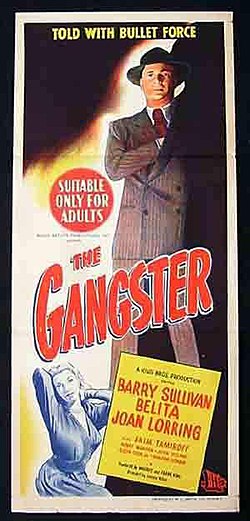
The Gangster , also known as Low Company, is a film noir directed by Gordon Wiles , which was released in 1947 .
| Gangster | |
|---|---|
| The gangster | |
 | |
| Genre | Film noir |
| Producer | Gordon Wiles |
| Producer | Frank King Maurice King |
| Author script | Daniel Fuchs Dalton Trumbo |
| In the main cast | Barry Sullivan Belita Joan Lorring Akim Tamiroff |
| Operator | Paul Ivano |
| Composer | Louis Grunberg |
| Film company | King brothers production Allied Artists Pictures (distribution) |
| Duration | 84 min |
| A country |  USA USA |
| Language | English |
| Year | 1947 |
| IMDb | ID 0039410 |
The film tells about a middle-level gangster ( Barry Sullivan ), who, under the influence of a spell from a nightclub singer ( Belita ), gradually loses her grip, which leads to his destruction by a competitor.
Critics have paid particular attention to the psychology of this picture, which is not characteristic of gangster films, and to its non-standard artistic solution.
This was the second joint film by Barry Sullivan and Belita after the film Suspence (1946) a year earlier.
Content
- 1 plot
- 2 Cast
- 3 Filmmakers and lead actors
- 4 History of the film
- 5 Movie Rating by Criticism
- 5.1 Overall rating of the film
- 5.2 Evaluation of the work of the director and creative team
- 5.3 Assessment of acting
- 6 notes
- 7 Literature
- 8 References
Story
For six years, the gangster Shabanka ( Barry Sullivan ), using iron grip and criminal methods, built his own small network of controlled entertainment establishments along the Neptune Beach New York area promenade, in the slums of which he was born and raised. Shabanka’s struggle for influence in the criminal world left him without friends and cost him a scar on his face. The gangster’s base is an ice cream parlor, run by the restless but loyal businessman Nick Jammy ( Akim Tamiroff ), who provides legal cover and fundraising from all Shabanka enterprises. With the help of this money, Shabanka secures the favor of the authorities, as well as control over local crime. Once in the area controlled by Shabanka, a racketeer Cornell ( Sheldon Leonard ) appears, who decides to take over the entire small Shabanka empire. Using a powerful force cover, he goes to Jamie, demanding that he arrange a meeting with Shabanka. Realizing the seriousness of the situation, Jammy bombards Shabanka with calls and requires an immediate meeting, but Shabanka does not pay attention to Jammy's warnings, stating that Cornell is weak against him, and Jammy has nothing to worry about. In fact, all the thoughts of Shabanka are far from business, and he is completely absorbed in the singer from the local night club Nancy Starr ( Belita ). He waits for her at the entrance to the club, sits in her dressing room and at performances, pays for her expensive apartment and bills, and showers with expensive gifts. Nancy is grateful and even sympathetic to Shabanka for his care, but suffers from his excessive custody and jealousy. One afternoon, when Nancy refuses to go out with him for expensive shops, Shabanka decides to secretly follow her, finding out that Nancy has gone to meet a theater agent named Beaumont ( Leif Erickson ), who promises to arrange her on one of the Broadway shows . In the evening, a conflict arises between Shabanka and Nancy after a gangster claims that Beaumont is too small a fish in business to organize a Broadway contract for her. In an ice cream parlor, Shabanka is once again forced to convince the frightened Jammy that Cornell poses no threat to their business, even despite Jamie’s claim that their financial situation was seriously shaken after Shabanka retired and began to spend a lot of money on her girlfriend . There Shabanka meets his former accountant Carty ( John Ireland ), who became a gamer, as a result of which he lost his job and got into debt. Carty begs Shabanka for $ 100-200 to get a gambling business, but he categorically refuses to help the former accountant. The young and decent Dorothy ( Joan Lorring ), who recently began working as a cashier and accountant with Jamie, begins to realize that she got a job in an organization controlled by an immoral gangster. Having witnessed his cruel conversation with Carty, Dorothy announces to Shabanka his dismissal, and when he gives her $ 200 as a severance pay, he refuses to take his money. Soon, Carty's wife comes to the cafe to warn her husband that her brothers are looking for him for stealing $ 1,300 from their car repair shop, where Carty got an accountant. Meanwhile, Cornell's henchmen, at gunpoint, take Jamie to a meeting with his boss. Cornell demands to give him a list of all the points that pay money to Shabanka, but the devotee Jammy refuses to cooperate with him. To restore relations with Nancy, Shabanka buys her an expensive mink coat, after which the grateful singer offers them both to go on a picnic on the sea coast. They have a wonderful day, and for the first time a truly warm relationship develops between them. At that moment, when Nancy and Shabanka rest on the beach, two of Cornell's henchmen come up to them, demanding that he arrive to meet his boss. Their tough conversation ends with them hitting Shabanka with a pistol grip on the head, as a result of which he loses consciousness. Recovering, Shabanka accuses the terrified Nancy that she brought the bandits at him, but immediately takes her words back.
Shabanka finally understands the strength of his adversary and begins to raise his ties, which ensured his position, however, both political lobbyists and local criminal groups refuse him support. Then Shabanka comes to Nancy, offering to flee the city with him. When she says that she is ready to return all the valuables and valuable gifts to him, Shabanka asks her to hand over all the valuable things to the pawnshop, planning to collect a brigade in another city to fight Cornell with the proceeds. Meanwhile, Carty's wife comes to the cafe in search of a husband whom she has not seen for two days. She begs Shabanka for help, but is refused, after which Dorothy again accuses Shabanka of cruelty and selfishness. During a conversation with Jemmy, Shabanka finds out that he could not stand the pressure and handed Cornell a list of enterprises subordinate to him. Shabanka heads for a meeting with Cornell, who says that the time when they could cooperate has already passed, and now he already controls Shabanka enterprises, offering him the humiliating position of a tax collector with enterprises with a salary of $ 80 per week. The indignant Shabanka leaves, before leaving, reminding the completely bewildered Jammy that he still works for him. In response, Cornell states that if Shabanka touches Jemmy, he will be killed within twenty minutes. Meanwhile, his wife’s brothers are catching and beating Carty, demanding that they immediately give the stolen money. Once again, having promised to pay, Carty comes to the cafe, penetrating the office of Jamie, who has just brought money from subordinate enterprises. Carty begs Jamie to give him 200-300 dollars, but when he refuses, Carty, who has turned up a pan under his arm, hits him with all his strength on the head. Jammy falls and dies, and Carty, without even taking the money, runs away in fear. When Shabanka arrives at Nancy’s apartment to go with her to the train station, the people of Cornell are already waiting for him. Shabanka accuses Nancy of betrayal, to which she replies that she once loved him, but his paranoia led to her hating him. And after Cornell promised her a role on Broadway, she decided to turn him over to Shabanka. Cornell leaves, taking Nancy with him and taking all the money that Shabanka collected for the trip. That evening, Shabanka learns that Jammy was killed and, accordingly, he is facing reprisal from Cornell. Not knowing where else to hide from the bandits, he comes home to Dorothy, who accuses him of the fact that he is guilty of the death of Jemmy. Although it was already reported on the radio that Carty had come to the police and confessed to the murder, however, according to Dorothy, it was Shabank who brought him to this desperate step. She tells Shabanka that he must finally pay for refusing to help others, to which he replies that the only thing he considers himself guilty of is that he was not cruel enough and not unprincipled enough, and allowed his own free rein feelings. Realizing that he has nowhere to go, Shabanka goes to the deserted embankment on a rainy night and shouts to Cornell that he can "take it all", and at that moment they kill him. After that, the police arrest Cornell and his gang.
Cast
- Barry Sullivan - Shabanka
- Belita - Nancy Starr
- Joan Lorring - Dorothy
- Akim Tamiroff - Nick Jammy
- Harry Morgan - Shorty
- John Ireland - Carty
- Sheldon Leonard - Cornell
- Fifi D'Orsay - Mrs. Ostroleng
- Virginia Christine - Mrs. Curty
- Elisha Cook - Oval
- Ted Hekt - Swain
- Leif Erickson - Beaumont
- Charles McGraw - Dougas
- John Kellogg - Sterling
- Shelley Winters - Hazel
Filmmakers and Leaders
The film is based on the novel by Daniel Fuchs “Low Company” (1937), the script was also written by Fuchs [1] [2] . According to some sources, the famous screenwriter of the picture was the famous Hollywood author Dalton Trumbo , but his name is not indicated in the credits [1] [3] . As movie historian Jeremy Arnold writes, “Fuchs was a key figure in the film noir genre, writing scripts for such significant films as The Meaningless Triumph (1948), Cross Criss Cross (1949), Street Panic (1950) and„ Storm Warning “(1951), and later - the script of the classic biographical musical“ Love Me or Leave Me ”(1955) with the participation of James Cagney and Doris Day ” [1] [4] .
As Arnold further notes, "the director of the film, Gordon Wiles, had an extraordinary career during which he was cast from one to the other and back." In the early 1930s, he began as a production designer, having won an Oscar for the film Transatlantic (1931), began working as a director in 1935, and again became an artist in the early 1940s [1] . He tried himself once again as a director with the movie "Gangster", but only after the originally appointed director Edward Blat left the project in mid-December 1946 due to inconsistencies in his production schedule [1] [5] . In 1950, after completing work on Say Endfield ’s noir “ Criminal History ” (1950), Wiles died at the age of 46 [1] [4] .
Barry Sullivan , who played the main role in this picture, soon became a prominent actor in the noir genre, playing in such films as “ Substitute ” (1947), “ Tension ” (1949), “ Unknown Man ” (1951), “ Reason for Anxiety ” (1951) and The Loophole (1954) [1] . The actress, known as Belita (her birth name is Maria Belita Jepson-Turner), was a professional skater who was brought to Hollywood to try to repeat with her the success of another European skater - Sonya Heny . According to Arnold, “although Belita made several films on the subject of figure skating, such as Escapades on Ice (1941) and Silver Skates (1943), in the future she was more remembered by film fans for her dramatic roles in low-budget noir films. " A year earlier, Sullivan and Belita played romantic partners in the interesting film noir " Suspens " (where she also dances a lot) " [1] [4] .
Movie Story
As Arnold notes, Gangster “was one of the first films released by Allied Artists , a newly formed subsidiary of the poor film company Monogram Pictures . Allied was conceived as a trademark for high-budget films - the prestigious Monogram films, unless of course such a word is applicable to the products of this studio ” [1] .
The film was produced by the brothers Frank and Maurice Kingi, who tried to repeat the phenomenal success of their previous film “ Dillinger ” (1945). That film, made on the micro-budget, was extremely successful, collecting around the world a substantial $ 4 million [1] [2] . According to Arnold, "as a result, the King brothers, whose family began with bootlegging and the supply of slot machines, unexpectedly turned out to be major players in the film industry." Their best film “ Crazy About Weapons ” (1950) will be released three years later [1] .
The working title of the film was “Low Company (Shabanka History)” [5] .
According to the American Film Institute , the film had difficulty censoring the Production Code Administration . In particular, it is noted that “although the exact nature of Shabanka’s criminal business has not been revealed in history, according to the studio’s working documents, the Administration’s representatives got the“ unmistakable impression that he manages the brothel network ”. As a result, “all references to prostitution from the final version of the film were removed” [5] . The administration also claimed that financial support for Shabanka Nancy “inevitably led to the conclusion about sexual intercourse between them,” however, the script did not change in this part [5] . In addition, the Administration “objected that Cornell and his people would go unpunished. As a result, the final in the final version of the film was accordingly changed ” [5] . Also, as recorded in the memorandum of July 23, 1947, the Administration tried to persuade the King brothers to change the name of the film, but they refused on the grounds that they “have neither Bergman nor Clark Gable, ” and therefore they are forced to use “quite sensational names in order to interest the public in their product ” [5] . Earlier, in the Administration’s memorandum of March 6, 1947, it was noted that recently the King brothers “boasted loudly and unpleasantly that, since they have money, they will be able to push through the Administration of the Production Code everything they need, which they stated directly, as in the form of an assumption ” [5] .
For the filming of this film, Allied leased operator Paul Ivano from Universal Studios [5] .
The site of the American Institute of Motion Picture Arts noted that “just before the start of the filming, the actress Belita was removed from the film after she opposed the name of Sullivan in the credits higher than her. Allied accused Belita of publicly spreading rumors that the studio was forcing her to wear indecent costumes and forbade her husband, actor Joel McGinnis, to be on the set. However, by the beginning of February 1947, the dispute was settled, and Belita returned to work on the film. In the final version, the name of Sullivan was indicated in the credits above the name of Belita ” [5] .
In February 1954, the film was released by the Allied Artists studio for a second time in a pair with the Monogram film “Dillinger” (1945) [5] .
Criticism of the film
Overall rating of the film
Jeremy Arnold calls the picture “a harsh and bitter portrait of a racketeer who is increasingly obsessed with paranoia and inner uncertainty” as he has problems with a rival gangster, his own girlfriend and a losing gambler. According to Arnold, this is "a rather unusual and exciting film with an emphasis on psychology", although "for many it seemed too pretentious and pretentious." And, of course, this is a “film noir with several disgusting and doomed characters from the underworld and an excellent cast of supporting actors, including veterans of noir Akim Tamiroff , Henry Morgan , Charles McGraw and Elisha Cook (pay attention also to Shelley Winters as a teller) " [1] . According to the TV Guide magazine reviewer, “This is an unusual film in the film noir genre, which emphasizes the psychological side. Although the script is confusing in some places, it strives for a deeper approach than such gangster films as “ Enemy of the Society ” (1931) or “ Al Capone ” (1959). ” As noted in the review, thanks to its special stylistic decision, "at one time the film was considered as something like an artistic triumph." And although, in the opinion of the reviewer, “the film has a fascinating unusualness,” nonetheless, he “draws an image of a person with a type of mind and consciousness that no American gangster showed in reality” [3] .
Hal Erickson notes that although "the film is presented as a psychological drama, it has a lot of shooting and blood to satisfy fans of the militants, as well as a powerful sexual appeal in the face of the girlfriend of the gangster Nancy (played by the figure skater of the studio Monogram Belita )" [2] . Dennis Schwartz calls the picture a "criminal melodrama of the poor studio" with elements typical of traditional crime stories, which however "does not follow the traditional way of tracking the rise and fall of his hero. Instead, the film focuses on creating an atmosphere of hopelessness and despair, as well as looking artistically stylish, as director Gordon Wiles creates an exalted work that is too reminiscent of a theater and which is too pretentious for such a modest story ” [6] . According to Glenn Erickson, this is "another unexpected and excellent noir" from the studio Allied Artists . The critic notes that "in the course of action there is little action that is completely concentrated in the final part of the picture." For the rest of the time, the film sometimes “slows down to show some very strange visual effects,” while continuing to fill the “story of betrayal and doom with ever greater sadness and suffering." The harsh noir character of the picture is evidenced by “the bitter words of Shabanka closer to the finale that his only sin was that he was not harsh enough. Nobody needed to be trusted, and nobody needed to be loved ” [4] .
Evaluation of the work of the director and creative team
As Dennis Schwartz notes, although it is believed that the script was written by Daniel Fuchs in his own book, Low Company, his “excessive pretentiousness and artistry can be attributed to the rumor that Dalton Trumbo had his hand in the script without indicating in the credits” [6] .
Glenn Erickson notes that his creative team, especially production designer Paul Sylos, who “created impressive scenery, including the exterior and interior of the Neptune Beach Pier”, as well as “cameraman Paul Ivano , who shot films such as “ Cruel Shanghai ” (1941) and “ Flesh and Fantasy ” (1943) ” [4] .
Actor rating
According to Glenn Erickson, “ Sullivan squeezes the most out of a rare role for himself. His Shabanka is like a feudal lord who is too mired in his personal desires to realize that his kingdom is between his fingers. Shabanka constantly talks about the cruel things he had to go through to get to the top, but the people around him either hate him or are even more scared. He has no illusions about the love of the inhabitants of Neptune Beach for him. " According to the critic, "another outstanding game comes from Akim Tamiroff as Nick Jammy, who is alarmed that Shabanka does not take the warnings seriously enough." Glenn Erickson also notes that the film contains “a whole bunch of great character roles that were vividly played in this film, including Elisha Cook , Charles McGraw , Murray Elper, Jeff Corey and Sid Melton.” And, in addition, in the picture appears in an episode of Shelley Winters . “It was already her 17th film role, and there was only one role left before she became a major“ discovery ”thanks to George Cukor's film“ Double Life ”(1947)” [4] . Hal Erickson among the supporting actors distinguishes Sheldon Leonard as the main rival of Shabanka, who in this picture "gives out a more subtle variation of his patented screen image of a tough guy" [2] . According to the TV Guide reviewer, “Sullivan, Tamiroff, Ireland, and other actors are a little too theatrical” in this generally bleak picture, where, thanks to Wiles, “a certain degree of theatricality is constantly present” [3] .
Notes
- ↑ 1 2 3 4 5 6 7 8 9 10 11 12 Jeremy Arnold. The Gangster (1947). Article . Turner Classic Movies. Date accessed August 19, 2018.
- ↑ 1 2 3 4 Hal Erickson. The Gangster (1947). Synopsis AllMovie. Date accessed August 19, 2018.
- ↑ 1 2 3 The Gangster. Review TV Guide. Date accessed August 19, 2018.
- ↑ 1 2 3 4 5 6 Glenn Erickson. The gangster Review DVD talk. Date accessed August 19, 2018.
- ↑ 1 2 3 4 5 6 7 8 9 10 The Gangster (1947). History . American Film Institute. Date accessed August 19, 2018.
- ↑ 1 2 Dennis Schwartz. Moves along not in the traditional way of tracing the rise and fall of a protagonist . Ozus' World Movie Reviews (January 12, 2004). Date accessed August 19, 2018.
Literature
- Alain Silver (Editor), Elizabeth Ward (Editor). Film Noir: An Encyclopedic Reference to the American Style, Third Edition . - Woodstock, New York: The Overlook Press, 1992 .-- ISBN 978-0-87951-479-2 .
- Michael F. Keaney. Film Noir Guide: 745 Films of the Classic Era, 1940–1959 . - Jefferson, North Carolina, and London: McFarland & Company, Inc., Publishers, 2003. - ISBN 978-0-7864-1547-2 .