The wingless eider [3] ( lat. Pinguinus impennis ) is a large flightless bird of the purebred family , extinct in the mid- 19th century . She was the only modern representative of the genus Pinguinus , which previously included the Atlantic eider. A wingless shag hired offspring on rocky, isolated islands with convenient approaches to the ocean and plenty of food. A combination of such conditions is rare, and there are few places suitable for bird nesting. In search of food, wingless eels spent most of their time in the northern waters of the Atlantic Ocean , covering New England , part of Spain , eastern Canada , Greenland , Iceland , the Faroe Islands , Norway , Ireland, and Great Britain .
| † Wingless Loon | |||||||||||||||||||||||||||||||||||
 | |||||||||||||||||||||||||||||||||||
| Scientific classification | |||||||||||||||||||||||||||||||||||
|---|---|---|---|---|---|---|---|---|---|---|---|---|---|---|---|---|---|---|---|---|---|---|---|---|---|---|---|---|---|---|---|---|---|---|---|
| |||||||||||||||||||||||||||||||||||
| International scientific name | |||||||||||||||||||||||||||||||||||
Pinguinus impennis ( Linnaeus , 1758 ) | |||||||||||||||||||||||||||||||||||
| Synonyms | |||||||||||||||||||||||||||||||||||
| |||||||||||||||||||||||||||||||||||
| Area | |||||||||||||||||||||||||||||||||||
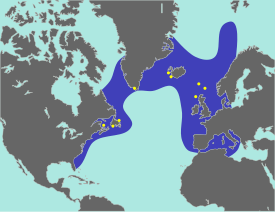 Estimated Range [1] Famous Colonies [2] | |||||||||||||||||||||||||||||||||||
| Security status | |||||||||||||||||||||||||||||||||||
| Disappeared species | |||||||||||||||||||||||||||||||||||

As the largest member of the family of purebreds, the wingless eel reached 75 to 85 cm (30 to 33 inches) in length and weight of about 5 kg (11 pounds). The massive hooked beak with hollows on its surface and the back of a wingless eun were black, while the rest of the body was white. A remarkable feature of the plumage of the bird was the alternation of under-eye white spots and stripes during the winter and summer periods of time. In summer, the bird had white spots, and in winter - wide stripes that were around the eyes . Despite the short wings with a length of 15 cm (5.9 inches), the flightless wingless eel swam perfectly in the water and hunted successfully. The wingless eel was fed by various species of fish , including American herring and capelin , as well as crustaceans . Despite the fact that the wingless eel swam perfectly in the water, on land it was very awkward. The main threats to her were man, killer whale , white-tailed eagle and polar bear .
The wingless shag has been known to people for over 100,000 years. She was the most important source of food and a symbol of many Native American cultures that existed with her. Many people of the archaic marine culture (the oldest Indian population of northeastern Canada) were buried along with the remains of a wingless eider. In one such burial, more than 200 beaks of eels were found, presumably decorating the cloak of an ancient man.
Due to the hunting of people for poultry for its meat, fluff and use as bait, the number of wingless sheds began to decline significantly by the middle of the 16th century . Realizing that the wingless eel was on the verge of extinction, scientists decided to include it in the list of protected birds , but this was not enough to save the species. The growing rarity of birds has increased the already strong interest of European museums and private collectors in getting stuffed animals and eggs, thereby ruining the last attempt to save a wingless eider. The last meeting with the wingless shed took place on July 3, 1844 in the area of the Icelandic island of Elday , although this date remains controversial, as reports began to come of separate observations and even the capture of some individuals. According to some ornithologists , the last meeting with the wingless eider occurred in 1852 , as a result of which the only individual was observed at the Great Newfoundland Bank .
The wingless shag became the first of the European and American birds completely destroyed by man [4] . In memory of the first loss of its continent, the journal of the American Society of Ornithologists was named The Auk ( “The Loon” ) [5] .
Content
Taxonomy
The wingless shag was one of the 4,400 species of animals first described by Karl Linnaeus in Nature 's System . In it, the wingless shag received the name Alca impennis [6] , which did not change until 1791 [7] . The name of the genus comes from the Spanish - Portuguese word alca , which meant "loon" [8] . In turn, the species name of the bird comes from the Latin word impennis , which meant "the absence of fly feathers" [8] . The bird received a similar Latin name for its short wings, which did not allow it to fly [8] . Some ornithologists believe that the most appropriate name for the genus would be Alca , since the taxonomic name of the bird genus Pinguinus was more associated with penguins than with eels [9] .
Analysis of the nucleotide sequence of mitochondrial DNA showed that the closest relative of the wingless eider is the species Alca torda [10] . A close relative of the wingless shed is also Lurik - a bird of the purebred family, whose origin is very different from representatives of the genus Pinguinus [8] . Despite the large size and inability to fly, the wingless eagle is often placed in the genus Alca , following the classification of Linnaeus . Alca is a derivative word from the Old Norse language , which means “loon” [8] .
Fossils (especially in Pinguinus alfrednewtoni ) and molecular studies of the genes showed that the eels , old people, and luriks separated after their common ancestor, supposedly similar to Synthliboramphus hypoleucus , spread throughout the North Atlantic [10] . By this time, the Atlantic guillemots , apparently, had already separated from other purebred North Atlantic [10] . Despite the fact that the loophole was widespread during the Pliocene , the origin of the luric is extremely poorly studied [10] . Molecular data obtained during the study of the remains of the bird showed that the wingless eider should be distinguished as a separate genus [10] , since it was not a relative of other , such as Mancalla , Praemancalla and Pan-Alcidae [11] .
Pinguinus alfrednewtoni was the largest flightless representative of the genus Pinguinus , who lived in the early Pliocene [12] . According to the famous remains found in the North Carolina , it is believed that the wingless eider and Pinguinus alfrednewtoni almost simultaneously separated from their common ancestor [12] . Pinguinus alfrednewtoni lived in the western part of the Atlantic Ocean, while wingless shag lived in the eastern [12] . After Pinguinus alfrednewtoni became extinct, a wingless eider spread throughout the North Atlantic [12] .
The Basques called the wingless shed arponaz , which in their language meant "spear-like beak" [13] . In Old French, the bird was called apponatz [13] , and the Spanish and Portuguese sailors called it - pingüinos [14] . Norwegians called the wingless eider geirfugl , which in their language meant "spear-bearing bird" [13] . From this name comes the common English bird names - garefowl or gairfowl [13] . The Eskimos called the wingless eider isarukitsck , which in their language meant "small wing" [14] . The Welsh called this species pingwen (actually the word is spelled pengwyn ), which in their language meant “white head” [15] . When European researchers in the Southern Hemisphere discovered the penguins known to us today, they noticed that these birds looked like a wingless shed and decided to name them as well as the aforementioned species. It should be noted that wingless eel and penguins do not have any kindred relationship [16] .
Description
With a height of 75 to 85 cm (30 to 33 inches) and a weight of 5 kg (11 pounds) [17] , wingless eels were the largest representatives of both their family and Charadriiformes . It is worth noting that wingless eels living in the far north were larger than their southern counterparts [11] . The plumage of males and females were very similar, despite differences in the size of the beak and femur [15] [18] [19] . The wingless eels had mainly a black back , a white belly, a shortened neck and legs, and also a small head and wings [20] . Due to the large subcutaneous layer of fat necessary to maintain heat, the loon looked like a rather complete bird [21] . Loon also had a characteristic wide white spot around the eyes that appeared during the summer [22] [23] . The eyes of the eider had either a nut or chestnut iris [22] [23] . During winter molting, white spots around the eyes of the wingless eider disappeared [15] , and in their place appeared a wide white strip and a small gray feather cover around it [15] . During the summer, the eider's neck remained black-brown, and when winter came, it became white [15] [18] . Some individuals had lateral gray feathers , the purpose of which is unknown [24] . The large beak curved from the bottom up was 11 centimeters (4.3 inches) long and had a characteristic yellow color inside [18] [21] . The beak also had deep white depressions, both in the upper and lower parts of the jaw [21] . In summer, the upper and lower jaws had seven and twelve depressions, respectively, and when winter came, their number decreased for unknown reasons [25] [26] . The wings were only 15 centimeters (5.9 inches) long, and the fly feathers barely reached 10 cm (3.9 inches) [21] . The paws and short claws were black, and the membranes were brownish-black [26] . The wingless eider also had large membranes, which allowed it to quickly swim and dive underwater [27] .
The zoological description of the chicks of the wingless shed is unknown, since today not a single caught specimen has been preserved. According to some scientists, the chicks were covered in gray fluff, although this fact is strongly disputed due to the lack of description [26] . In the chicks, the hollows in the beaks and the mottled black and white necks were barely noticeable and did not have a characteristic white spot, as in adults [28] . The gray feather line at the chicks began near the eyes and ended just below the eardrum [18] .
The vocalization of wingless eels is also a poorly studied aspect in its biology [29] . It is assumed that the vocalization of the eider was a low croak and a hoarse scream [29] . According to eyewitnesses of the 19th century, one individual in captivity made gurgling sounds during the alarm [29] .
Distribution and habitat
A wingless shack was discovered in the cold coastal waters of the North Atlantic , washing Canada , the northeastern United States , Norway , Greenland , Iceland , the Faroe Islands , Ireland , Great Britain , France and northern Spain [30] . Most of the time, the wingless flecker spent in the cold waters of the North Atlantic, however, when the breeding season began , it always went to land [25] [31] . The wingless shack 's bird bazaars stretched along the entire North Atlantic, from the Baffin Sea to the St. Lawrence Bay [25] [32] . This area also included Iceland, Norway and the British Isles [25] [32] [33] . The wingless shag created its nesting colonies mainly on rocky islands with gently sloping coastlines that allowed it to easily reach the sea [27] . It was believed that due to this limiting factor, the wingless eel created no more than twenty breeding colonies [27] . Loon nests predominantly in those places where there were a lot of fish and few predators, such as a white-tailed eagle and a polar bear [34] . Of all the colonies of the wingless shag, only seven are known: Papa Westray ( Orkney , Scotland ), St. Kilda ( Hebrides , Scotland ), Faroe Islands, Grimsey and Elday (Iceland), [35] and Madeleine Island in the Gulf of St. Lawrence [27] . According to researchers, a wingless eider could live in Cape Cod , in the Massachusetts area [27] . At the end of the 18th – beginning of the 19th centuries , the area of the wingless shack covered the islands of Funk, Grimsey, Eldi, St. Kilda and St. Lawrence Bay [32] . Funk Island was the largest known breeding colony of the Alert [36] .
The wingless eider migrated from the northern and southern nesting colonies after the fledglings prepared for swimming in autumn and winter [37] . A similar phenomenon was observed at the Great Newfoundland Bank [34] . The bones of wingless eels were even found in Florida , where birds swam four times: about 1000 BC. e. , 1000 AD e., in the XV and XVII centuries [38] [39] . It was believed that the bones found in Florida could be there as a result of trade between the native inhabitants of America [37] . Lunks very often swam into the Mediterranean Sea [32] . The 16th-century coastal watchtower in the area of the Sicilian city of Trapani [40] was originally called the “Tower of the wingless shed of St. Stephen” . The tower got this name because the wingless eel very often swam into the Gulf of Marausa [41] . In North America, the wingless shag during the winter period, as a rule, did not swim beyond the Massachusetts Bay [37] .
Habitat and social organization
Movement
A wingless loon moved at slow paces, using its wings to jump onto steep slopes [28] . During short-distance runs, she lumbered awkwardly in a straight line [31] . Among the natural predators, large mammals , such as killer whales and polar bears [42] , as well as birds, such as the white-tailed eagle , mainly stood out [31] . The ability to fly, the awkwardness on land, and gullibility to people, lost in the process of evolution, made the wingless eel quite a vulnerable bird, so it was not difficult to get it [31] . People hunted a wingless guesthouse exclusively for meat and feathers, as well as making stuffed animals for private collections and museums [31] . When any extraneous sounds appeared, the wingless eel began to respond to them, however, such phenomena rarely caused her a sense of fear [43] . Very often, a bird had to use its beak to pass through dense nesting colonies or to repel a threat or attack from a person [31] . The life expectancy of these birds was, according to some researchers, from 20 to 25 years, although this fact is rather dubious [44] . During winter southward migration, wingless eels were never sent as whole colonies; they traveled either in pairs or in small groups [45] .
The wingless loon as a whole swam perfectly, using its wings as a motor [28] . During swimming, almost the entire body of the wingless eun was under water with the exception of the head, which was always on the surface [31] . During a dive, a wingless eater could do various tricks under water, for example, spinning or sharp turns [45] . It is known that wingless eel dived to a depth of 76 meters (249 feet), although according to unconfirmed reports it could plunge up to 1 km (3300 feet) [46] . The breath hold in a wingless eun lasted, on average, 15 minutes longer than in a seal [45] . To get to the rocky coast of the islands, the wingless eel was first dispersed under water, and then abruptly jumped out of it to land [45] .
Nutrition
Flightless eels fed in shallow water , unlike other purebred ones , which hunted in the distant waters of the North Atlantic [47] , although they could swim at distances up to 500 kilometers (310 miles) from land [47] . It is believed that wingless eels during hunting first got together in large flocks , then surrounded prey under water, and at the end one of the individuals in the cluster caught a prey [47] . The main food for the wingless eider was fish , usually 12 to 20 cm (4.7 to 7.9 inches) long and weighing 40 to 50 g (1.4 to 1.8 ounces), although the species was hunted and to larger prey [47] . The bird could chase its prey on average to a depth of 75 meters (246 feet), but most of these dives were shallow to save energy [47] . The maximum immersion depth of a wingless shack is estimated at 130 meters (430 feet) [47] . The ability of wingless sheds to plunge deeply reduced competition with other purebred species. Based on the bones found on Funk Island, as well as environmental and morphological considerations, it was found that menhaden and capelin were the favorite food of wingless shed [48] . Other potential food presumptions were pinagoras , European cherchak , cod , crustaceans , and gerbil [46] [47] . Little is known about the nutrition of young individuals, but it is believed that they ate plankton , fish, and crustaceans burped by adult birds [36] [44] .
Reproduction
Бескрылые гагарки создавали пары либо в начале, либо в середине мая [49] . Изначально предполагалось, что бескрылые гагарки были моногамными птицами, однако на этот счёт существуют мнения, согласно которым самцы могли спариваться и с другими особями , как и многие представители семейства чистиковых [31] [44] . Создав пару, у подножия скалы самец и самка начинали строить гнездо, где они, вероятно, и спаривались [21] [31] . Чтобы показать своё социальное положение в колонии, самцы и самки бескрылой гагарки начинали трясти своими головами, демонстрируя свои белые пятна вокруг глаз, оперение и окраску клюва [31] . По мнению исследователей, социальные колонии бескрылых гагарок были довольно плотными и занимали почти 11 квадратных метров суши [31] . Хотя колонии включали в себя и другие виды чистиковых , на их фоне благодаря своим размерам сильно выделялись бескрылые гагарки [31] .
Самки бескрылой гагарки высиживали с конца мая по начало июня только одно яйцо , однако на всякий случай они могли отложить ещё одно, если первое будет утеряно [45] [49] . В годы, когда в море было мало рыбы, бескрылые гагарки не размножались [50] . Единственное яйцо бескрылой гагарки находилось на голой скале, на высоте до 100 метров (330 футов) над уровнем моря [28] [51] . По форме яйцо представляло собой удлинённый овал, размеры которого составляли в среднем 12,4 см (4,9 дюйма) на 7,6 см (3,0 дюйма) [7] [42] . Окраска скорлупы была довольно разнообразной: от светло-жёлтой до коричневой с различными вкраплениями чёрных и серых пятен, которые часто пересекались у большего основания яйца [28] [52] . Считается, что по пятнам и полоскам скорлупы родители находили в колонии птиц свои отложенные яйца [49] . Самец и самка бескрылой гагарки по очереди высиживали яйцо в течение 39—44 дней [42] [49] . Подобное событие, как правило, происходило в июне, однако в случае нехватки пищи высиживание могло начаться и в августе [42] [49] .
Птенцов , покрытых серым пухом, родители кормили по очереди [44] . Как только птенцам исполнялось всего 2—3 недели от роду, они оставляли свои гнёзда и выходили в открытое море [42] [49] . Данное событие происходило, как правило, в середине июля [42] [49] . Родители заботились о своих птенцах до тех пор, пока у тех не появлялись перья [49] . В это время можно было видеть, как птенцы плавали на спинах своих родителей [49] . Половой зрелости бескрылые гагарки достигали, как правило, в течение 4—7 лет [50] .
Отношения с людьми
Бескрылая гагарка известна людям более 100 000 лет, о чём свидетельствует хорошо очищенные кости , найденные в пещерах неандертальцев [30] . Изображения бескрылой гагарки были найдены в испанской и французской пещерах Эль Пинто и Коске [53] . Возраст изображений бескрылой гагарки в пещерах Эль Пинто и Коске составляет 35 000 и 20 000 лет, соответственно [14] .
Коренные американцы, которые жили около мест гнездования бескрылых гагарок, ценили птиц за их вкусное мясо и почитали их в качестве важного символа. Об этом почитании свидетельствуют изображения бескрылой гагарки, найденные на костяных ожерельях [54] . Человек, погребённый в пещере морской архаической культуры близ города на острове Ньюфаундленд 2000 лет до н. э., был найден в окружении более чем двухсот клювов бескрылой гагарки, которые, по мнению археологов, являлись частью костюма, сделанного из её шкурки и головы [54] . Почти половина костей птиц, найденных в могилах в этом месте, принадлежала бескрылой гагарке, которая, по мнению археологов, имела большое культурное значение для людей морской архаической культуры [55] . Вымершие беотуки с острова Ньюфаундленд делали пудинг из яиц гагарки [44] , а дорсетские эскимосы вели постоянную охоту на неё [55] . Из-за давления со стороны гренландских саккаков , которые вели чрезмерный промысел, численность бескрылой гагарки сильно сократилась [55] .
Европейские моряки, чтобы ориентироваться в водах Северной Атлантики , использовали гагарок в качестве маяка [14] . Присутствие бескрылых гагарок в северных водах свидетельствовало о том, что Большая Ньюфаундлендская банка была поблизости [14] .
Вымирание
До появления человека в местах гнездования бескрылой гагарки численность птицы оценивалась миллионами, однако это число до сих пор оспаривается [44] . Охота на бескрылую гагарку, по крайней мере с VIII века , велась в значительной степени из-за мяса , яиц и пуха птицы. В качестве доказательства существуют письменные свидетельства, согласно которым охота на бескрылую гагарку велась в Скандинавии , восточной части Северной Америки и на острове Лабрадор в позднем каменном веке [56] [57] . Ранние экспедиции и многочисленные экипажи кораблей под командованием Жака Картье , пытаясь найти золото на Баффиновой Земле , не были обеспечены едой на обратную дорогу, поэтому для пополнения запасов продовольствия использовали бескрылую гагарку в качестве удобного источника пищи и рыболовной снасти [58] . Охота на бескрылую гагарку не представляла собой особого труда: сначала моряки бросали якоря рядом с колонией и высаживались на берег, затем загоняли сотни гагарок на корабли, где потом забивали птиц [59] . Некоторые авторы успех подобного вида охоты ставили под сомнение [55] . Очень сильно в качестве пищи среди моряков ценились яйца бескрылой гагарки, так как они были в 3 раза больше кайровых , а также имели очень большой желток [55] . В ходе экспедиции в места гнездования бескрылой гагарки корабли завезли чёрных крыс [52] .
В течение малого ледникового периода из-за хищничества со стороны белых медведей численность бескрылой гагарки на большинстве островов сильно сократилась, однако именно широкомасштабная эксплуатация вида со стороны человека, целью которой был сбор пуха для изготовления подушек, стала основной причиной резкого падения популяции птицы [50] . К середине XVI века почти все гнездовые колонии , которые находились в европейской части Атлантического океана , были систематически уничтожены [60] . В 1553 году бескрылая гагарка получила первую официальную защиту , а в 1794 году Великобритания запретила убивать птиц ради добычи пуха и яиц [61] . В Сент-Джонсе лиц, нарушивших этот закон, публично пороли , однако бескрылую гагарку по-прежнему разрешалось использовать в качестве приманки [55] . Изначально в Северной Америке пух лабрадорской гаги был наиболее предпочтительным, однако после того, как данный вид птиц оказался на грани вымирания в 1770-х годах , коллекционеры переключились на бескрылую гагарку, в результате чего её роль в качестве источника пищи и приманки резко упала [55] [62] . Чучела и яйца бескрылой гагарки высоко ценились среди богатых европейцев, которые, не теряя времени, пополняли свою коллекцию животных [55] . Сбор большого количества яиц особенно сильно ударил по численности бескрылой гагарки [55] . Сборщики добывали только неоплодотворённые яйца бескрылой гагарки [42] . Если среди них попадались оплодотворённые яйца, то они автоматически выбрасывались [42] . Поняв, что не все птицы откладывают свои яйца в один день, сборщики приплывали в одну и ту же колонию по несколько раз [42] .
Последние замеченные на Британских островах бескрылые гагарки были пойманы и убиты на островах и Сент-Килда в Шотландии в июле 1840 года [63] . Заметив маленькие крылья и большое белое пятно на голове, три человека с острова Сент-Килда сначала поймали, потом связали, а затем бросили одну бескрылую гагарку в трюм [54] [64] . Охотники держали её живой в течение трёх дней до тех пор, пока не началась сильная буря [54] [64] . Посчитав, что бескрылая гагарка являлась причиной бури, они забили её палками [65] [64] .
Последняя колония бескрылой гагарки была обнаружена на исландском острове (с исланд. — «скала бескрылой гагарки») [66] . Этот остров вулканического происхождения , окружённый неприступными скалами, являлся убежищем бескрылой гагарки до тех пор, пока в 1830 году не произошло извержение , в результате которого он затонул [66] . После того, как затонул Гейрфугласкер, бескрылые гагарки переселились на близлежащий Эльдей , который был доступен для человека с одной стороны [66] . Когда в 1835 году колония была обнаружена, в ней было около пятидесяти птиц [66] . Музеи, желавшие получить чучела бескрылых гагарок, быстро начали истреблять птиц [66] . Последняя пара, найденная около высиживаемого яйца, была убита Йоном Брандсоном и Сигурдуром Ислейфсоном 3 июля 1844 года [67] . В 1852 году поступило сообщение о наблюдении живой особи на Большой Ньюфаундлендской банке , которое было официально признано Международным союзом охраны природы и природных ресурсов (МСОП) [68] .
Экспонаты
По состоянию на 1996 год музейные коллекции включали в себя 78 чучел, 75 яиц и 24 полных скелета бескрылой гагарки [69] . Хотя в неолитовой мусорной куче острова Фанк в XIX веке было найдено свыше тысячи костей, на сегодня существует лишь небольшое число целых скелетов [69] . Среди этих экспонатов также известны особи, которые подверглись естественной мумификации , а в хранятся глаза и внутренние органы двух птиц, убитых в 1844 году [69] . Четыре сохранившиеся шкурки бескрылой гагарки имеют зимнее оперение , среди которых только две принадлежат молодым особям [5] . Чучела птенцов на сегодняшний день не сохранились, поэтому описание основано на немногочисленных фактах [5] . После исчезновения птицы цена чучел бескрылой гагарки резко возросла, а аукционы в викторианской Англии вызывали огромный интерес. В современной Великобритании в настоящий момент находятся 15 чучел бескрылой гагарки [5] . Одно из таких чучел было куплено в 1971 году Исландским музеем национальной истории за рекордные 9000 фунтов [5] . Этот экспонат попал в Книгу рекордов Гиннеса как «самое дорогое проданное чучело птицы за всю историю» [5] . Цены яиц бескрылой гагарки также были весьма высокими, иногда достигая 11-кратной годовой зарплаты квалифицированного работника [5] . В настоящее время местонахождение шести яиц неизвестно, многие чучела были уничтожены [5] . В XX веке были уничтожены две препарированные бескрылые гагарки: одна — в в ходе Второй мировой войны , а другая — в лиссабонском музее Бокаж во время пожара в 1978 году [70] .
Культурный след
Бескрылая гагарка упоминается во многих романах и сказках зарубежных писателей:
- В сказке Чарльза Кингсли « Дети воды » бескрылая гагарка по имени Гейрфоул рассказывает историю о своём исчезновении [71] . Данная сказка примечательна тем, что на бескрылой гагарке была пара прозрачных очков, которую по ошибке нарисовал иллюстратор Чарльза Кингсли, неправильно поняв значение фразы « large pair of white spectacles », намекавшей на белые пятна вокруг глаз птицы [72] .
- Бескрылая гагарка также упоминается в сказке Эниды Блайтон [73] . В этой сказке главный герой отправляется в далёкое путешествие, чтобы найти исчезнувшие колонии бескрылой гагарки [73] .
- В романе «Улисс» Джеймса Джойса бескрылая гагарка появляется во сне главного героя, чтобы вернуть его в тихую страну фантазии и воспоминаний [74] .
- В сатирическом романе французского писателя Анатоля Франса описывается вымышленная история, согласно которой близорукий миссионер ошибочно крестил колонии бескрылой гагарки [75] .
- В историческом романе Патрика О'Брайана «Помощник хирурга» описывается поимка бескрылой гагарки и обнаружение её колоний неким вымышленным натуралистом Стивеном Мэтьюрином [76] .
- В книге «Трагедии моря» канадского писателя и биолога Фарли Моуэта описывается трагическая история уничтожения бескрылой гагарки [77] .
Бескрылая гагарка является символом таких учреждений, как , , Университет Аделаиды , сигаретной компании British Great Auk Cigarettes , а также талисманом соревнования [5] [78] [79] [80] [81] . Она также присутствует на двух картинах американского художника Уолтона Форда («Ведьма с острова Сент-Килда» и «Остров Фанк») [82] , на монографии английского художника и писателя под названием «Последняя стоянка» [83] , а также на кубинских почтовых марках 1974 года [84] . Бескрылая гагарка также является центральной темой пьесы [85] , а также музыкальной рок-оперы [86] . Согласно книге Гомера Хайкема и фильму « Октябрьское небо » в честь бескрылой гагарки были названы самодельные ракеты [87] .
Notes
- ↑ Grieve, Symington. The Great Auk, or Garefowl: Its history, archaeology, and remains . — Thomas C. Jack, London, 1885.
- ↑ Parkin, Thomas. The Great Auk, or Garefowl . — JE Budd, Printer, 1894.
- ↑ Винокуров А. А. Редкие и исчезающие животные. Птицы : Справ. allowance / ed. V. E. Sokolova . — М. : Высшая школа, 1992. — С. 56. — 446 с. : ill. - 100,000 copies. — ISBN 5-06-002116-5 .
- ↑ Mowat, Farley. Sea of Slaughter. — Прогресс, 1984. — ISBN 5-010-01079-8 .
- ↑ 1 2 3 4 5 6 7 8 9 Cokinos 2000, p. 331
- ↑ Linnaeus, C. Systema naturae per regna tria naturae, secundum classes, ordines, genera, species, cum characteribus, differentiis, synonymis, locis. Tomus I. Editio decima, reformata. : [] . — Holmiae : Laurentii Salvii, 1758. — P. 130.
- ↑ 1 2 Gaskell, Jeremy. Who Killed the Great Auk? . — Oxford University Press (USA), 2000. — P. 152. — ISBN 0-19-856478-3 .
- ↑ 1 2 3 4 5 Johnsgard, Paul A. Diving Birds of North America . — Lincoln : University of Nebraska Press, 1987. — P. 265—266. — ISBN 0-8032-2566-0 .
- ↑ Fuller, Errol. The Great Auk. — illustrated. — Southborough, Kent, UK : Privately Published, 1999. — P. 401. — ISBN 0-9533553-0-6 .
- ↑ 1 2 3 4 5 Moum, Truls; Arnason, Ulfur & Árnason, Einar. Mitochondrial DNA sequence evolution and phylogeny of the Atlantic Alcidae, including the extinct Great Auk ( Pinguinus impennis ) (англ.) // Molecular Biology and Evolution : journal. — Oxford: Oxford University Press , 2002. — Vol. 19 , no. 9 . — P. 1434—1439 . — PMID 12200471 .
- ↑ 1 2 Montevecchi, William A.; David A. Kirk. Systematics-Great Auk (Pinguinus impennis) . The Birds of North America Online . Cornell Lab of Ornithology (1996). Дата обращения 29 апреля 2010. Архивировано 5 июня 2012 года.
- ↑ 1 2 3 4 Olson, Storrs L. (2001), "Miocene and Pliocene Birds from the Lee Creek Mine, North Carolina" , in Ray, Clayton E., Smithsonian Contributions to Paleobiology , vol. 90, Washington DC: Smithsonian Institution Press, p. 279 , < http://si-pddr.si.edu/dspace/handle/10088/2006 >
- ↑ 1 2 3 4 Cokinos 2000, p. 333
- ↑ 1 2 3 4 5 Cokinos 2000, p. 314
- ↑ 1 2 3 4 5 Crofford 1989, p. eight
- ↑ Crofford 1989, p. ten
- ↑ Livezey, Bradley C. Morphometrics of flightlessness in the Alcidae (неопр.) // The Auk . — Berkeley, CA: University of California Press, 1988. — Т. 105 , № 4 . — С. 681—698 . Архивировано 29 февраля 2008 года.
- ↑ 1 2 3 4 Montevecchi, William A.; David A. Kirk. Characteristics-Great Auk ( Pinguinus impennis ) . The Birds of North America Online . Cornell Lab of Ornithology (1996). Дата обращения 29 апреля 2010. Архивировано 5 июня 2012 года.
- ↑ Montevecchi, William A.; David A. Kirk. Measurements-Great Auk (Pinguinus impennis) . The Birds of North America Online . Cornell Lab of Ornithology (1996). Дата обращения 29 апреля 2010. Архивировано 5 июня 2012 года.
- ↑ Crofford 1989, p. 15
- ↑ 1 2 3 4 5 Crofford 1989, p. 28
- ↑ 1 2 Crofford 1989, p. 9
- ↑ 1 2 Cokinos 2000, p. 310
- ↑ Rothschild, Walter. Extinct Birds . — London : Hutchinson & Co, 1907.
- ↑ 1 2 3 4 Crofford 1989, p. 29th
- ↑ 1 2 3 Montevecchi, William A.; David A. Kirk. Appearance-Great Auk (Pinguinus impennis) . The Birds of North America Online . Cornell Lab of Ornithology (1996). Дата обращения 29 апреля 2010. Архивировано 5 июня 2012 года.
- ↑ 1 2 3 4 5 Cokinos 2000, p. 312
- ↑ 1 2 3 4 5 Francis Orpen Morris. A History of British Birds . — Groombridge and Sons, Paternoster Way, London, 1864. — Vol. 6. — P. 56—58.
- ↑ 1 2 3 Montevecchi, William A.; David A. Kirk. Sounds-Great Auk (Pinguinus impennis) . The Birds of North America Online . Cornell Lab of Ornithology (1996). Дата обращения 28 апреля 2010. Архивировано 5 июня 2012 года.
- ↑ 1 2 Crofford 1989, p. five
- ↑ 1 2 3 4 5 6 7 8 9 10 11 12 Montevecchi, William A.; David A. Kirk. Behavior-Great Auk (Pinguinus impennis) . The Birds of North America Online . Cornell Lab of Ornithology (1996). Дата обращения 28 апреля 2010. Архивировано 5 июня 2012 года.
- ↑ 1 2 3 4 Crofford 1989, p. thirty
- ↑ Meldegaard, Morten. The Great Auk, Pinguinus impennis (L.) in Greenland (англ.) // Historical Biology : journal. — Taylor & Francis , 1988. — Vol. 1 , no. 2 . — P. 145—178 . — DOI : 10.1080/08912968809386472 .
- ↑ 1 2 Montevecchi, William A.; David A. Kirk. Habitat-Great Auk (Pinguinus impennis) . The Birds of North America Online . Cornell Lab of Ornithology (1996). Дата обращения 29 апреля 2010. Архивировано 5 июня 2012 года.
- ↑ Relics of the Great Auk on Funk Island, by John Milne. The Field, March 27, April 3,10,1875.
- ↑ 1 2 Montevecchi, William A.; David A. Kirk. Great Auk (Pinguinus impennis) . The Birds of North America Online . Cornell Lab of Ornithology (1996). Дата обращения 28 апреля 2010. Архивировано 5 июня 2012 года.
- ↑ 1 2 3 Montevecchi, William A.; David A. Kirk. Migration-Great Auk (Pinguinus impennis) . The Birds of North America Online . Cornell Lab of Ornithology (1996). Дата обращения 29 апреля 2010. Архивировано 5 июня 2012 года.
- ↑ Weigel, Penelope Hermes. Great Auk Remains from a Florida Shell Midden (англ.) // American Ornithological Society . — Berkeley, CA: University of California Press , 1958. — Vol. 75 , no. 2 . — P. 215—216 . Архивировано 29 февраля 2008 года.
- ↑ Brodkorb, Pierce. Great Auk and Common Murre from a Florida Midden (англ.) // American Ornithological Society . — Berkeley, CA: University of California Press, 1960. — Vol. 77 , no. 3 . — P. 342—343 . Архивировано 29 февраля 2008 года.
- ↑ Башня города Трапани
- ↑ Залив Марауса
- ↑ 1 2 3 4 5 6 7 8 9 Crofford 1989, p. 35
- ↑ Cokinos 2000, p. 315
- ↑ 1 2 3 4 5 6 Cokinos 2000, p. 313
- ↑ 1 2 3 4 5 Crofford 1989, p. 32
- ↑ 1 2 Cokinos 2000, p. 311
- ↑ 1 2 3 4 5 6 7 Montevecchi, William A.; David A. Kirk. Food Habits-Great Auk (Pinguinus impennis) . The Birds of North America Online . Cornell Lab of Ornithology (1996). Дата обращения 29 апреля 2010. Архивировано 5 июня 2012 года.
- ↑ Olson, Storrs L; Swift, Camm C. & Mokhiber, Carmine. An attempt to determine the prey of the Great Auk ( Pinguinus impennis ) (англ.) // The Auk : journal. — 1979. — Vol. 96 , no. 4 . — P. 790—792 .
- ↑ 1 2 3 4 5 6 7 8 9 Bengston, Sven-Axel Breeding, Ecology and Extinction of Great Auk (Pinguinus impennis) . The Auk. A Quarterly Journal of Ornithology . American Ornithologists' Union (1996). Дата обращения 6 июня 2012. Архивировано 26 июня 2012 года.
- ↑ 1 2 3 Montevecchi, William A.; David A. Kirk. Demography-Great Auk (Pinguinus impennis) . The Birds of North America Online . Cornell Lab of Ornithology (1996). Дата обращения 29 апреля 2010. Архивировано 5 июня 2012 года.
- ↑ Crofford 1989, p. 33
- ↑ 1 2 Great Auk egg . Norfolk Museums & Archaeology Service. Дата обращения 8 мая 2009. Архивировано 26 июня 2012 года.
- ↑ Crofford 1989, p. 6
- ↑ 1 2 3 4 Tuck, James A. Ancient peoples of Port au Choix: The excavation of an Archaic Indian cemetery in Newfoundland (англ.) // Newfoundland Social and Economic Studies : journal. — St. John's: Institute of Social and Economic Research, Memorial U of Newfoundland, 1976. — Vol. 17 . — P. 261 .
- ↑ 1 2 3 4 5 6 7 8 9 Montevecchi, William A.; David A. Kirk. Conservation-Great Auk (Pinguinus impennis) . The Birds of North America Online . Cornell Lab of Ornithology (1996). Дата обращения 29 апреля 2010. Архивировано 5 июня 2012 года.
- ↑ Greenway, James C. Extinct and Vanishing Birds of the World, 2nd Edition. — New York : Dover Publications, 1967. — P. 271—291. — ISBN 978-0-486-21869-4 .
- ↑ Jordan, Richard H; Storrs L. Olson. First record of the Great Auk ( Pinguinus impennis ) from Labrador (англ.) // The Auk : journal. — University of California Press, 1982. — Vol. 99 , no. 1 . — P. 167—168 . Архивировано 29 февраля 2008 года.
- ↑ Crofford 1989, p. 38
- ↑ Crofford 1989, p. 39
- ↑ Crofford 1989, p. 40
- ↑ Cokinos 2000, p. 330
- ↑ Cokinos 2000, p. 329
- ↑ Rackwitz, Martin. Travels to Terra Incognita: The Scottish Highlands and Hebrides in Early Modern Travellers' Accounts C. 1600 to 1800. — Waxmann Verlag, 2007. — P. 347. — ISBN 978-3-8309-1699-4 .
- ↑ 1 2 3 Fuller, Errol. The Great Auk: The Extinction of the Original Penguin . — Bunker Hill Publishing, 2003. — P. 34. — ISBN 978-1-59373-003-1 .
- ↑ Gaskell, Jeremy. Who Killed the Great Auk? . — Oxford UP, 2000. — P. 142. — ISBN 978-0-19-856478-2 .
- ↑ 1 2 3 4 5 Crofford 1989, p. 43
- ↑ Ellis, Richard. No Turning Back: The Life and Death of Animal Species. — New York : Harper Perennial , 2004. — P. 160. — ISBN 0-06-055804-0 .
- ↑ Pinguinus impennis (BirdLife International, 2004) (англ.) . The IUCN Red List of Threatened Species . Дата обращения 11 мая 2006 г..
- ↑ 1 2 3 Luther, Dieter. Die ausgestorbenen Vögel der Welt : [] . — 4. — Heidelberg : Westarp-Wissenschaften, 1996. — P. 78—84. — ISBN 3-89432-213-6 .
- ↑ Fuller, Errol (1999). The Great Auk. ISBN 0-9533553-0-6
- ↑ Kingsley, Charles. The Water-Babies, A Fairy Tale for a Land Baby. — Oxford : Oxford University Press, 1995. — ISBN 0-19-282238-1 .
- ↑ A Fairy Tale for a Land Baby
- ↑ 1 2 Blyton, Enid. The Island of Adventure. — London : Macmillan, 1944.
- ↑ Joyce, James. Ulysses . — Charleston, SC : BiblioLife, 2007. — P. 682. — ISBN 978-1-4346-0387-6 .
- ↑ France, Anatole. Penguin Island . — Project Gutenberg.
- ↑ O'Brian, Patrick. The Surgeon's Mate . — New York : WW Norton and Company, 1981. — P. 84—85. — ISBN 0-393-30820-0 .
- ↑ Mowat, Farley. Sea of Slaughter. — New York : Bantam Books, 1986. — P. 18. — ISBN 0-553-34269-X .
- ↑ Auk News . Archmere Academy (26 апреля 2010). Дата обращения 28 апреля 2010. Архивировано 5 июня 2012 года.
- ↑ Fleming College Auk's Lodge Student Association . Fleming College Auk's Lodge Student Association (15 апреля 2010). Дата обращения 28 апреля 2010. Архивировано 5 июня 2012 года.
- ↑ Holzknecht, Karin O'Sqweek 2005 . Adelaide University Choral Society (2005). Дата обращения 28 апреля 2010. Архивировано 19 июля 2008 года.
- ↑ Schettle, Liz Competition summons inner intellect (недоступная ссылка) . The Oshkosh West Index (17 декабря 2004). Дата обращения 29 апреля 2010. Архивировано 4 октября 2007 года.
- ↑ Ford, Walton. Pancha Tantra. — illustrated. — Los Angeles : Taschen America LLC, 2009. — ISBN 3-8228-5237-6 .
- ↑ Fuller, Errol. The Great Auk. — illustrated. — Southborough, Kent, UK : Privately Published, 1999. — ISBN 0-9533553-0-6 .
- ↑ Burns, Phillip Dodo Stamps . Pib's Home on the Web (6 июля 2003). Дата обращения 28 апреля 2010. Архивировано 5 июня 2012 года.
- ↑ Jeffes, Simon. 'Still Life' at the Penguin Cafe. — London : Peters Edition Ltd, 2002. — ISBN 0-9542720-0-5 .
- ↑ Durka-The Great Auk . Rockford's Rock Opera (2010). Дата обращения 10 мая 2010. Архивировано 5 июня 2012 года.
- ↑ Hickam, Homer Books- Rocket Boys/October Sky . Homer Hickam Online (2006). Дата обращения 29 апреля 2010. Архивировано 5 июня 2012 года.
Bibliography
- Cokinos, Christopher. Hope is the Thing with Feathers: A Personal Chronicle of Vanished Birds. — Warner Books, 2000. — ISBN 0-446-67749-3 .
- Crofford, Emily. Gone Forever: The Great Auk. — Crestwood House, 1989. — ISBN 0-89686-459-6 .
- Fuller, Errol. The Great Auk. — Privately Published, 1999. — ISBN 0-9533553-0-6 .
Links
- Бескрылая гагарка на сайте Dronts.ru
- Бескрылая гагарка на сайте Криптозоология.ру
- Бескрылая гагарка на сайте «Вымершие животные»
- Бескрылая гагарка на сайте Звериный род
- Факты о бескрылой гагарке (англ.)
- Гагарка в 3D (англ.)