“Res” - the tragedy of an anonymous Greek playwright of the 4th century BC. er , long attributed to Euripides . Named after the Thracian king Resa and describes the outing of Odysseus and Diomedes in the camp of the Trojans during the Trojan War , - an episode contained in the tenth song of the Iliad .
| Res | |
|---|---|
| Ῥῆσος | |
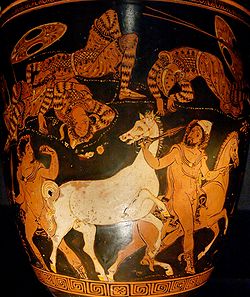 Odysseus and Diomedes abduct Resa's horses | |
| Genre | tragedy |
| Author | unknown |
| Original language | ancient greek |
| Date of writing | IV century BC. er |
| Electronic version | |
The shortest of the ancient tragedies that have survived to the present day (totals 996 verses) [1] .
Characters
- Khor - Trojan Guard
- Korifey - the old warrior
- Hector - the king, the leader of the Trojan and the allied ratification
- Aeneas - Trojan nobleman
- Dolon - Trojan
- Shepherd - old man
- Res - the young Thracian king
- Odysseus , Diomedes - Achaean Kings
- Athena
- Paris
- Resa's carter
- Muse is the mother of Resa
The question of authorship and dating
“Res” is the only tragedy that can be attributed with greater or lesser certainty to the 4th century BC. er and the only anonymous play of the ancient Greek theater (all the other Greek tragedies that have reached our time are written in the V century BC and belong to the three great tragedians - Aeschylus , Sophocles, or Euripides ). In the medieval manuscripts the tragedy “Res” is among the plays of Euripides , however, it differs noticeably from them in formal, substantive, ideological and stylistic terms, therefore in modern literary criticism it is unanimously recognized as a play of a later time.
Artistic features
The tragedy is characterized by dynamic plot and external spectacularity. There are several innovative theater techniques in it: for example, the traditional theatrical herald , which usually does not take part in the action, plays a more prominent role here than its predecessor playwrights: it appears in the image of Resa's wounded driver. The beginning of the play is unique, where the chorus of warriors entering the stage awakens Hector with a cheerful song - none of the ancient playwrights, who usually began their tragedies with a leisurely prologue , have such a dynamic introduction. However, in the literature it was hypothesized that “in the manuscript, which served as a model for those in whom Res was preserved,” the initial page [2] was lost, and thus the author of the tragedy did not make any artistic experiments.
Russian translations
The only translation of the tragedy into Russian was made by I. F. Annensky and was published in 1896. According to modern researchers, there is no reason to consider this translation successful: “In some cases, the metric originality of the original <...> is ignored, there is no attempt to approach the metric structure of choral parties, modernism is abundantly used (“ spy ”,“ cordon ”,“ slogan ” etc.) ” [2] .
Basic Russian editions
- Translation by I. Annensky (original version) // Journal of the Ministry of National Education . - 1896. - H. CCCVII. - September. - p. 128-145 (5th pagination); October. - p. 1-32 (5th pagination).
- Translation by I. Annensky (original version) // Res. The tragedy attributed to Euripides. - SPb., 1896.
- Translation by I. Annensky (as amended by P. Sokolov) // Res. The tragedy of Euripides . - SPb., 1909.
- Translation by I. Annensky (original version) // Euripides. Tragedies: In 2 vols. - M., 1999. - T. 2. - p. 565-611. - ( Literary monuments ).
Literature
- Annensky I. "Res". The tragedy attributed to Euripides // Journal of the Ministry of National Education . - 1896. - H. CCCVII. - September. - p. 100-127 (5th pagination).
Notes
- ↑ Annensky I. “Res”. The tragedy attributed to Euripides // Journal of the Ministry of National Education . - 1896. - H. CCCVII. - September. - p. 100 (5th pagination).
- ↑ 1 2 Yarkho V. Notes // Euripides. Tragedies: In 2 vols. - M., 1999. - T. 2. - P. 698. - ( Literary monuments ).