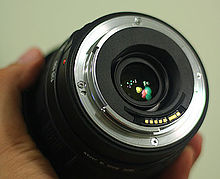


Canon EF - the bayonet mount of the Canon EOS series of cameras , as well as the name of the family of corresponding lenses.
The abbreviation EF comes from the English. E lectro- F ocus ("electro focus ") [1] . There are no mobile mechanical connections between the camera and the lens, control is carried out through special contacts provided by the mount design. This technology allows the camera's electronics to focus the lens and control the iris using the built-in lenses.
The diameter of the mount is 54 mm, the type of mount is bayonet (three asymmetrical inward-facing lobes are used). The working section of the Canon EF mount is 44 mm.
Content
- 1 EF mount history
- 1.1 Canon EF-S
- 1.2 Canon EF-M
- 1.3 Canon RF
- 1.4 Compatibility and third-party lenses
- 2 Technologies
- 2.1 Ultrasonic Drive (USM)
- 2.2 Optical Stabilizer (IS)
- 2.2.1 Technology Development
- 2.3 Diffraction optics (DO)
- 2.4 STM stepper motor
- 2.5 L-series lenses
- 3 Other technologies
- 4 Basic Elements of Canon EF Lenses
- 5 Lens and camera communication
- 6 Types of lenses with EF mount
- 6.1 Fixed focal length lenses
- 6.2 Zoom lenses
- 7 Comparison with other mounts
- 8 See also
- 9 notes
- 10 Literature
- 11 Links
EF mount history
The EF mount first appeared in 1987 on the Canon EOS 650 and replaced the outdated Canon FD (not compatible with EF). The main difference between the EF mount and the previous ones is the complete absence of any mechanical connections between the lens and the camera, instead of which only electrical connections using contacts are used. This is achieved, in particular, by replacing the mechanical drive of the jumping diaphragm with an electromagnetic actuator built into the lens. The transmission of the aperture values of aperture , focal length and other parameters is also carried out by electric circuits.
An autofocus system drive is built into each lens, which has become a revolutionary solution in camera manufacturing. Prior to this, an autofocus drive was built into the camera body, connecting to the lens barrel with a special coupling in the bayonet ring. The most significant gain from this solution was obtained with telephoto lenses , whose heavy frames require more powerful engines for the required speed. At the time of its appearance, the EF mount had the largest diameter (54 mm) among all 35 mm cameras on the market [2] . Such a diameter, significantly exceeding the diagonal of a small-format frame, made it possible for the first time to build lenses with a large rear lens, providing telecentricity of non-axial beams in the image space and a sheer incidence of light over the entire area of the frame. Telecentric lenses are preferable when shooting on color multilayer films with internal color separation [3] . Later, this feature was even more in demand in digital photography, providing Canon optics with a competitive advantage over photo systems with a smaller mount diameter.
By the end of 2010, Canon has released more than 50 different EF lenses covering focal lengths from 8 to 1200 mm . In August 2012, the company celebrated the release of its 80 millionth EF lens. [four]
Canon EF-S
With the introduction of the Canon EOS 300D in 2003, Canon launched a new type of lens: the EF-S . This mount is a modification of EF and is designed specifically for digital cameras with an APS-C format matrix ( crop factor is 1.6). Such cameras can use both EF and EF-S lenses. At the same time, cameras with a full-sized matrix are not compatible with EF-S lenses due to the design features of the latter.
Today, Canon EF-S lenses can be used with Canon EOS 7D , Canon EOS 7D Mark II , 20D , 30D , 40D , 50D , 60D , 70D , Canon EOS 77D , Canon EOS 80D , 100D , Canon EOS 200D , 300D , 350D , 400D , 450D , 500D , 550D , 600D , 650D , 700D , Canon EOS 750D , Canon EOS 760D , Canon EOS 800D 1000D , 1100D , 1200D and Canon EOS 1300D . These cameras also support any other EF lens mount.
Canon EF-M
In June 2012, Canon introduced the Canon EOS M mirrorless digital camera . Simultaneously with the camera, the Canon EF-M mount is introduced, which is a modification of the Canon EF. [5]
The working length of the EF-M is 18 mm, which is noticeably less than 44 mm for the EF mount. The EF-M has a mount other than EF, but allows the use of lenses with an EF or EF-S mount through a special adapter.
Together with Canon EOS M, the following lenses with an EF-M mount [5] are presented:
- Canon EF-M 22 mm f / 2 STM
- Canon EF-M 18-55 mm f / 3.5-5.6 IS STM
- Canon EF-M 11-22mm f / 4.0-6.5 IS STM
Canon RF
On September 5, 2018, the company announced the release of a full-frame sensor Canon EOS R mirrorless camera and the new Canon RF mount [6] . The new mount is based on the Canon EF architecture, but has significant differences. With the same diameter of the ring 54 mm, the working length was shortened, which became equal to 20 mm. In addition, up to 12 increased the number of contacts.
EF and EF-S lenses are compatible with the RF mount through an adapter (Canon produces several types of such adapters, including an adapter with an integrated polarizing filter) [7] .
Specially for the RF mount, new lenses were developed [8] :
- RF 35mm f / 1.8 Macro IS STM
- RF 50mm f / 1.2L USM
- RF 28-70mm f / 2L USM
- RF 24-105mm f / 4L IS USM
Compatibility and third-party lenses
A number of third-party manufacturers: Sigma , Tamron , Tokina - produce autofocus lenses with an EF mount, several more, including Samyang , Carl Zeiss , Cosina - non-autofocus. Electronic protocol support is implemented by reverse engineering , since manufacturers do not have access to Canon specifications [9] . Canon does not guarantee the correct operation of third-party lenses on their cameras, moreover, Canon prescribes “rejection” of third-party lenses in their cameras, and third-party manufacturers mask their lenses as Canon ones. For example, Sigma 50 / 1.4 Art for Canon is defined by cameras as 35 / 1.4. After the next firmware update in the camera, third-party lenses that normally worked before this often stop working. Older Sigma lenses on fresh Canons suffer from huge front-focus and aperture-aperture, while older cameras work fine with them.
Using adapter adapters, it is possible to use lenses with other mounts on the Canon EOS cameras and having a longer working length (for example, the K-mount (Pentax), Olympus OM, Nikon F , M42 , etc.).
Since the working length of the previous Canon mount - Canon FD - is less than that of the Canon EF (42 and 44 mm, respectively), the use of such lenses without a major modification on the Canon EOS family of cameras is impossible. There are adapters-adapters with optical elements (which, in fact, are "teleconverters" with a very small magnification factor) for lenses of the FD family, but they are suitable only for telephoto lenses.
Technology
As technology advances, Canon has developed and implemented solutions that improve image quality and usability in a number of lenses:
- USM ( Eng. Ultrasonic Motor drive ) - ultrasonic focusing drive ;
- STM ( Eng. Stepping Motor drive ) - focusing drive with a stepper motor ;
- IS ( English Image Stabilizer ) - optical image stabilizer ;
- DO ( eng. Diffractive Optics ) - diffraction optics;
- L ( luxury ) - professional-grade lenses with enhanced image quality, as well as dust / moisture protection in some models. L-series optics contains special optical materials, such as fluorite, ultralow dispersive or ultralow dispersive element;
Since these technologies are implemented directly in the lens itself, they can be used with any camera with an EF / EF-S mount.
Ultrasonic Drive (USM)
An ultrasonic AF drive appeared in the EF 300 mm f / 2.8L USM in 1987 . Canon was the first manufacturer to use this technology in its products. Lenses equipped with a USM motor provide faster focusing, produce less noise and consume less energy compared to conventional motors used in lenses [10] .
Ultrasonic lenses are abbreviated as USM in the name. Some lenses with this drive are labeled “Ultrasonic” on the body and a gold ring on the lens barrel. L-series lenses equipped with a USM motor do not have a gold ring; instead, there is a red ring indicating that the lens belongs to the L-class, but the red Ultrasonic logo is applied to the lens barrel.
Canon uses two types of USM motors:
- USM ring type ( English ring-type USM ). The rotor and stator here are large rings, inside of which the actual lenses of the lens are located. This design allows you to achieve maximum focusing speed compared to other types of motors. Also, when using the ring type USM, it is possible to use automatic (AF) and manual (MF) focusing at the same time, when the user can adjust the focus at any time without switching the camera or lens to manual mode. This is a significant advantage, because when using other types of motors, manual focusing in automatic mode is possible only if a special mechanical coupling is used in the lens, which protects the motor from damage, in other cases it is necessary to switch the camera or lens to manual mode.
- USM with a micromotor ( English micromotor USM ). The ultrasonic motor is located in the lens housing, and the force from it is transmitted using the drive (gears), as in a conventional motor. As a result, many of the advantages of the USM are lost - manual focusing (MF) in automatic mode (AF) is impossible (unless a special coupling is built into the lens), the gear drive is a source of additional noise. The only lens with a micromotor and manual focus function without switching modes is the Canon EF 50 f / 1.4 .
- Micro USM II . Canon ’s version of the micromotor drive used by Canon at the end of 2008. Unlike Micro USM, in USM II the stator part is located inside the rotor and a new oscillation format is used. This made it possible to obtain a more compact and lightweight version of the drive.
Optical Stabilizer (IS)
Canon was the first manufacturer of photographic equipment to implement optical stabilization with a group of movable lenses in the lens.
When using slow shutter speeds or telephoto lenses, the likelihood of ruining the frame with a shiver increases (blur due to hand shake). The optical stabilizer allows you to increase the likelihood of a sharp frame in such conditions. To do this, gyroscopes built into the lens, which measure the level of vibration, and movable lenses, oscillating in such a way as to compensate for the external shaking, are used.
Lenses with an optical stabilizer are marked with the abbreviation IS in the name, and the Image Stabilizer logo is applied to the lens barrel.
Technology Development
The technology was first used in a 1995-3-300mm f / 4-5.6 IS USM lens . The first generation of stabilizers provided a gain of about two steps (for example, you could use a shutter speed of 1/100 instead of 1/400 for a lens without a stabilizer). However, the stabilizer had significant limitations - it took about a second for self-tuning, could not be used when shooting with a tripod (he could introduce vibration under these conditions) and shooting with wiring (the lens electronics did not make differences for intentional movement and tried to compensate for it).
An improved version of the stabilizer was soon developed, which was first applied to the 300mm f / 4L IS USM lens in 1997. A new mode (mode 2) was added to the operation scheme for use when shooting with horizontal wiring. In this mode, the lens compensated for shifts only in the plane perpendicular to the wiring.
The next improvement appeared in telephoto lenses released in 1999 (from 300mm f / 2.8L IS USM to 600mm f / 4L IS USM ). The new stabilizer received a tripod recognition system, and now it did not need to be turned off when installing the camera on a tripod.
The next generation of stabilizers appeared in 2001 with a 70-200mm f / 2.8L IS USM lens . The self-tuning time was reduced from 1 second to 0.5 seconds, and the stabilization efficiency was increased from 2 stops to 3, and subsequently to 4 (for example, in a 70-200 f / 4L IS USM lens ) [11] .
The latest generation of stabilizers is used in the EF 200mm f / 2L IS USM lens . It provides up to 5 stages of gain in comparison with unstabilized lenses [12] .
Diffraction Optics (DO)
The use of diffraction optics reduces the actual size and weight of the lens compared to conventional lenses. In addition, such lenses have excellent chromatic aberration suppression. In Fresnel diffraction lenses, XA is directed in the opposite direction compared to conventional lenses, therefore, by combining these two types of lenses, you can get rid of chromatic aberrations as much as possible.
Today, the production of diffractive elements is very expensive, so they are used in a very limited number of lenses. Canon has only three lenses with diffraction elements in its lineup - the EF 70-300mm f / 4.5-5.6 DO IS USM, the EF 400mm f / 4 DO IS USM and the EF 400mm f / 4 DO IS II USM.
Lenses with diffraction optics are marked with the abbreviation DO in the name and a green ring on the body.
STM stepper motor
In 2012, the first two lenses with a stepper motor (STM - stepper motor) were presented together with a Canon EOS 650D camera equipped with a matrix, in which part of the pixels is intended for focusing by the phase difference method. This technology provides multiple quick movements of the focusing group of lenses over short distances, and with an extremely low noise level. Lenses with STM technology in combination with cameras that provide phase focusing using the matrix, allow you to quickly and silently focus in Live View and when shooting video.
L Series Lenses
L-series lenses (initially the English low dispersion - “low dispersion” [13] , subsequently the English luxury - “luxury” [14] ) are the “top” and most expensive models in the Canon lens line. Such lenses have excellent optical quality and a robust body to withstand harsh environmental conditions and constant use. Most of the latest L-lenses are dust and splash proof. For these reasons, L-series lenses are popular with professionals and serious enthusiasts.
Many lenses in the L-series contain fluorite or ultra -low dispersion glass lenses in combination with low dispersion and aspherical elements. At the same time, this is a necessary but not sufficient condition, since there are non-L lenses with such optical elements. L-lenses are often equipped with USM motors (especially recently) and optical stabilizers. There are EF and EF-S lenses that have comparable or even superior optical quality, but do not bear the L mark due to their less robust construction or other features [15] .
L-series lenses with a focal length of 200 mm and higher (for example, EF 70-200 mm, EF 100-400 mm) are usually painted white instead of the usual black.
L-series lenses are marked with a red ring on the body and the letter L in the name.
Other Technologies
In addition to the above, a number of other technologies are used in Canon EF lenses:
- Ultra-precise aspherical lenses .
- Fluorite (fluorspar) lenses.
- Translucent Super Spectra Lens Coating.
- The systems of the rear (when focusing the rear group of lenses are moved) and internal (when focusing rear and middle groups of lenses are moving) focusing.
- A floating system for moving the lens that is responsible for preventing aberrations when focusing (for example, in an EF 24 mm f / 1.4L USM lens).
- and etc.
Canon EF Basic Elements
Despite the variety of Canon EF mount lenses, they all share a number of common elements:
- Lens mount mark - Used to properly mount the lens on the camera. It is made in the form of a red circle (white square on Canon EF-S lenses , white circle on Canon EF-M lenses ). Similar marks are available on the camera body.
- Focusing ring - serves for manual focusing, as well as for changing the value set by the camera’s automation when using automatic focusing (only on those lenses that have the ability to manually adjust the focus in automatic mode). Most lenses are made in the form of a separate ring, but on some lenses (for example, Canon EF-S 18-55mm ), you need to rotate the front lens to focus.
- Zoom ring - used to change the focal length on zoom lenses .
- Distance scale window - is available on most lenses and is designed to help the photographer focus the lens at different focal lengths (indicated in meters and feet ). On some lenses, instead of such a window, a corresponding scale is applied next to the focusing ring.
- Focus mode switch - is designed to switch between auto (AF) and manual (MF) focus modes (on autofocus lenses).
- Focus Lever Switch - A switch found on the most telephoto and macro lenses. Designed to limit the minimum focal length of the lens, which allows to increase the focusing speed and avoid automation errors.
- Soft focus ring - is available on specialized soft focus lenses and is designed to change the degree of effect obtained.
- Image stabilizer switch - available on lenses with an optical stabilizer (“Image Stabilizer”) and is used to turn this feature on and off.
- Image stabilizer mode switch - present on modern lenses with an image stabilizer and allows you to switch between the first (Mode 1, normal mode of the stabilizer) and second (Mode 2, which allows you to shoot with wiring) modes of the stabilizer.
- Autofocus stop button - is available on some telephoto lenses and allows you to temporarily (while holding this button) disable the autofocus system.
- Focus preset - found on super telephoto lenses and consists of the “Set” button, switch and ring. Allows preset focus values to be stored in the lens memory.
- Thread for installing filters - allows you to install various filters on the lens.
- Mount lens hood - allows you to install the lens hoods on the lens.
- Tripod socket - usually present on heavy telephoto lenses and allows you to mount the lens itself on the tripod or monopod , rather than the camera.
Lens-Camera Communication
Communication between the camera and the lens is via electrical contacts using the modified Serial Peripheral Interface (SPI) protocol ("mode 3" mode, 8 data bits , no SS line, other signal lines are also not used as in the standard SPI). The table shows the functions of the individual contacts with which the lenses and cameras of the Canon EOS system are equipped [2] (counterclockwise on the camera, clockwise on the lens):
| Title | Function | Note |
|---|---|---|
| Vbat | + 6 V - power supply of the autofocus drive | Used on all cameras and lenses |
| P-gnd | Earth | |
| P-gnd | ||
| Vdd | +5.5 V - power supply of digital logic systems | |
| DCL | Data from camera to lens (MOSI) | |
| DLC | Data from the camera lens (MISO) | |
| LCLK | Camera-generated clock signal (SCLK, CPOL = 1, CPHA = 1) | |
| D-gnd | Earth Digital Logic Systems | |
| COM1 | Основной контакт телеконвертера [16] | Только на объективах серии «L» и некоторых макрообъективах |
| EXT0 | Перемычка на COM1 для «Life Size Converter» и 1,4 × телеконвертера | |
| EXT1 | Перемычка на COM1 для 2 × и 1,4 × телеконвертеров |
Информация, получаемая от объектива, используется фотокамерой при фокусировке и замере экспозиции . Данные также являются основой для записываемых в EXIF сведений об использованном объективе.
Данные, получаемые объективом от камеры, содержат команды управления для привода автофокуса и диафрагмы.
Все объективы серии «L» с фокусным расстоянием более 135 мм, а также объективы 400 мм , 70-200 мм , 100-400 мм , 50 мм Compact Macro имеют три дополнительных контакта на байонете. Контакты используются для взаимодействия объектива с телеконвертерами Canon Extender EF (в том числе «Life Size Converter»).
Виды объективов с байонетом EF
Объективы с байонетом EF делятся на:
- объективы с фиксированным фокусным расстоянием
- объективы с переменным фокусным расстоянием ( зум-объективы )
Среди продукции Canon присутствуют четыре тилт-шифт-объектива TS-E (от англ. Tilt Shift ), специализированный макрообъектив MP-E (от англ. Macro Photography ). Эти объективы не имеют автофокуса и имеют ограничения по замеру экспозиции с некоторыми камерами. TS-E и MP-E не обозначены как EF, так как не имеют электрофокуса. Имеются два телеконвертора, которые могут использоваться только с длиннофокусными объективами.
Объективы с фиксированным фокусным расстоянием
| Фокусное расстояние | Диафрагма | Макрорежим | USM | Стабилизатор (IS) | L-серия | DO |
|---|---|---|---|---|---|---|
| 14 мм (II) | f/2.8 | No | Yes | No | Yes | No |
| 15 мм ( рыбий глаз ) | f/2.8 | No | No | No | No | No |
| 20 мм | f/2.8 | No | Yes | No | No | No |
| 24 мм (II) | f/1.4 | No | Yes | No | Yes | No |
| 24 мм | f/2.8 | No | No | No | No | No |
| 24 мм IS | f/2.8 | No | Yes | Yes | No | No |
| 28 мм | f/1.8 | No | Yes | No | No | No |
| 28 мм | f/2.8 | No | No | No | No | No |
| 28 мм IS | f/2.8 | No | Yes | Yes | No | No |
| 35 мм | f/1.4 | No | Yes | No | Yes | No |
| 35 мм | f/2.0 | No | No | No | No | No |
| 35 мм IS | f/2.0 | No | Yes | Yes | No | No |
| 40 мм | f/2.8 | No | No | No | No | No |
| 50 мм | f/1.0 | No | Yes | No | Yes | No |
| 50 мм | f/1.2 | No | Yes | No | Yes | No |
| 50 мм | f/1.4 | No | Yes | No | No | No |
| 50 мм (II) | f/1.8 | No | No | No | No | No |
| 50 мм | f / 2.5 | Yes | No | No | No | No |
| 85 мм | f/1/2 | No | Yes | No | Yes | No |
| 85 мм (II) | f/1.2 | No | Yes | No | Yes | No |
| 85 мм | f/1.4 | No | Yes | Yes | Yes | No |
| 85 мм | f/1.8 | No | Yes | No | No | No |
| 100 мм | f/2.0 | No | Yes | No | No | No |
| 100 мм | f/2.8 | Yes | No | No | No | No |
| 100 мм | f/2.8 | Yes | Yes | No | No | No |
| 100 мм | f/2.8 | Yes | Yes | Yes | Yes | No |
| 135 мм | f/2 | No | Yes | No | Yes | No |
| 135 мм (софт-фокус) | f/2.8 | No | No | No | No | No |
| 180 мм | f/3.5 | Yes | Yes | No | Yes | No |
| 200 мм | f/1.8 | No | Yes | No | Yes | No |
| 200 мм | f/2.0 | No | Yes | Yes | Yes | No |
| 200 мм II | f/2.8 | No | Yes | No | Yes | No |
| 300 мм | f/2.8 | No | Yes | No | Yes | No |
| 300 мм (II) | f/2.8 | No | Yes | Yes | Yes | No |
| 300 мм | f/4 | No | Yes | No | Yes | No |
| 300 мм | f/4 | No | Yes | Yes | Yes | No |
| 400 мм (II) | f/2.8 | No | Yes | No | Yes | No |
| 400 мм (II) | f/2.8 | No | Yes | Yes | Yes | No |
| 400 мм | f/4 | No | Yes | Yes | No | Yes |
| 400 мм | f/5.6 | No | Yes | No | Yes | No |
| 500 мм | f/4.5 | No | Yes | No | Yes | No |
| 500 мм (II) | f/4 | No | Yes | Yes | Yes | No |
| 600 мм | f/4 | No | Yes | No | Yes | No |
| 600 мм (II) | f/4 | No | Yes | Yes | Yes | No |
| 800 мм | f/5.6 | No | Yes | Yes | Yes | No |
| 1200 мм | f/5.6 | No | Yes | No | Yes | No |
| Фокусное расстояние | Диафрагма | Макрорежим | USM | Стабилизатор (IS) | L-серия | DO |
EF 85 мм f/1.8
EF 100 мм macro
EF 24 мм
EF 400 мм f/2.8
EF 135 мм f/2 L
EF 50 мм f/1.4 USM
EF 50 мм f/1.8 II
Объективы с переменным фокусным расстоянием
| Фокусное расстояние | Диафрагма | USM | Стабилизатор (IS) | L-серия | DO |
|---|---|---|---|---|---|
| 11-24 | f/4 | Yes | No | Yes | No |
| 16-35 mm (II) | f / 2.8 | Yes | No | Yes | No |
| 17-35 mm | f / 2.8 | Yes | No | Yes | No |
| 17-40 mm | f / 4 | Yes | No | Yes | No |
| 20-35 mm | f / 2.8 | No | No | Yes | No |
| 20-35 mm | f / 3.5-4.5 | Yes | No | No | No |
| 22-55 mm | f / 4-5.6 | Yes | No | No | No |
| 24-70 mm (II) | f / 2.8 | Yes | No | Yes | No |
| 24-70 mm | f / 4.0 | Yes | Yes | Yes | No |
| 24-85 mm | f / 3.5-4.5 | Yes | No | No | No |
| 24-105 mm | f / 4 | Yes | Yes | Yes | No |
| 28-70 mm | f / 2.8 | Yes | No | Yes | No |
| 28-70 mm II | f / 3.5-4.5 | No | No | No | No |
| 28-80 mm | f / 2.8-4 | Yes | No | Yes | No |
| 28-80 mm II | f / 3.5-5.6 | No | No | No | No |
| 28-80 mm II | f / 3.5-5.6 | Yes | No | No | No |
| 28-80 mm V | f / 3.5-5.6 | Yes | No | No | No |
| 28-90 mm II | f / 4-5.6 | Yes | No | No | No |
| 28-90 mm III | f / 4-5.6 | No | No | No | No |
| 28-105 mm | f / 3.5-4.5 | Yes | No | No | No |
| 28-105 mm II | f / 3.5-4.5 | Yes | No | No | No |
| 28-105 mm | f / 4-5.6 | Yes | No | No | No |
| 28-135 mm | f / 3.5-5.6 | Yes | Yes | No | No |
| 28-200 mm | f / 3.5-5.6 | Yes | No | No | No |
| 28-200 mm | f / 3.5-5.6 | No | No | No | No |
| 28-300 mm | f / 3.5-5.6 | Yes | Yes | Yes | No |
| 35-70 mm | f / 3.5-4.5 | No | No | No | No |
| 35-70 mm | f / 3.5-4.5A | No | No | No | No |
| 35-80 mm III | f / 4-5.6 | No | No | No | No |
| 35-80 mm | f / 4-5.6 | Yes | No | No | No |
| 35-105 mm | f / 3.5-4.5 | No | No | No | No |
| 35-105 mm | f / 4.5-5.6 | No | No | No | No |
| 35-135 mm | f / 3.5-4.5 | No | No | No | No |
| 35-135 mm | f / 4-5.6 | Yes | No | No | No |
| 35-350 mm | f / 3.5-5.6 | Yes | No | Yes | No |
| 38-76 mm | f / 4.5-5.6 | No | No | No | No |
| 50-200 mm | f / 3.5-4.5 | No | No | No | No |
| 50-200 mm | f / 3.5-4.5 | No | No | Yes | No |
| 55-200 mm II | f / 4.5-5.6 | Yes | No | No | No |
| 70-200 mm II | f / 2.8 | Yes | Yes | Yes | No |
| 70-200 mm | f / 2.8 | Yes | Yes | Yes | No |
| 70-200 mm | f / 2.8 | Yes | No | Yes | No |
| 70-200 mm | f / 4 | Yes | Yes | Yes | No |
| 70-200 mm | f / 4 | Yes | No | Yes | No |
| 70-210 mm | f / 3.5-4.5 | Yes | No | No | No |
| 70-210 mm | f / 4 | No | No | No | No |
| 70-300 mm | f / 4.5-5.6 | Yes | Yes | No | Yes |
| 70-300 mm | f / 4-5.6 | Yes | Yes | No | No |
| 75-300 mm | f / 4-5.6 | Yes | Yes | No | No |
| 75-300 mm II | f / 4-5.6 | Yes | No | No | No |
| 75-300 mm III | f / 4-5.6 | No | No | No | No |
| 80-200 mm | f / 2.8 | No | No | Yes | No |
| 80-200 mm | f / 4.5-5.6 | Yes | No | No | No |
| 80-200 mm II | f / 4.5-5.6 | No | No | No | No |
| 90-300 mm | f / 4.5-5.6 | No | No | No | No |
| 90-300 mm | f / 4.5-5.6 | Yes | No | No | No |
| 100-200 mm | f / 4.5A | No | No | No | No |
| 100-300 mm | f / 4.5-5.6 | Yes | No | No | No |
| 100-300 mm | f / 5.6 | No | No | No | No |
| 100-300 mm | f / 5.6 | No | No | Yes | No |
| 100-400 mm | f / 4.5-5.6 | Yes | Yes | Yes | No |
| Focal length | Diaphragm | USM | Stabilizer (IS) | L-series | DO |
EF 17-40 f / 4 L USM,
EF 28-105 f / 3.5-4.5 USM,
EF 70-200 f / 4 L USMEF 16-35mm f / 2.8L USM
EF 100-400 mm f / 4.5-5.6 L
EF 17-40 mm f / 4 L
EF 28-105 mm f / 3.5-4.5 USM II
EF 70-200 mm f / 2.8 L USM
EF 70-300 mm f / 4-5.6 IS USM
EF 80-200 f / 4.5-5.6
Comparison with other mounts
| Comparison table of the most common lens mounts | |||||
|---|---|---|---|---|---|
| Title | Working segment mm | Diameter mm | The size frame | Type of | Production |
| Mamiya RB [17] | 112.0 | ? | 6 × 7 cm | bayonet mount with a lock on the lens | ? |
| Mamiya RZ [17] | 105.0 | ? | 6 × 7 cm | bayonet mount with a lock on the lens | ? |
| Rolleiflex SL66 [17] | 102.8 | ? | 6 × 6 cm | bayonet mount | 1966-1992 |
| Bronica [17] | 101.7 | 57 | 6 × 6 cm | multi-mount bayonet | ? |
| Pentax 67 [17] | 84.95 [18] | ? | 6 × 7 cm | external and internal bayonet mount | ? |
| Bronica GS1 | ? | ? | 6 × 7 cm | bayonet mount | 1983-2002 |
| Bayonet B | 82.1 [18] | 60 | 6 × 6 cm | 3-way bayonet mount | Since 1957 |
| Kowa Six / Super 66 | 79 | ? | 6 × 6 cm | ring ring | 1968-1974 |
| Hasselblad 500/2000 [17] | 74.9 | ? | 6 × 6 cm | bayonet mount | - |
| Bayonet B [18] | 74.0 | 60 | 6 × 6 cm | snap ring mount | Since 1957 |
| Rolleiflex SLX | 74 | ? | 6 × 6 cm | bayonet mount | since 1976 |
| Pentax 645 [17] | 70.87 | ? | 6 × 4.5 cm | bayonet mount | - |
| Mamiya 645 [17] | 63.3 | ? | 6 × 4.5 cm | bayonet mount | Since 1975 |
| Leica visoflex | 62.5 | ? | 24 × 36 mm | bayonet mount | 1935-1984 |
| Hasselblad H [19] [17] | 61.63 | ? | 6 × 4.5 cm | bayonet mount | ? |
| Leica s | ? | ? | 54 × 45 mm | bayonet mount | Since 2008 |
| T2-mount [17] ("M42 × 0.75") | 55 | 42 | 24 × 36 mm | thread | Since 1962 modern view T mount |
| Topcon UV | 55 | ? | 24 × 36 mm | bayonet mount | since 1964 |
| T-mount [17] ("M37 × 0.75") | 50,2 | 37 | 24 × 36 mm | thread | 1957-1962 |
| Praktina | fifty | ? | 24 × 36 mm | ring ring | since 1952 |
| Iccarex | 48 | ? | 24 × 36 mm | ring ring | 1966-1971 |
| Bayonet Contax N | 48 | ? | 24 × 36 mm | bayonet mount | since 2001 |
| Bayonet Ts ( Zenit 4 ) [20] | 47.58 | 47 | 24 × 36 mm | snap ring mount | 1964-1968 |
| Bayonet Leica R [17] | 47.0 [18] | ? | 24 × 36 mm | bayonet mount | Since 1964 |
| Nikon F mount [21] [17] | 46.5 [18] | 44 | 24 × 36 mm | three-leaf bayonet mount | Since 1959 |
| Olympus OM [17] | 46 [18] | ? | 24 × 36 mm | three-leaf bayonet mount with a lock on the lens | 1972-2002 |
| Contarex | 46 | ? | 24 × 36 mm | bayonet mount | 1958-1966 |
| Rolleiflex SL35 | 45.6 | ? | 24 × 36 mm | three-leaf bayonet mount | ? |
| Bayonet Contax-Yashica | 45.5 | ? | 24 × 36 mm | three-leaf bayonet mount | 1975—? |
| Bayonet K [21] [17] | 45.5 | 48.5 | 24 × 36 mm | three-leaf bayonet mount | since 1976 |
| Altix | 45.5 outdoor; 42.5 internal | ? | 24 × 36 mm | ring ring | 1939-1959 |
| Mamiya E / EF (ZE / CS) | 45.5 | ? | 24 × 36 mm | bayonet mount | since 1980 |
| Pentina | 45.5 | ? | 24 × 36 mm | ring ring | since 1960 |
| M42 × 1 [22] [23] | 45.5 | 42 | 24 × 36 mm | thread | since 1948 |
| M37 × 1 | 45.46 | 37 | 24 × 36 mm | thread | c 1939 |
| M39 × 1 / 45.2 [20] | 45,2 | 39 | 24 × 36 mm | thread | 1953-1967 |
| Exakta [17] | 44.7 [18] | 38 | 24 × 36 mm | Three-leaf bayonet mount | - |
| Voigtlander Bessamatic [17] | 44.7 | 47 | 24 × 36 mm | snap ring mount | - |
| DKL mount | 44.7 | ? | 24 × 36 mm | bayonet mount | since 1957 |
| Bayonet A (Minolta A / Sony α) [21] | 44.50 | 49.7 | 24 × 36 mm | three-leaf bayonet mount | since 1986 |
| Rolleiflex SL35 [17] | 44.46 | - | 24 × 36 mm | bayonet mount | 1970-1998 |
| Praktica b | 44.40 | 48.5 | 24 × 36 mm | bayonet mount | since 1980 |
| M40 × 1 | 44 | 40 | 24 × 36 mm | thread | 1938-1947 |
| Canon ef | 44 | 54 | 24 × 36 mm | three-leaf bayonet mount | Since 1987 |
| Canon EF-S | 44 | 54 | 22.2 × 14.8 mm | three-leaf bayonet mount | Since 2004 |
| Bayonet Sigma SA | 44 | 44 | 24 × 36 mm | bayonet mount | Since 1992 |
| Bayonet Kiev-Avtomat | 44.0 [18] | 41 | 24 × 36 mm | bayonet mount | 1965-1985 |
| Minolta SR / MC / MD [24] | 43.50 [18] | ? | 24 × 36 mm | three-leaf bayonet mount | 1958-2001 |
| Fujica x | 43.5 | ? | 24 × 36 mm | three-leaf bayonet mount | ? |
| Petriflex | 43.5 | ? | 24 × 36 mm | ring ring | since 1963 |
| Rectaflex | 43,4 | ? | 24 × 36 mm | bayonet mount | 1947-1958 |
| M41,2x1 | 42.05 | 41.2 | 24 × 36 mm | thread | since 1947 |
| Bayonet D [20] | 42.0 | 40.5 | 24 × 36 mm | ring ring | since 1965 |
| Canon r | 41.9 | 48 | 24 × 36 mm | ring ring | 1959-1964 |
| Canon FL | 41.9 | 48 | 24 × 36 mm | ring ring | 1964-1971 |
| Canon FD [21] | 41.9 | 48 | 24 × 36 mm | ring ring | 1971-1990 |
| Canon FDn | 41.9 | 48 | 24 × 36 mm | bayonet mount | 1978-1990 |
| Bayonet Miranda | 41.5 | 44 | 24 × 36 mm | four-leaf bayonet with thread 44x1 | 1954-1974 |
| Konica F [17] | 40.5 [18] | 40 | 24 × 36 mm | bayonet mount | 1960-1963 |
| Konica AR | 40.5 | ? | 24 × 36 mm | bayonet mount | 1965-1988 |
| Standard 4: 3 | 38.67 | fifty | 17.3 × 13 mm | bayonet mount | Since 2003 |
| Alpa [17] | 37.8 | 48 | 24 × 36 mm | bayonet mount | - |
| Hasselblad XPan | 34.27 | ? | 24 × 65 mm | bayonet mount | since 1998 |
| Bayonet mount Contax-Kiev RF | 34.85 outdoor [18] ; 31.85 domestic | 49 outdoor; 36 inner | 24 × 36 mm | external and internal bayonet mount | 1932-1985 |
| Bayonet Contax G | 28.95 | ? | 24 × 36 mm | bayonet mount | 1994-2005 |
| Olympus Pen F | 28.95 | ? | 24 × 18 mm | bayonet mount | c 1963 |
| M39 × 1 / 28.8 [22] | 28.8 | 39 | 24 × 36 mm | thread | 1932-1995 |
| M24 × 1 | 28.8 | 24 | 14 × 21 mm | thread | 1961-1965 |
| Bayonet Leica M [17] | 27.8 [18] | ? | 24 × 36 mm | four-petal bayonet mount | Since 1954 |
| M39 × 1 / 27.5 | 27.5 | 39 | 18 × 24 mm | thread | 1967-1974 |
| Bayonet 110 | 27 | ? | 17 × 13 mm | bayonet mount | Since 1978 |
| Bayonet Fujifilm G | 26.7 | ? | 32.9 × 43.8 mm | bayonet mount | Since 2017 |
| Samsung NX [17] | 25.5 | 42 | 23.4 × 15.6 mm | bayonet mount | Since 2010 |
| Canon RF | twenty | 54 | 24 × 36 mm | bayonet mount | Since 2018 |
| Bayonet L | twenty | 51.6 | 24 × 36 mm | bayonet mount | Since 2014 |
| Micro 4: 3 (Micro Four Thirds) [17] | 19.25 | 44 | 17.3 × 13 mm | bayonet mount | Since 2008 |
| Canon EF-M | eighteen | 54 | 22.3 × 14.9 mm | bayonet mount | Since 2012 |
| Bayonet E (Sony NEX) | eighteen | 46.1 | 24 × 36 mm | bayonet mount | Since 2010 |
| Fujifim x | 17.7 | 40.6 | 23.6 × 15.6 mm | bayonet mount | Since 2012 |
| Nikon 1 | 17 | ? | 13.2 × 8.8 mm | bayonet mount | 2011-18 |
| Nikon Z mount | 16 | 55 | 24 × 36 mm | bayonet mount | Since 2018 |
| Pentax Q | 9.2 | ? | 6.17 × 4.55 mm, 7.44 × 5.58 mm ( Q7 ) | bayonet mount | Since 2011 Since 2013 |
| Samsung NX-M | 7.3 | ? | 13.2 × 8.8 mm | bayonet mount | ? |
See also
- Canon FL
- Canon eos
Notes
- ↑ Steven Sinofsky. Nikon versus Canon: A Story Of Technology Change . Learning by Shipping (April 7, 2018). Date of treatment April 8, 2018.
- ↑ 1 2 Canon History Hall: Birth of New-Generation Autofocus SLR Camera Archived July 24, 2008. (eng.)
- ↑ Theory of Optical Systems, 1992 , p. 94.
- ↑ Canon celebrates production of 80 million EF interchangeable lenses . Archived on October 18, 2012.
- ↑ 1 2 PC World Canon Announces EOS M, Its First Mirrorless Interchangeable-Lens Camera
- ↑ Canon EOS R full-frame mirrorless camera officially presented . iXBT.com (September 5, 2018). Date of appeal September 5, 2018.
- ↑ Canon EOS R: First Look (Russian) , Prophotos.ru (September 7, 2018). Date of treatment November 5, 2018.
- ↑ Rogov, Anton . Photo of Canon RF lenses for Canon full-frame mirrorless Canon - Fototips.ru (Russian) , Fototips.ru (September 1, 2018). Date of treatment November 5, 2018.
- ↑ NK Guy. Canon EOS Beginners' FAQ. Part III - Lenses . Date of treatment November 29, 2008. Archived January 28, 2012.
- ↑ Lenses: Quieter and faster (inaccessible link) . Pentaxnews.ru. Date of treatment September 13, 2008. Archived on April 5, 2008.
- ↑ EF70-200mm f / 4L IS USM (English) . Canon.com - Canon Camera Museum. Date of treatment September 13, 2008. Archived January 28, 2012.
- ↑ Technology Hall . Canon.com - Canon Camera Museum. Date of treatment September 13, 2008. Archived January 28, 2012.
- ↑ Tom O'Connor. 34 superzoom lenses compared // Popular Photography. - 1984. - No. 12 . - P. 64 . - ISSN 1542-0337 .
- ↑ Canon EOS World . Canon.jp. Date of treatment September 13, 2008. Archived January 28, 2012.
- ↑ William L. Castleman. Performance Review of the Canon EF 50mm f / 1.0L USM Lens . Date of treatment September 13, 2008. Archived January 28, 2012.
- ↑ Canon Extender EF 1.4 × Parts Catalog PDF
- ↑ 1 2 3 4 5 6 7 8 9 10 11 12 13 14 15 16 17 18 19 20 21 22 23 Stephen H. Westin. Alphabetical List of Camera Mounts (English) (August 6, 2012). Date of treatment June 15, 2013.
- ↑ 1 2 3 4 5 6 7 8 9 10 11 12 V. Gutskin. Mounting interchangeable lenses // " Soviet Photo ": magazine. - 1981. - No. 4 . - S. 42 . - ISSN 0371-4284 .
- ↑ IMAGE PLANE LOCATION . H System Digital Cameras . Hasselblad . Date of treatment June 15, 2013.
- ↑ 1 2 3 GOST 10332-63 Photographic devices. Camera Lens Connections . Standards Zenit Camera (January 1, 1964). Date of treatment June 17, 2013.
- ↑ 1 2 3 4 M.D. Shtykan. Characteristics of the mounts of leading photographic companies in Japan and their variants adopted in the USSR and the GDR The world technical level of mount development . Zenit Camera (1987). Date of treatment June 15, 2013.
- ↑ 1 2 GOST 10332-72 Cameras for 35 mm film. The main dimensions of the threaded connections of the lenses with cameras . Free library of GOSTs (July 1, 1973). Date of treatment June 16, 2013.
- ↑ Threaded lens . Standards Zenit Camera. Date of treatment June 17, 2013.
- ↑ Modifications of the Minolta SR bayonet mount . Sony Club (February 22, 2006). Date of treatment August 31, 2013.
Literature
- N.P. Zakaznov, S.I. Kiryushin, V.I. Kuzichev. Chapter VI. Beam limitation in optical systems // Theory of optical systems / T.V. Abivova. - M .: "Engineering", 1992. - S. 92-102. - 448 p. - 2300 copies. - ISBN 5-217-01995-6 .
- EF Lens Work III . - 8th ed. - Canon Inc. Lens Products Group, 2006.
Links
- EFLens - Website about EF lenses. Date of treatment September 13, 2008. Archived January 28, 2012.
- Lenses and accessories (inaccessible link) . - Russian site of Canon . Date of treatment September 13, 2008. Archived June 20, 2001.
- Canon EF PDF Lens List
- Catalog of all compatible lenses for Canon EF mount (EF-S) . Date of treatment February 14, 2011. Archived on January 28, 2012.
- Canon EOS Technoclopedia: Canon EF-Lenses . - a lens chart with technical specifications, comments and test references. Date of treatment April 5, 2012. Archived on April 28, 2012.