Marite is a 1947 Soviet feature film-biography about a Lithuanian partisan, Hero of the Soviet Union Marita Melnikaite .
| Marite | |
|---|---|
| Marytė | |
 | |
| Genre | drama, biography film, war film |
| Producer | Vera Stroeva |
| Author script | Fedor Knorre Salome Neris (poem) |
| Operator | Eugene Andricanis , Galina Pyshkova |
| Composer | Balis Dvarionas |
| Film company | Mosfilm |
| Duration | 85 minutes |
| A country |  the USSR the USSR |
| Tongue | |
| Year | 1947 |
| IMDb | ID 0039610 |

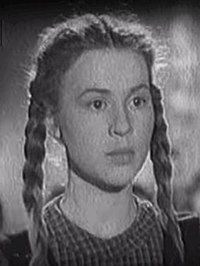
The film that marked the beginning of Lithuanian cinematography.
Content
Story
Bourgeois Lithuania . Seven-year-old Marite from a poor family goes to shepherds, then she works as a laborer, a servant, and works in a factory.
After the overthrow of the bourgeois government, a new life opens in front of it in Soviet Lithuania, but war sets in.
Mary joins the partisan detachment. During one of the operations, Mary and her comrades were overtaken by the Germans. After an unequal battle, the wounded Maria is captured by the Nazis. Under torture of the executioners, she does not give out information about the location of the partisan detachments, and the Nazis execute the stubborn girl.
The last shots of the film show Vilnius liberated by the Red Army, where at a rally Lithuanian poetess Salome Neris reads a poem dedicated to Mary:
Don't cry dear about me
I will not leave you. And in the spring
I sprout sprout green.
I will be with you in the exploits of labor
And in the noisy rustle of the red banner.
Cast
- Tatyana Lennikova - Marite
- Margarita Gromyko - Marite in childhood
- Juozas Laucius - Petras, Shepherd
- Liliana Binkite - Elena
- Nikolay Chaplygin - Alexas, commander of partisan detachments
- Bronus Kiselyus - Dzhugas
- Juozas Siparis - Antanas
- Mikhail Astangov - priests
- Nikolai Grabbe - Kazyukas
- Nikolai Plotnikov - father Marite
- Elena Kondratyeva - mother of Marite
- Nadir Malishevsky - Belov
- Jurgis Pyatrauskas - owner of the plant
- Andrey Popov - Nikolay
- Victor Koltsov - Ludas
- Vladimir Balashov - Eustace, friend Marite
- Alexander Lukyanov - teacher
- Casimir Kimanthaite - Yanite
- Fedor Ivanov - Algirdas
- Laimonas Noreika - Jozef
- Tamara Tikhomirova - Regina
In the episodes: Audris Hadaravicius , Tatyana Lavrova , Varvara Sevastyanova , Donatas Banionis and others.
Shooting
The film Marite, which marked the beginning of Lithuanian cinema, was created at Mosfilm , but cinematographers of the future Lithuanian film studio were involved.
The film was mainly based on documentary material.
Filming was carried out in Vilnius and in the Zarasai Territory - in the homeland of Maria Melnikait. [1] The group traveled to the places where Marite grew up, where in the days of bourgeois Lithuania she was bristling for a fist, where she was partisan and accomplished her feat. The film gives views of the Neman River spilling into the floods. [2] The partisan retreat episode through the spring Neman was filmed in Vilnius, on the Neris River . [one]
Criticism
Criticism, noting the shortcomings of the film, noted its strengths, paying attention to the fact that this is the first Lithuanian film.
The film “Marite” suffers to a large extent from schematics and illustrativeness, in it all the episodes are built as an illustration of one general thought about patriotism, about loyalty to the motherland. The themes of the episodes are often not disclosed in a dialogue that answers only to the general idea, and therefore the film is devoid of the dramatic tension and the force of emotional impact that it could have on its subject, on its material.
- The art of cinema , 1948
The director Stroeva showed the scenes of Marite’s childhood with a feeling, she decided to major scenes of Lithuania’s accession to the Soviet Union. The battle scenes resolved randomly and listlessly were much weaker for the director. Stroev did not overcome the dramatic fragmentary, multi-linear scenario.
- Essays on the history of Soviet cinema, 1961 [3]
The film has one peculiarity characteristic of Soviet cinema of the 50s in general. This is a formally, purely outwardly understood national color. The false beauty of the village landscape, against which a monumental figure of an old Lithuanian shepherd dressed in a national costume is drawn, the spectacular runs of Komsomol members (also in national costumes) along the old Vilnius lanes - all this penetrated the film not only because of a superficial acquaintance with the Lithuanian way of life ( although this undoubtedly played a role), but also as a tribute to the adopted scheme. ... With all the obvious flaws, the films Marite and Dawn Over the Neman played a significant role in the development of Lithuanian cinematography. Not to mention the public resonance that was caused by the very fact of their appearance, it should be noted that work on films was a good professional school for Lithuanian cinema youth.
- History of Soviet cinema, 1975 [4]
The release of the film on the screens became a big event in the cultural life of the republic. The film was loved not only by the Lithuanian audience. In 1962, it was reprinted. When meeting with cinematographers and spectators of socialist countries, I had to make sure that many people learned the first information about the heroic past of the Lithuanian people, and sometimes the very existence of Lithuania, from the film Marite. The best episodes of the film are deeply dramatic, marked by cinematic expressiveness. Especially those where the authors followed the poetic images of the poem. These include, for example, the episode of the partisans retreating through the spring Neman, the cold, frightening spill of which was shot with such skill by cameraman E. Andrikanis. The icy swift river with snow still not melted on the banks, into which Marita rushed, dragging her comrades, in the film personifies the image of her native land, awakening after a three-year occupation, and the courage of a fragile girl who never thought to become a heroine is the courage of the Lithuanian people. Whether there was such an episode in the biography of Marite, or whether it was created by the imagination of artists, is not so significant. He was supposed to appear in the film, he was expected by all those who were familiar with the poem of Salome Neris.
- Cinema of Soviet Lithuania, 1980 [1]
The film marked the beginning of the artistic cinematography of Soviet Lithuania. The value of the picture in those years is difficult to overestimate. It became a significant event in the cultural life of the young socialist republic. ... There were also vivid, expressive scenes in Marita, which bathed the individual (we emphasize - caused by time) flaws in the picture. For example, an episode of the crossing of Marite with her comrades through the Neman River that spilled over in the spring.
- A.I. Vytrobets , 1981 [2]
The film was the last black and white film by cameraman Eugene Andricanis :
The operator tried to compensate for the lack of color in Marita by the picturesqueness of landscape plans and expressive portraits. In Marita, he no longer returned to documentary methods of filming, as if defiantly getting rid of even any hints of documentary. The frame even more than it was before acquires the compositional completeness of the painting, static and poise in Marita. Signs of monumentality of the pictorial solution of individual plans appear. But at the same time, Andricanis’s ability to operate with light becomes even more subtle, with the help of which he created the necessary tonality, chiaroscuro contrasts, expressive accents in the frame.
- A.I. Sampler [2]
Notes
- ↑ 1 2 3 Marianna Maltciene - Cinema of Soviet Lithuania - “Art”, Leningrad Branch, 1980 - 247 p. - page 27
- ↑ 1 2 3 A. Vystorobets - Eugene Andrikanis - M.: “Art”, 1981 - 280 p. - p. 98-99
- ↑ Essays on the History of Soviet Cinema, Institute of the History of Arts (Moscow, Russia) - M .: Art, 1961 - Volume 3 - p. 211
- ↑ History of Soviet Cinema, Volume 3 - Institute of the History of Arts (Moscow, Russia) - M.: “Art”, 1975 - pp. 280-282