
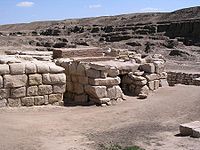
Tanis ( Egypt ḏʿnt , Greek Τάνις , Hebrew צוען (Tsoan); modern San El Hagar, Arabic. صان الحجر ) - ancient Egyptian city, center of the 19th nome (septa) of Lower Egypt Imenti-pehu , on the eastern arm of the Nile - Tanit (now Muizz ). The capital of ancient Egypt (along with Thebes ) during the XXI dynasty .
Content
History
During the collapse of the monarchy under the Hyksos in the Nile Delta was the focus of their power. The problem of the location of the capital of the Hyksos Avaris has long remained unresolved. In particular, mistakenly identified Avaris, Per-Ramses and Tanis [1] . After the Austrian expedition led by Manfred Bitak began its excavations in Avaris in 1966, the question of the whereabouts of the Hyksos capital and Pere-Ramses was finally resolved.
According to the Bible ( Num. 13:23 ), Tanis is founded 7 years later than Hebron . It is not known how this should be understood, in any case, the first undoubted traces of the existence of the city belong to the XII dynasty . Colossi of Amenemkhet I , who founded the temple in Tanis, Usertesenov (one of them is now in Berlin ), etc. are found here.
XIX Dynasty
The city achieved particular prosperity during the constant wars with Asia during the 19th dynasty , when the pharaohs ( Seti I , Ramses II , Merenpt ) often had a residence here due to their proximity to the Syrian border. Perhaps the veneration of Set by these kings was partly due to the local character of Tanis for this deity.
Capital at the 21st Dynasty
The 21st dynasty was called by the Manetho "Thanitic" and, starting with the pharaoh Smendes , had the capital Tanis, providing the priests of Thebes . Hence the name of Egypt in the psalms "field of Thaneos" ( Isa. 19:11 ). During dodecarchy , Tsar Petubast II ruled here, and in Persian times, Prince Tahos , who performed various priestly posts.
Greco-Roman era
The city also flourished in Greco-Roman times. The remains of the temple erected at the Ptolemies , as well as many private houses with furniture are found. Of particular interest is the native of Bokhaui with Egyptian-made things, a library of demotic papyri and a portrait statue of the owner, with a demotic inscription. Nearby is the house of a Roman official with Western-style furnishings and Greek papyri. Both houses date back to the 2nd century . Now on the site of Tanis is the fishing village of San, populated by Bashmurite Copts , who once remained faithful to Orthodoxy during Monophysitism , then converted to Islam , but still bearing the old name Malakiin-Melkhitov.
Excavations
Excavations in Tanis were carried out by: Lepsius, who found here in 1866 the famous Canope decree ; Mariette , who discovered the ruins of the temple and found many monuments of sculpture; Flinders Petrie , who conducted systematic research in 1884 .
The famous French Egyptologist in 1939 discovered the royal necropolis in Tanis and the untouched burial places of the pharaohs Osorcon II, Psusennes and Sheshonok III. [2] According to the calculations of J. Goyon (Georges Goyon, French archaeologist, personal Egyptologist of King Farouk), the ancient masters used approximately 60 kg of gold and 200 kg of silver to create sarcophagi and funeral ornaments found here.
|
Notes
- ↑ Montet P. Tanis, Avaris et Pi-Ramsès // Revue biblique, 39. Paris, 1930. P. 5-28
- ↑ TANIS (SAN EL KHAGAR) Egyptological Collection
Literature
- Turaev B.A. Tanis // Encyclopedic Dictionary of Brockhaus and Efron : 86 volumes (82 volumes and 4 additional). - SPb. , 1890-1907.
Links
- Tanis or Tanes // Biblical Encyclopedia of Archimandrite Nicephorus . - M. , 1891-1892.
- Zoan .