Dominican mango [1] ( lat. Anthracothorax dominicus ) - a species of bird of the hummingbird family.
| Dominican Mango |

Male Dominican Mango on the island of Haiti |
| Scientific classification |
|---|
| No rank : | Bilateral symmetrical |
| Suborder : | Hummingbird ( Trochili ) |
| Subfamily : | Typical hummingbirds |
|
| International scientific name |
|---|
Anthracothorax dominicus ( Linnaeus , 1766 ) |
| Area |
|---|

|
| Security status |
|---|
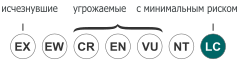
Least ConcernedIUCN 3.1 Least Concern : 22725737 |
|
Scientists distinguish two subspecies, which are often considered separate species: one lives on the island of Haiti and neighboring islands, the other on the island of Puerto Rico and neighboring islands.
Content
Dominican Mango Female in the Sierra de Baoruko National Park, Dominican Republic
Dominican mangoes are rather large hummingbirds with a relatively long beak slightly bent down [2] . Males of the Dominican mango have a shiny bronze-green plumage in the upper part, velvet-black in the lower part, the throat and chin are metallic green, the tail is purple with blue-black tips of feathers. Females, which also have a shiny bronze-green plumage in the upper part, are colored gray in the lower part, turning into pale white in the abdomen, the tail is purple-brown. In addition, females noticeably a small white spot behind the eye. Young males are similar to females, but they have a velvet-black median band and there is no white spot behind the eye. Birds have a slightly curved black beak [3] .
The distinguishing features of Puerto Rican mangoes in this case are called the distribution of the blue-black strip only in the throat and chest to the middle of the abdomen, and not completely like the Dominican mango. In males, the central tail feathers are colored bronze-green; in females, the outer tail feathers are brown-gray. Puerto Rican mango females also have an extra small spot behind the eye, which is absent in young males, which are generally similar to females [4] .
The length of the Dominican mango according to Alive is 11–12.5 cm , the weight of males is 6–8.2 g , and females are 4–7 g [3] . The length of the Puerto Rican mango is 11–12 cm , the mass of males is 4.8–7.2 g , and the females are 4–6.4 g [4] . Birds with Puerto Rico are noticeably smaller, the wing length is 4.15, the tail is 5.63?) [4] .
Both in Haiti and in Puerto Rico, it is a fairly quiet bird for which there is no detailed description of the repertoire. Among the sound signals, a repeating short “tsip” and a high iridescent trill [3] [4] .
The Dominican subspecies of this species of hummingbird-mango lives on the island of Haiti and the large neighboring islands of Tortu , Gonav , Vash and Beata . Found in the José del Carmen Ramirez National Park and the Sierra de Baoruko National Park ( Dominican Republic ) and in the Macaya Biosphere Reserve ( Haiti ). Most common in semi-arid regions, can live in gardens, on shady coffee plantations and in hills with arid shrubs along the coast. It occurs at an altitude of up to 2600 meters above sea level, while it rarely occurs at altitudes above 1500 meters and in pine forests above 1100 meters. Presence at high altitudes usually indicates forest degradation [3] .
The range of the Puerto Rican subspecies is 30,200 km² and includes Puerto Rico itself , the British Virgin Islands and the Virgin Islands [5] . In Puerto Rico, mango lives mainly in lowlands, gardens and forest edges, usually distributed in coastal areas with fairly rare trees [4] at an altitude of up to 800 meters above sea level [5] . He is the most numerous of the five species of hummingbirds present on the island itself and on neighboring islands [4] . The birds probably died out on the islands of St. John , Anegada , Vieques and became rare in eastern Puerto Rico, unable to withstand competition with [4] [5] .
Birds do not migrate. Belongs to the species of least concern , but is included in the CITES II application of the Convention on the International Trade in Endangered Species of Wild Fauna and Flora , that is, control over their trade is carried out [5] [6] .
Mostly birds feed on nectar of flowering plants from the genera of cordia ( Cordia ), inga ( Inga ), melocactus ( Melocactus ), bauginia ( Bauhinia ), morning glory ( Ipomoea ), hibiscus ( Hibiscus ), erythrina ( Erythrina ), Sabinea and others. They can catch insects in the air and remove spiders from the surface of leaves and bark. Birds find food mainly at an altitude of 4-20 meters above the ground, but can also feed at lower altitudes up to 2 meters. Males protect their nectar-rich territories [3] .
Female Dominican Mango on the island of Haiti
Dominican Mango Female on Puerto Rico
Dominican mango can lay eggs at any time of the year [3] [2] , but the main season is the period from December to August [3] . In Puerto Rico, most of the nests were recorded between December and August. Perhaps birds lay their eggs twice a year [4] .
Birds build a compact bowl-shaped nest on trees, shrubs or cacti at a height of 1 to 10 meters (according to research in the southwest of the Dominican Republic, nests are located at a height of 1 to 7 meters, with an average height of 3.1 meters). The nest is usually lined with soft plant fibers and covered with lichens, moss and cobwebs [3] [4] .
The masonry contains two white eggs. The chicks are covered with black down with two grayish dorsal rows of feathers [3] . In Puerto Rico, the female lays eggs for 15 days, the chicks remain in the nest for another 22-25 days [4] .
The bird with Puerto Rico was first described in 1801 by French scientists Jean Baptiste Odber and Louis Jean Pierre Viejo under the name Trochilus aurulentus (from the Latin aurum - “gold” [7] ) [4] [8] . The genus Anthracothorax (from the Greek. Anthrax - “coal, black” and the Greek. Thorax - “chest” [7] ) was isolated in 1831 by the German zoologist Friedrich Boyer [9] . The species name dominicus is associated with the habitat of birds and the name given to the bird by the French zoologist Mathuren-Jacques Brisson in 1760 - Colibry de S. Domingue [7] .
This species includes two subspecies [9] , which are considered by some scientists as separate species:
- A. d. dominicus lives on the island of Haiti and satellite islands [6] ;
- A. d. aurulentus lives on the island of Puerto Rico and the satellite islands [5] .
- ↑ Boehme R. L. , Flint V. E. The Bilingual Dictionary of Animal Names. Birds. Latin, Russian, English, German, French / Ed. ed. Acad. V. E. Sokolova . - M .: Rus. lang., "RUSSO", 1994. - S. 156. - 2030 copies. - ISBN 5-200-00643-0 .
- ↑ 1 2 Antillean Mango . Neotropical birds online. Date of treatment October 8, 2018.
- ↑ 1 2 3 4 5 6 7 8 9 HBW Alive: Hispaniolan Mango .
- ↑ 1 2 3 4 5 6 7 8 9 10 11 HBW Alive: Puerto Rican Mango .
- ↑ 1 2 3 4 5 Anthracothorax aurulentus (English) . The IUCN Red List of Threatened Species .
- ↑ 1 2 Anthracothorax dominicus . The IUCN Red List of Threatened Species .
- ↑ 1 2 3 Jobling JA The Helm Dictionary of Scientific Bird Names. - London: A&C Black Publishers Ltd, 2010 .-- P. 49, 138. - 432 p. - ISBN 978-1-4081-2501-4 .
- ↑ Ridgway R. Genus Anthracothorax (English) // The birds of North and Middle America: a descriptive catalog, Part V. - Marshall Cavendish, 1911. - P. 454—473.
- ↑ 1 2 Gill F. & Donsker D. (Eds.): Hummingbirds . IOC World Bird List (v9.2) (June 22, 2019). doi : 10.14344 / IOC.ML.9.2 .
- Hispaniolan Mango / Schuchmann KL, Kirwan GM // Barn-owls to Hummingbirds. - Barcelona: Lynx Edicions, 1999. - (Handbook of the Birds of the World: [16 v.] / In: J. del Hoyo, A. Elliott, J. Sargatal; 1992-2013, vol. 5). - ISBN 978-84-87334-25-2 .
- Puerto Rican Mango / Schuchmann KL, Kirwan GM // Barn-owls to Hummingbirds. - Barcelona: Lynx Edicions, 1999. - (Handbook of the Birds of the World: [16 v.] / In: J. del Hoyo, A. Elliott, J. Sargatal; 1992-2013, vol. 5). - ISBN 978-84-87334-25-2 .
- Schuchmann KL, Boesman P., Kirwan GM Hispaniolan Mango . Handbook of the Birds of the World Alive (October 19, 2017). Date of appeal September 8, 2018.
- del Hoyo J., Collar N., Kirwan GM Puerto Rican Mango . Handbook of the Birds of the World Alive (July 12, 2018). Date of appeal September 8, 2018.